3.3-3.8 - Energy stores, transfers and dissipation
When a trolley stops, its energy has not vanished. Track energy between stores, draw transfer diagrams and use conservation to explain lifting, collisions, braking and heating water.
Stores, pathways and the chosen system
Imagine a trolley rolling across a floor until it stops. The trolley's kinetic energy store decreases. The wheels, floor and nearby air become slightly warmer, so their thermal energy stores increase. The energy has changed where it is stored; it has not been used up.
An energy account begins by choosing a system: the object or group of objects being studied. A boundary separates that system from everything outside it. The best boundary depends on the question. A trolley alone is useful for describing its decreasing kinetic store, while a wider system containing the trolley, floor and nearby air is needed to track where all that energy goes.
An energy store describes energy associated with an object's motion, condition or position in an interacting system. A transfer pathway describes how energy moves from one store to another.
Energy is measured in joules (J). A store is a way to describe an amount of energy; it is not a container filled with an energy substance. A transfer can change the amounts in several stores at once.
The stores needed in this lesson are:
- the kinetic store of a moving object;
- the gravitational potential store of an object-Earth system;
- the elastic potential store of a stretched or compressed object;
- the chemical store of a battery or fuel reacting with its surroundings;
- the thermal stores of objects and their environment.
Energy can be transferred mechanically when a force does work, electrically when charges move through a circuit, by heating because of a temperature difference, or by waves such as sound and electromagnetic radiation. A pathway is a process, not another store. For example, the current in a kettle provides an electrical transfer pathway; the wire is not described as an "electrical energy store" in this account.
Always attach a store to the relevant object or system. "The kinetic store of the trolley decreases" is more precise than "kinetic energy turns into heat" because it identifies what changes and where the energy is stored afterwards.
Conservation in a closed system
Energy is conserved: it cannot be created or destroyed. It can be transferred between stores and across a system boundary.
A closed system is one for which no energy is transferred across the chosen boundary during the interval being studied. Transfers may still occur between stores inside that boundary. Therefore:
In a closed system, there is no net change in total energy. The total before a change equals the total after it, although the energy can be shared differently among the stores.
Suppose the system boundary surrounds a trolley, ramp, Earth and the relevant nearby environment. During one journey up the ramp, the trolley's kinetic store decreases by 160 J while the gravitational potential store of the trolley-Earth system increases by 118 J.
Worked example
The amount that must have entered other stores is:
energy transferred to other stores = 160 J - 118 J = 42 J
That 42 J is mainly in the thermal stores of the wheels, ramp and nearby air. The check is , so the total for the closed system is unchanged. Calling the missing 42 J "destroyed" would break the conservation rule.
If the boundary had surrounded only the trolley, some energy would have crossed the boundary into the ramp and air. That smaller system would be open for this interval, but conservation still works when the full transfer across its boundary is included.
Reading and constructing transfer diagrams
An energy-transfer diagram is a representation of an account, not a picture of a substance flowing. It compares a defined starting snapshot with a defined finishing snapshot. Boxes name stores; labelled arrows show transfer pathways; branches show that more than one store can increase.
[DIAGRAM: asset_name: 10_1PH0-P1-03B_3.3-3.8 - Energy stores, transfers and dissipation - diagram 01; asset_slug: 1ph0-p1-03b-energy-stores-transfers-dissipation_diagram_01; recommended_method: image_gen; description: Monochrome start-to-end scientific diagram of a trolley compressing a bumper, with a closed-system boundary, correctly labelled stores, mechanical-transfer arrows, and thermal dissipation branch.]
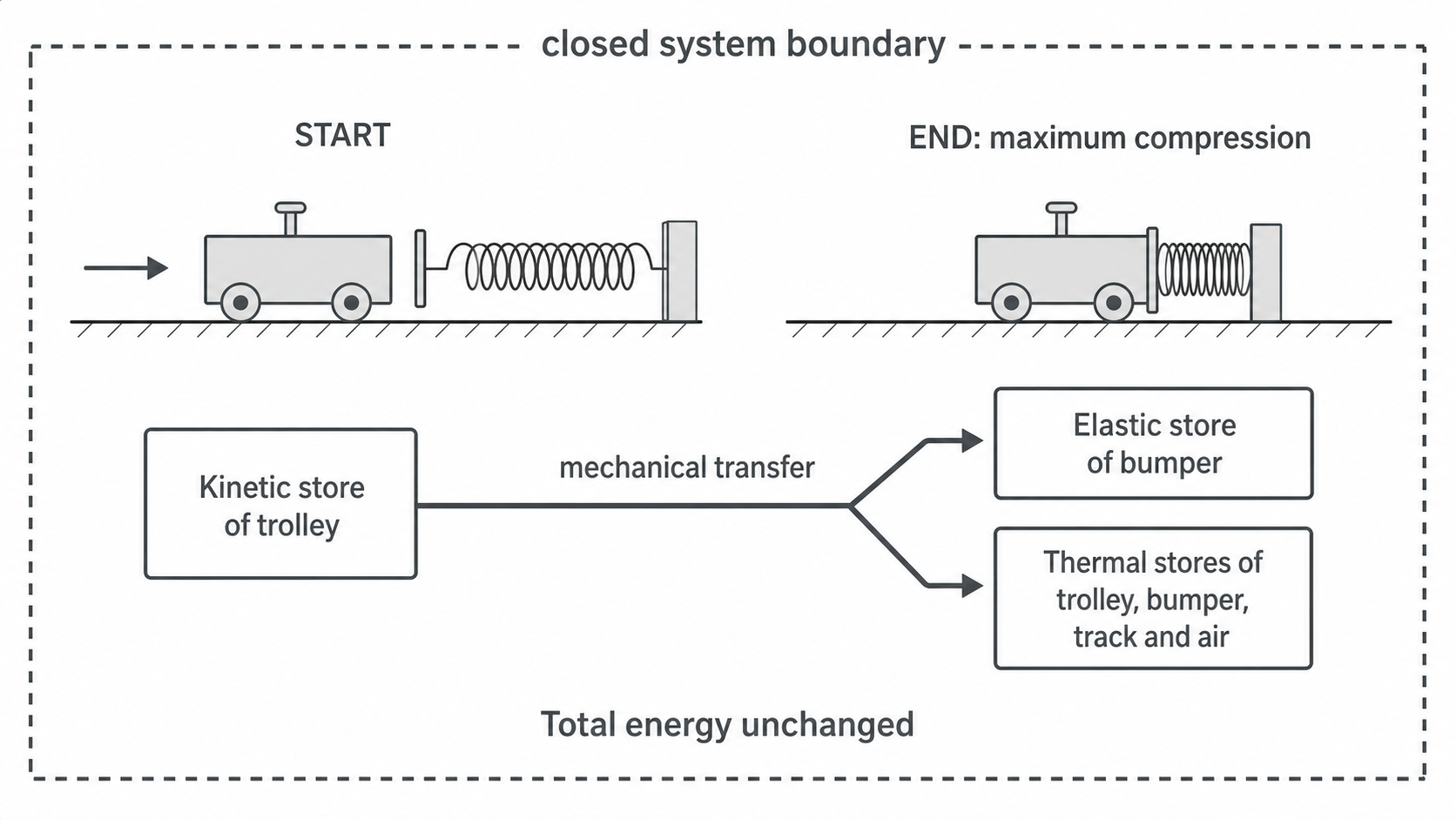
The diagram chooses the instant just before the trolley touches the bumper as the start and maximum compression as the end. At the start, the trolley has a kinetic store. Contact forces then transfer energy mechanically. At maximum compression, some energy is in the bumper's elastic store and some is in thermal stores of the trolley, bumper, track and nearby air. Sound waves can also transfer energy into the surroundings, but sound is not itself an energy store.
Use this sequence when drawing or interpreting a transfer diagram:
- State the start and end of the change.
- Draw the system boundary and decide whether energy crosses it.
- Name only the stores that change, including the object or interacting system.
- Draw arrows in the direction of transfer and label each pathway.
- Include branches to thermal stores or other receiving stores, then check that no energy has been made or destroyed.
Try a diagram in your notebook (self-check)
A trolley hits a spring bumper on a level track. Between just before impact and maximum compression, its kinetic store decreases by 90 J; the spring gains 66 J. Draw the changing stores and labelled transfer arrows. Include the remaining energy and a closed boundary containing the relevant surroundings.
Model check: the trolley's kinetic store decreases by 90 J. A mechanical-transfer arrow branches to the spring's elastic store (66 J) and thermal stores of the trolley, bumper, track and air (24 J). No arrow crosses the chosen closed boundary, and 66 + 24 = 90 J. Do not label sound or heating as stores. Your drawing need not copy the layout, but it must preserve these stores, directions and energy balance. This notebook drawing is not automatically marked.
A store can exist without changing. A car moving at constant speed has a kinetic store, but that store is not part of an energy-change diagram unless the speed changes. Likewise, the gravitational store is irrelevant during a level collision if there is no height change over the chosen interval.
A rising object: choosing the interval
Once an object has been projected upwards, it slows while it rises. Its kinetic store decreases while the gravitational potential store of the object-Earth system increases. Gravity transfers energy mechanically between these stores. The same account applies to an object moving up a slope after release: it is the vertical rise, not the distance along the slope, that matters for the gravitational change.
In an ideal model without resistance, the loss of kinetic energy equals the gain in gravitational potential energy. Real air resistance or friction also increases thermal stores of the object, air or slope. For example, if the kinetic store decreases by 80 J and the gravitational store gains 73 J, the other stores must gain 7 J. The object reaches a smaller height than in the no-resistance model because less of its initial kinetic energy becomes gravitational potential energy.
Fix the interval before naming the stores. The thrower's chemical store matters while the hand launches the object. After release, there is no continuing push from the hand. Gravity is a force, not a store that gets used up.
Collisions and braking: where motion goes
When a moving object hits an obstacle, contact forces slow it and may deform either object. The moving object's kinetic store decreases. At maximum compression, an elastic store can hold some of that energy; some also increases thermal stores. The bumper diagram shows this stage. After vibrations have died away, energy initially stored elastically may have been returned as motion or dissipated into thermal stores. Sound carries energy by waves and eventually transfers it to the surroundings; sound is not an energy store.
A vehicle slowing on a level road gives a second example. Work done against braking friction and air resistance transfers energy from the vehicle's kinetic store to thermal stores of the brakes, tyres, road and air. A temperature rise is evidence of those store increases. No gravitational store change is needed when the height is unchanged.
These changes do not destroy the energy of motion. They spread it into stores from which it is difficult to recover for driving the vehicle. Braking is useful for stopping safely; the resulting thermal energy is less useful for making the vehicle move again.
Accelerating a trolley and heating water
A constant resultant forward force makes a trolley speed up. As the force acts through a distance, it does work and the trolley's kinetic store increases. Identify the source too: in a battery-powered trolley the battery's chemical store decreases, energy is transferred electrically to the motor, and the motor transfers energy mechanically to the trolley. Some thermal stores also increase. A force is the cause of mechanical transfer, not a supply of energy created from nothing.
An electric kettle uses a different intended output. Energy reaches the heating element electrically. The hotter element then transfers energy by heating to the water, increasing the water's thermal/internal energy store as the water is brought to the boil. The thermal stores of the casing and room also increase, which is less useful for heating the water.
The element must become hotter than the water for this transfer to occur; its warming is part of the route, so do not label every joule entering the element as waste. Energy that remains in the kettle body or escapes into the room instead of reaching the water is an unwanted transfer for the stated task.
Dissipation and less useful stores
Mechanical processes become wasteful when friction, drag or deformation causes a temperature rise. Energy that could have increased the intended store is transferred into thermal stores of the machine and its surroundings. This spreading of energy is called dissipation.
Energy is dissipated when it is transferred into stores that are more spread out and less useful for the intended purpose, most commonly thermal stores of the surroundings.
In every real system change, some energy is dissipated. Bearings warm, moving parts deform, air is disturbed, electrical components heat up, and sound is eventually absorbed. Once a small amount of energy is spread among a huge number of particles in the surroundings, it is difficult to gather it and transfer it back into one useful store.
"Less useful" depends on the purpose. Increasing the water's thermal store is useful in a kettle, while increasing the kitchen air's thermal store is not useful for boiling that water. In a vehicle, increasing the brake discs' thermal store is the mechanism that slows the car, but the spread-out energy cannot then drive the car forward without another energy supply.
Dissipation never means destruction. A device can have less energy available for its intended task while the total energy of a closed system remains exactly the same. The careful statement is "energy is dissipated to thermal stores of the surroundings", not "energy is lost".