2.1-2.5 - Scalars, vectors, speed and velocity
Distance and displacement can describe the same journey differently. Learn when direction matters, how an arrow represents a vector, and why equal speeds need not mean equal velocities.
Magnitude and direction
Compare these descriptions of a moving train:
12 m/s12 m/s east
Both include a magnitude, meaning the size of the quantity: 12 m/s. Only the second description includes a specific direction: east.
A scalar quantity has magnitude but no specific direction. It is completely described by a value and an appropriate unit.
A vector quantity has both magnitude and a specific direction. Leaving out either one makes the vector description incomplete.
Saying that a scalar has no direction does not mean the object itself cannot be moving in a direction. It means direction is not part of that particular quantity. Speed, for example, describes how fast an object moves without including where it is heading.
A vector can be represented by an arrow. The arrowhead shows the direction, and the arrow's length can represent the magnitude when a scale is used. The arrow is a model of the vector, not a physical mark left behind by the moving object or force.
Distance and displacement
Imagine walking from a start point to a finish point along a winding path. There are two different ways to describe how far the journey takes you:
- Distance is the total length of the path travelled. It has magnitude only, so distance is a scalar.
- Displacement is the change in position from the start to the finish, including the straight-line direction from start to finish. It has magnitude and direction, so displacement is a vector.
[DIAGRAM: asset_name: 02_1PH0-P1-02A_2.1-2.5 - Scalars, vectors, speed and velocity - diagram 01; asset_slug: 02_1ph0-p1-02a_2-1-2-5-scalars-vectors-speed-and-velocity_diagram_01; recommended_method: image_gen; description: a clear monochrome route from labelled start A to finish B, contrasting the winding path labelled distance with a straight arrow labelled displacement and showing its direction]
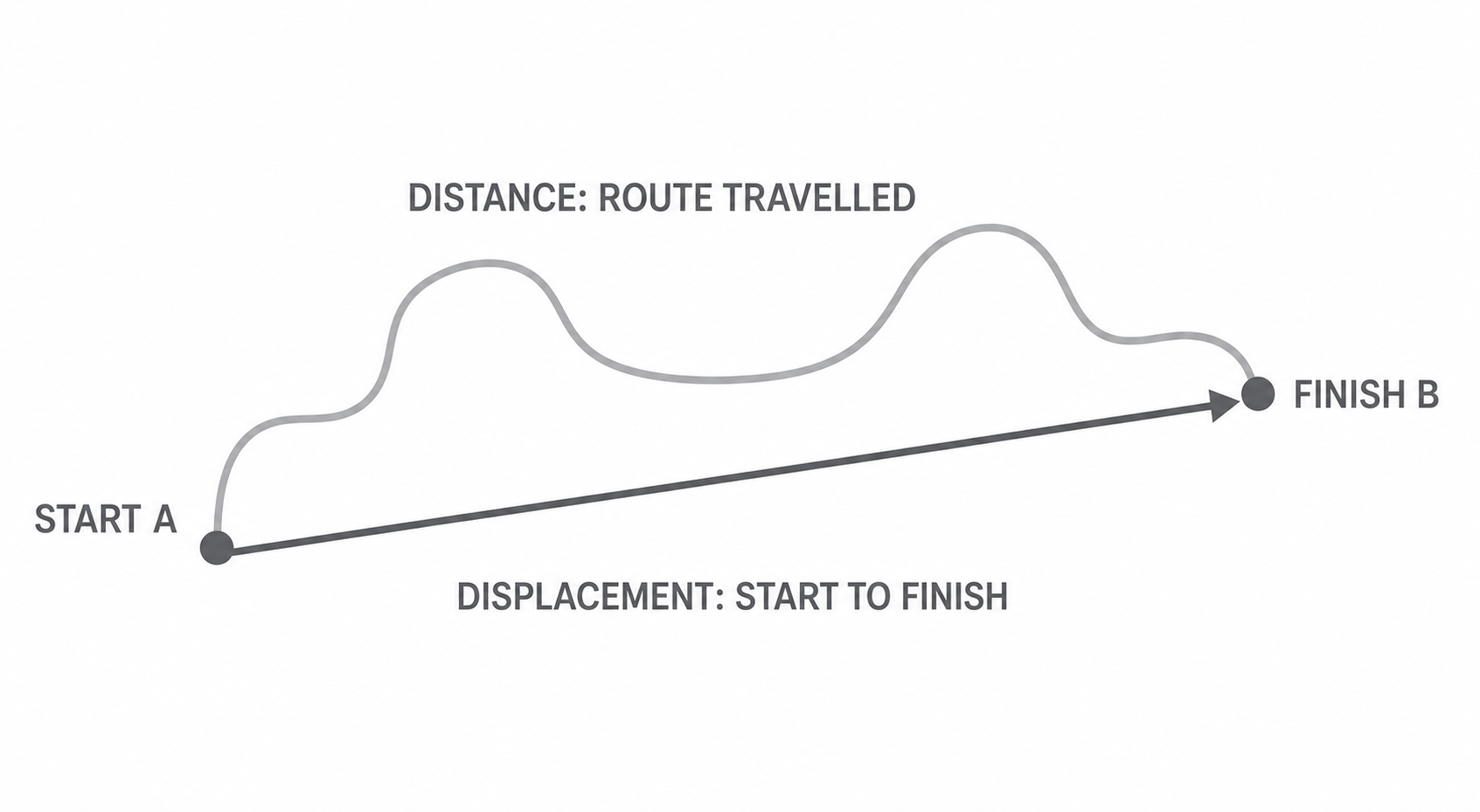
The travelled path and the displacement connect the same start and finish, but they represent different quantities. A detour increases distance without changing the displacement between those fixed endpoints. If you return to your starting point, you have travelled a non-zero distance but your displacement is zero; zero displacement is the special zero-vector case.
The direction must belong to the displacement itself. 400 m is only a magnitude, whereas 400 m north is a complete displacement.
Distance follows the route. Displacement compares the final position with the initial position and includes direction.
Worked comparison. Walk 80 m east and then 30 m west along the same path. Your distance is . Your finish is only east of your start, so your displacement is 50 m east. Adding the route lengths answers a different question from comparing the endpoints.
Speed and velocity
Speed and velocity form a similar pair:
- Speed tells you how fast an object is moving. It is a scalar because it has no specific direction.
- Velocity is speed in a stated direction. It is a vector because it has both magnitude and direction.
For example, 8 m/s states a speed. 8 m/s east states a velocity. The unit can be the same, but the quantities are not interchangeable because only velocity includes direction.
Two objects can therefore have the same speed but different velocities. Cyclists moving at 6 m/s north and 6 m/s south are equally fast, but their directions are opposite. Two velocities are the same only when both their magnitudes and their directions match.
Classifying physical quantities
The distinction applies beyond descriptions of a journey. These are the quantities you need to recall as scalars or vectors.
| Scalar quantity | Why direction is not required |
|---|---|
| distance | It records the length of the route travelled. |
| speed | It records how fast an object moves. |
| mass | It records the amount of matter in an object. |
| energy | It has an amount but no direction. |
| Vector quantity | What makes direction matter |
|---|---|
| displacement | It is a directed change from initial to final position. |
| velocity | It is speed in a stated direction. |
| acceleration | A complete acceleration has a magnitude and direction. |
| force | A force acts on a named object with a magnitude and direction. In a force-arrow model, the arrow starts at the relevant point or region of action on that object. |
| weight | Weight is a force on an object, so it has direction as well as magnitude. Near Earth's surface, it acts towards the centre of Earth. |
| momentum | A complete momentum has a magnitude and direction. |
Mass and weight are especially easy to confuse. Mass is a scalar; weight is a vector because weight is a force. Likewise, having a number and unit does not make a quantity scalar: 20 N downward is a vector description because it includes both the force's magnitude and its direction.
Scalars: distance, speed, mass, energy.
Vectors: displacement, velocity, acceleration, force, weight, momentum.
Use the definition, not the familiarity of the word, to decide which group a quantity belongs to.