2.20-2.22 - Circular motion and inertial mass
Higher tier: an object can accelerate without getting faster. Use changing direction to explain circular motion, then use inertial mass to compare how difficult it is to change an object’s velocity.
Constant speed, changing velocity
Imagine a rubber bung being swung at constant speed on a string. Its speed is constant because the magnitude of its velocity does not change. Its velocity still changes because velocity is a vector: it includes both magnitude and direction.
At each point on the circle, the instantaneous velocity points along a tangent to the path. A moment later, the tangent points in a different direction. The continuous change in velocity means that the object is accelerating even though it is not getting faster or slower.
For that acceleration to occur, there must be a resultant force directed towards the centre of the circle. This inward resultant is called the centripetal force. "Centripetal" describes the role and direction of the resultant force; it is not an extra type of force. For example, tension can provide it for a ball on a string, friction can provide it for a car turning on a level road, and gravity can provide it for an orbiting object.
[DIAGRAM: asset_name: 06_1PH0-P1-02E_2.20-2.26 - Circular motion and momentum - diagram 01; asset_slug: 1ph0-p1-02e-circular-motion-and-momentum_diagram_01; recommended_method: image_gen; description: Monochrome top-down scientific diagram of two snapshots on one circular path, with equal-length tangential velocity arrows and inward resultant-force arrows pointing exactly towards the labelled centre.]
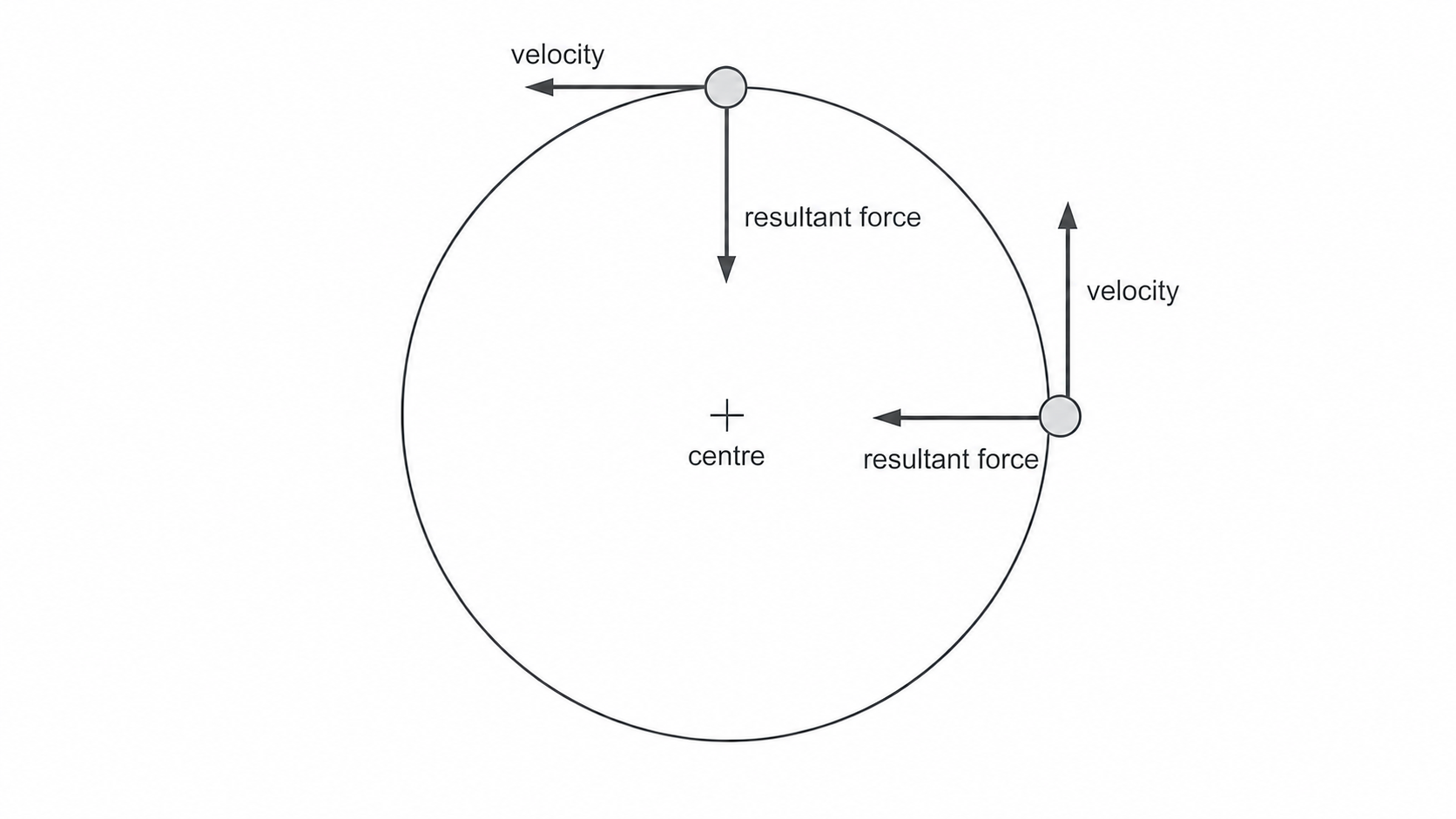
The diagram is a vector representation, not a trace of forces left behind. Each velocity arrow is tangent to the path. Each resultant-force arrow points radially inward, at right angles to the velocity at that instant. There is no outward resultant force on the moving object. If the inward force stopped, the object would initially continue along the tangent at that point rather than move radially outward.
Inertial mass and changing velocity
It is easier to change the velocity of an empty shopping trolley than a loaded one using the same resultant force. Inertial mass measures how difficult it is to change an object's velocity, including changing it from rest. A larger inertial mass means a smaller acceleration for the same resultant force.
Newton's second law, , can be rearranged to define inertial mass as the ratio of resultant force to acceleration:
- is inertial mass in kilograms, kg.
- is the resultant force in newtons, N.
- is acceleration in metres per second squared, m/s².
The force must be the resultant force on the chosen object, not just one force when other forces are unbalanced.
Worked example
A car has a resultant driving force of 720 N and accelerates at 0.60 m/s². Calculate its inertial mass.
Start with the relationship and rearrange if needed:
The quantities are already in N and m/s², so no unit conversion is needed.
To two significant figures, . This is plausible for a car. If the same 720 N acted on a vehicle with greater inertial mass, its acceleration would be less than 0.60 m/s².