2.8-2.10 - Acceleration and velocity-time graphs
Velocity can change even when an object is already moving. Learn how signs, gradients and areas describe a journey, and how to choose an equation when time is unknown. This lesson, including graph area, is for both tiers.
Acceleration as a change in velocity
Speed tells us how fast an object moves. Velocity also includes direction, so it is a vector. Acceleration is the rate at which velocity changes; an object accelerates if its speed changes or if its direction changes.
For motion along a straight line, choose one direction as positive. The initial velocity is u, the final velocity is v, and the time taken is t.
acceleration = change in velocity / time taken
Acceleration is measured in . An acceleration of means that the velocity changes by 2 m/s every second. The unit check is .
Worked example
A cyclist's velocity increases from 4.0 m/s to 10.0 m/s in 3.0 s.
First find the change in velocity rather than using either velocity on its own:
Then substitute:
If the positive-direction velocity falls from 10 m/s to 4 m/s, v - u is negative. The acceleration is then negative: it points opposite to the chosen positive direction. A negative acceleration does not always mean slowing down, because the effect depends on the directions of both velocity and acceleration. In straight-line motion, an object slows when its acceleration is opposite to its velocity.
Do not confuse a large velocity with a large acceleration. A vehicle can move quickly at constant velocity and have zero acceleration; another can move slowly while its velocity changes rapidly.
Uniform acceleration when time is unknown
Sometimes the initial velocity, final velocity, acceleration and distance are known, but the time is not. For straight-line motion with uniform acceleration, use:
v = final velocity (m/s), u = initial velocity (m/s), a = acceleration (), x = distance (m) for the straight-line, no-reversal motion used here.
The superscript 2 applies to the whole velocity value. For example, if , then , not 12 m/s.
Worked example
A car accelerates uniformly from 6.0 m/s to 14.0 m/s at . Find the distance travelled.
Start with the equation and substitute before rearranging:
The result is positive and has the correct unit. It is also plausible: the car's velocity is between 6 and 14 m/s throughout, so covering 40 m while it speeds up is reasonable.
For slowing motion in the positive direction, both and a are negative. Their signs cancel when calculating a positive distance.
The equation requires constant acceleration. If the object reverses direction, its signed displacement and total distance differ; split the journey before applying a distance interpretation. For the worked car, the alternative check is and average velocity , so . The average-of-endpoints shortcut is valid here because acceleration is uniform.
Velocity-time graphs: value, gradient and area
On a velocity-time graph, time is on the horizontal axis and velocity is on the vertical axis. One graph therefore contains three different kinds of information:
- the vertical value gives velocity at that time;
- the gradient gives acceleration;
- the area between the line and the time axis gives distance travelled for the uniform-acceleration, above-axis cases considered here.
[DIAGRAM: asset_name: 03_1PH0-P1-02B_2.6-2.11 - Speed, acceleration and motion graphs - diagram 02; asset_slug: 1ph0-p1-02b-speed-acceleration-motion-graphs_diagram_02; recommended_method: matplotlib; description: Exact velocity-time graph with uniform acceleration, constant velocity and uniform deceleration segments, plus precise shaded geometric areas for distance calculations.]
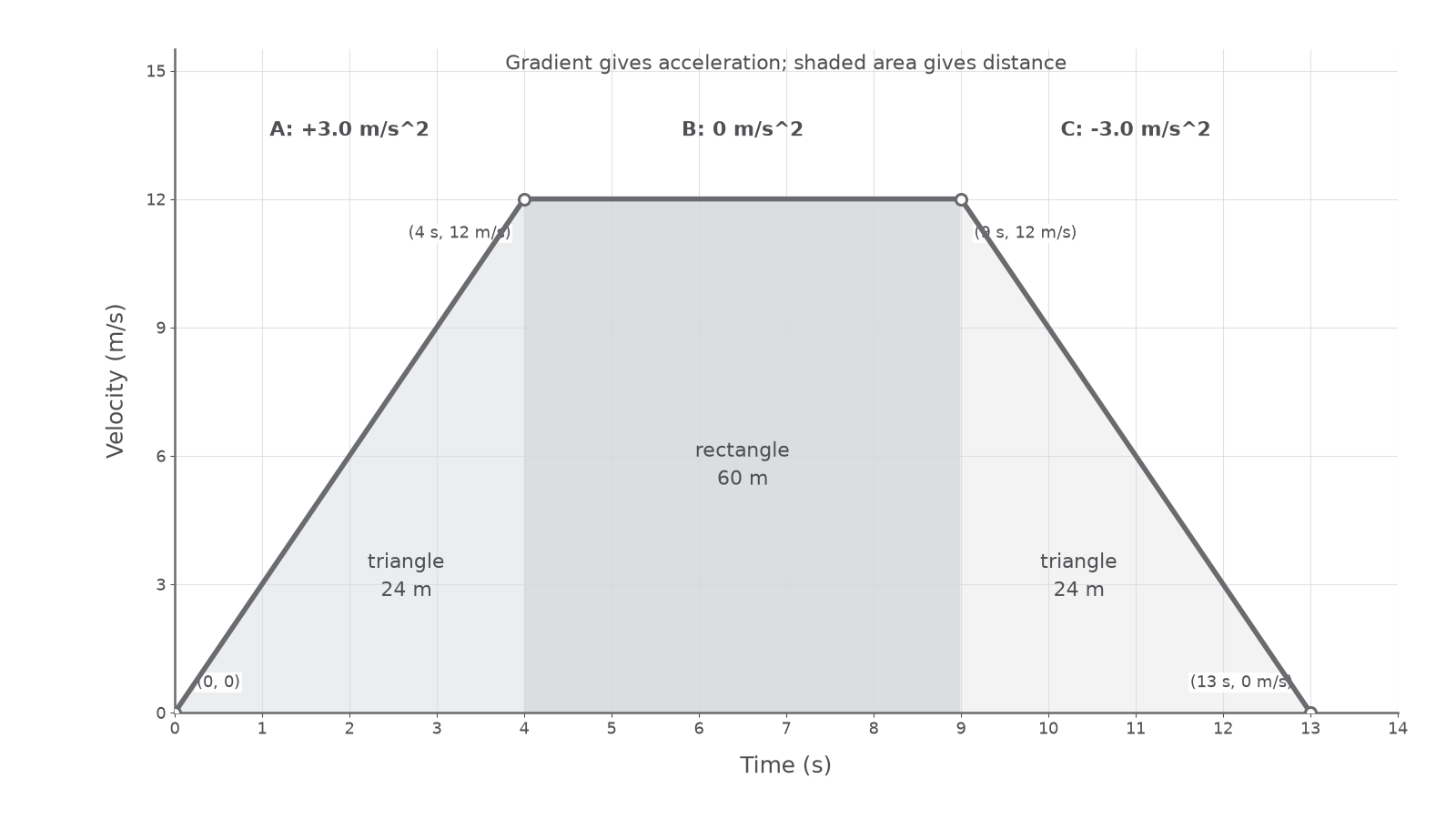
For stage A, velocity rises uniformly from 0 to 12 m/s in 4 s. Its gradient is:
a = change in velocity / change in time = (12 - 0) / (4 - 0) = 3.0 m/
Stage B is a horizontal line at 12 m/s. Its gradient is zero, so acceleration is zero even though the object is moving quickly. Stage C has a negative gradient: the positive velocity falls uniformly to zero, so the object decelerates.
The distance travelled is the total area under the line. Split the region into simple shapes:
- stage A triangle:
- stage B rectangle:
- stage C triangle:
total distance = 24 + 60 + 24 = 108 m
The units explain why area represents distance: . Always use the width of the actual time interval, not simply the final time reading on the axis.
Compare gradients only after checking the axis scales. On the same axes, a steeper upward segment means greater positive acceleration. A steeper downward segment means a more negative acceleration. A horizontal line can represent a stationary object at zero velocity or a moving object at non-zero velocity: its height matters. For motion below the time axis, signed area gives displacement; add the magnitudes of areas if finding total distance across a reversal.