4.7, 4.17 - Measuring wave speed core practical
Measure water waves, sound in air and vibrations in a metal rod, then judge whether each instrument can resolve the quantity it measures.
Choosing measurements
The aim is not simply to obtain a number. It is to decide whether each instrument can resolve the quantity being measured and then use the measurements to determine wave speed.
For a repeating wave:
- frequency,
f, is the number of complete waves passing a fixed point each second, measured in hertz (Hz); - wavelength, , is the distance between successive matching points, such as one wavefront and the next, measured in metres (m);
- wave speed,
v, is the distance travelled by a wave pattern per second, measured in metres per second (m/s).
If N waves pass in time t, then . Wave speed can then be found in either of two ways.
From travel measurements:
From a repeating pattern:
The measurements must refer to the same wave under the same conditions. For example, changing the water depth between measuring f and would make the two measurements an invalid pair.
Equipment is suitable when it has an appropriate range and resolution, responds quickly enough, and lets the reading be associated unambiguously with the intended quantity. A metre rule is suitable for a 0.80 m rod, but a handheld stopwatch is not suitable for a sound pulse that crosses that rod in a fraction of a millisecond.
Measuring water ripples
A ripple tank is a controlled way to measure waves in a fluid. Use a shallow layer of water, a straight dipper driven by a low-voltage motor, a ruler, a stopwatch and a phone or camera that can freeze the moving pattern.
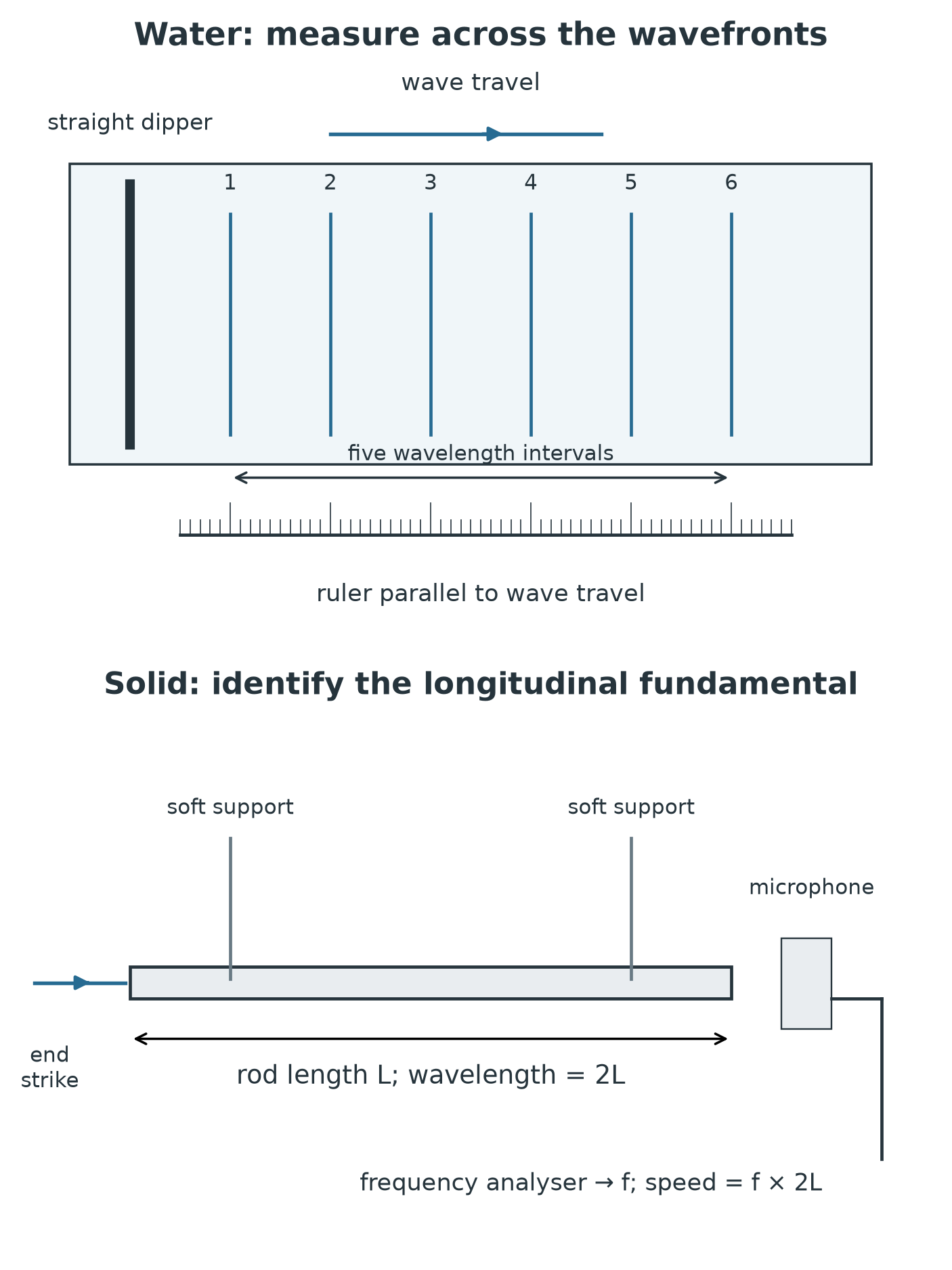
[DIAGRAM: asset_name: 14_1PH0-P1-04B_4.7, 4.17 - Measuring wave speed core practical - diagram 01; asset_slug: 1ph0-p1-04b-measuring-wave-speed-diagram-01; recommended_method: matplotlib; description: Ruler perpendicular to six crest lines spans five gaps; dipper parallel to fronts; rod end strike and supplied fundamental wavelength2L explicit.]
Method
- Place the ripple tank level, add a shallow, even depth of water, and fix the ruler along the direction in which the waves travel. Set the straight dipper to produce clear, steady, parallel wavefronts.
- Choose a fixed point. Count the number
Nof wavefronts that pass it in a measured interval, such as 10.0 s. Calculate . Counting for several seconds makes a one-wave counting uncertainty a smaller fraction of the total. - Take a still photograph or pause a video with the ruler in the same plane as the pattern. Measure from the first wavefront to the sixth matching wavefront: this distance contains five wavelengths, so divide it by 5. Measuring several wavelengths reduces the percentage uncertainty from locating any one line.
- For a direct speed measurement, mark two positions a measured distance
dapart. Use video to measure the time taken for the same identifiable wavefront to move from the first position to the second, then calculate . - Repeat the count, photograph and travel-time measurement at least three times. Calculate means, check for anomalous readings, and compare
d / twith for the same dipper frequency and water depth.
Do not measure the curved length of a crest or the entire visible wave train. Wavelength is one repeat spacing measured in the direction of travel, perpendicular to these straight wavefronts.
Water near electrical equipment is the relevant hazard. Use the specified low-voltage supply, keep the supply on the bench away from the tank, use dry hands, and mop up spills immediately to prevent both electrical contact and slipping.
Worked example
In 12.0 s, 24 wavefronts pass a marker:
The distance from the first to the sixth wavefront is 0.300 m. There are five wavelength intervals:
So:
A video measurement gives and , so . The two results are close, which supports the method, although agreement alone does not prove that both methods are free from systematic error.
Measuring waves in a solid
Sound travels through a metal rod so quickly that direct human timing is impractical. Instead, the experiment measures a length and a frequency, then calculates the speed.
Method
- Suspend a long metal rod horizontally from two stable clamp stands using rubber bands. The rubber bands allow the rod to vibrate and reduce transfer of vibration into the stands.
- Measure the rod length
Lwith a metre rule. Record the ruler resolution and read the scale at eye level. - Strike one end lightly along the length of the rod to excite longitudinal vibration; do not strike the side to excite bending. Hold a smartphone frequency analyser or a microphone connected to a data logger close to the rod and identify the fundamental longitudinal frequency specified for this setup, using repeated peaks and the teacher's mode check.
- Repeat the strike and frequency reading. If one peak is not repeatable, background sound or a different vibration mode may be confusing the measurement. A loud higher harmonic or bending resonance is not automatically the required fundamental.
- For the fundamental longitudinal mode of a free-ended rod, use the supplied relationship . Calculate .
For example, let and . Convert the prefix before substitution:
This is thousands of metres per second, so the order of magnitude is plausible for sound in metal. At this speed, crossing 0.800 m takes about 0.00016 s; a person's reaction time is vastly longer, confirming that a handheld stopwatch is unsuitable.
Keep the stands stable on the bench, keep fingers and faces clear of the striking end, and use only the controlled strike specified by the teacher's risk assessment. Eye protection is appropriate where the local risk assessment identifies a risk from striking metal.
Measuring sound in air
An echo provides a long enough sound path to measure in air. Stand a microphone a measured distance d from a large, flat wall. Make a short sound next to the microphone and use a data logger or oscilloscope to record the initial pulse and the returning echo.
The displayed trace is a graph of microphone signal against time; it is a representation of when the sound arrives, not a picture of the sound's path. Read the time interval between the two pulses. The sound travels to the wall and back, so the total distance is 2d:
speed of sound = 2d / Δ t
Repeat several pulses and calculate a mean. Use one clear reflecting wall, avoid nearby competing reflectors, and increase d where practical: a longer echo time makes the fixed time resolution a smaller percentage of the interval. Keep the microphone and sound source together so that d is measured from the correct position.
For example, if and the echo delay is 0.146 s:
total distance = 2 × 25.0 = 50.0 m
to three significant figures.
This is close to the expected value of about 340 m/s for room-temperature air. A result near 170 m/s would suggest that the return journey had been forgotten.
Evaluating the equipment
This practical compares measurement methods rather than testing one simple cause-and-effect relationship. The medium and equipment are the changed categories; the measured values, spread and uncertainty are the outcomes. Within each arrangement, control the conditions that affect the comparison: keep ripple depth and dipper setting constant while obtaining paired water-wave measurements, and keep the rod, support arrangement and frequency-analysis settings constant between strikes.
| Measurement | Suitable equipment | Why it is suitable | Main limitation and specific improvement |
|---|---|---|---|
| Water-wave frequency | Fixed marker, video or stopwatch | Many waves can be counted during a measurable interval | A one-wave counting error matters; count for longer, repeat the count and calculate a mean |
| Water wavelength | Still image and ruler in the pattern's plane | The moving fronts are frozen and the scale is visible | Fronts have finite width; measure across several wavelength intervals and divide |
| Water-wave speed | Two measured positions and video timing | Ripples move slowly enough for a travel time to be resolved | Choosing the same front can be difficult; use frame-by-frame video and a longer measured path |
| Rod wavelength | Metre rule plus the supplied relationship | Rod length is large compared with the ruler divisions | End positions can be ambiguous; measure the rod more than once from eye level |
| Rod frequency | Microphone and frequency analyser | Rapid vibration is converted into a measurable frequency spectrum | Background peaks may interfere; repeat in a quiet room and identify the consistent fundamental longitudinal peak |
| Rod speed by direct timing | Handheld stopwatch | Not suitable | The travel time is much shorter than reaction time; calculate speed from measured frequency and wavelength instead |
| Sound speed in air | Tape measure, microphone and electronic time trace | A long echo path and electronic timing give a resolvable interval | Competing echoes can confuse the trace; use one large reflector and a longer clear path |
Repeats help reveal random variation and allow a mean, but they do not remove a systematic error such as a miscalibrated ruler or an incorrect oscilloscope time base. Comparing two independent routes for the water-wave speed is especially useful: close values increase confidence, while a large difference directs attention to counting, scale placement or timing.
Choose equipment by comparing its range, resolution and response time with the measurement. Measure over many waves or a long travel path where possible, keep conditions controlled, and process the exact distance and time that belong together.