2.11-2.13 - Measuring and estimating motion
Choose a speed-measurement method by matching a measured distance to its corresponding time. Then use familiar speeds and accelerations to judge whether a result is plausible.
Measuring speed in the laboratory
Every speed method must pair a measured distance with the time taken to cover that same distance. Different apparatus choices suit different motions.
- Metre rule and stopwatch: mark two positions, measure their separation, time the object between them, then divide distance by time. This is simple but human reaction time can be a large fraction of a short interval. Repeating the run and calculating a mean reduces random variation; a longer measured interval reduces the percentage effect of a similar start/stop timing uncertainty, provided the required quantity is still the average speed over that interval.
- Video timing: place a scale in the plane of motion, record the object, count frames between two known positions and divide by the frame rate to find the time. A fixed camera and a scale beside the path reduce perspective error.
Worked video reading. If 24 frame intervals pass at 60 frames per second, elapsed time is . An object moving 0.60 m in that time has average speed . Count intervals, not both endpoint images: frames numbered 10 and 34 are 24 intervals apart.
Matching light-gate distances and times
Light gate: attach an opaque card of measured width L along the direction of travel to a trolley. An electronic timer records the interruption time while the card blocks the beam, so the short-interval speed at the gate is . This is an average over the finite card width, although a narrow card makes it a closer estimate of the instantaneous speed.
[DIAGRAM: asset_name: 03_1PH0-P1-02B_2.6-2.11 - Speed, acceleration and motion graphs - diagram 03; asset_slug: 1ph0-p1-02b-speed-acceleration-motion-graphs_diagram_03; recommended_method: image_gen; description: Monochrome side-view laboratory diagram showing a card-equipped trolley crossing two aligned light gates connected to one electronic timer on a runway.]
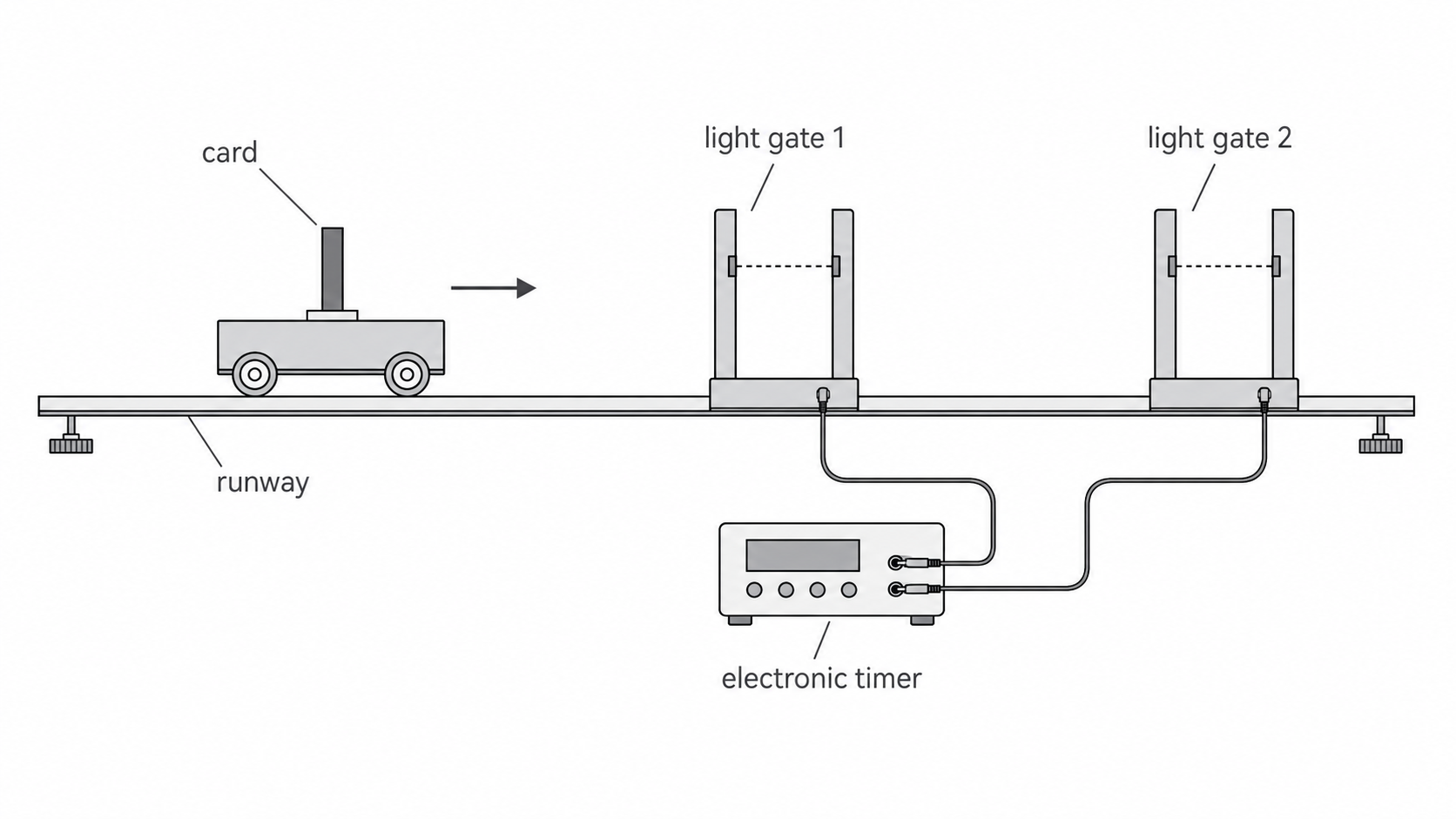
The apparatus illustration is schematic: arrange each beam across the path so that the card interrupts it. The measured card width is along the trolley’s travel direction.
Two light gates can be used in two ways. Dividing the measured distance between the beams by the travel time between them gives the average speed over that separation. Alternatively, use the card width and interruption time at each gate to find an initial velocity u and final velocity v; measure the time between those velocity readings and use to find average acceleration.
Match each distance to its time. The distance between gates does not belong in card width / interruption time, and the card width does not belong in distance between gates / travel time.
Speed and acceleration scales
A number is only useful when its size makes physical sense. Someone walking covers roughly a metre in a second, while sound in air covers hundreds of metres in the same time. Typical speeds are estimates, not exact properties: they change with the person, vehicle and conditions.
| Motion or phenomenon | Useful typical speed |
|---|---|
| walking | about 1.5 m/s |
| running | about 3 m/s |
| everyday cycling | about 5 m/s |
| moderate breeze | about 7 m/s |
| car on a main road | about 20 m/s |
| gale-force wind | about 20 m/s |
| high-speed train | about 80 m/s |
| passenger aircraft in flight | about 250 m/s |
| sound in air | about 340 m/s |
These are order-of-magnitude anchors. A reasonable estimate for a walking speed might be between 1 m/s and 2 m/s; 100 m/s would not be reasonable. Wind has a particularly wide range, and the speed of sound in air varies slightly with conditions.
Acceleration tells us how quickly velocity changes. Because velocity includes direction, an object accelerates when it speeds up, slows down, or changes direction.
For motion in a straight line:
acceleration = change in velocity / time taken
For example, a bus that goes from 0 m/s to 10 m/s in 20 s has an acceleration of:
Useful magnitudes are roughly for a gently starting bus or train, a few for a car accelerating or braking firmly, and for free fall near Earth's surface. In free fall, gravity is the only force considered. Ignoring air resistance, means the downward velocity changes by about 10 m/s every second.