1.1-1.4 - Units, prefixes and standard form
A measurement needs a quantity, a value and a unit. Learn how to convert units without changing the physical amount, use powers of ten, and report a result with sensible precision.
Quantities and SI units
Suppose a stopwatch shows 12.4. That display gives a numerical value, but it does not yet say what was measured or which unit was used. A complete measurement needs all three:
- physical quantity: what is measured, such as time;
- numerical value: the number, such as
12.4; - unit: the agreed comparison standard, such as the second,
s.
The International System of Units (SI) is the agreed system of measurement units used in science. A unit symbol is case-sensitive: m means metre, while M is the prefix mega.
The SI base units listed for this GCSE Physics course are:
| Physical quantity | SI unit | Symbol |
|---|---|---|
| length | metre | m |
| mass | kilogram | kg |
| time | second | s |
| electric current | ampere | A |
| temperature | kelvin | K |
| amount of substance | mole | mol |
Other quantities use derived units, which are built from base units. Some derived units have their own names and symbols:
| Physical quantity | SI unit | Symbol |
|---|---|---|
| frequency | hertz | Hz |
| force | newton | N |
| energy | joule | J |
| power | watt | W |
| pressure | pascal | Pa |
| electric charge | coulomb | C |
| electric potential difference | volt | V |
| electric resistance | ohm | Ω |
| magnetic flux density | tesla | T |
Write a space between a value and its unit, as in 15 N. Do not pluralise a unit symbol: 15 N is correct, not . Capital letters matter because symbols such as N, J, W, Pa, C, V and T are named after people, whereas m and s are lower-case.
Prefixes as powers of ten
Scientists use prefixes so that measurements are convenient to read. A prefix attached to a unit changes the size of that unit by an exact power of ten. The prefix and unit symbol stay together with no space: km, mA and MHz each form one unit symbol.
| Prefix | Symbol | Factor | Meaning of one prefixed unit |
|---|---|---|---|
| giga | G | 1 G-unit = 1 000 000 000 units | |
| mega | M | 1 M-unit = 1 000 000 units | |
| kilo | k | 1 k-unit = 1 000 units | |
| centi | c | 1 c-unit = 0.01 unit | |
| milli | m | 1 m-unit = 0.001 unit | |
| micro | μ | 1 μ-unit = 0.000 001 unit | |
| nano | n | 1 n-unit = 0.000 000 001 unit |
[DIAGRAM: asset_name: 01_1PH0-C-01_1.1-1.4 - Units, prefixes and standard form - diagram 01; asset_slug: edexcel-gcse-physics-01-units-prefixes-standard-form_diagram-01; recommended_method: matplotlib; description: an exact horizontal power-of-ten scale locating the seven required SI prefixes around the unprefixed unit, with arrows showing larger and smaller factors]
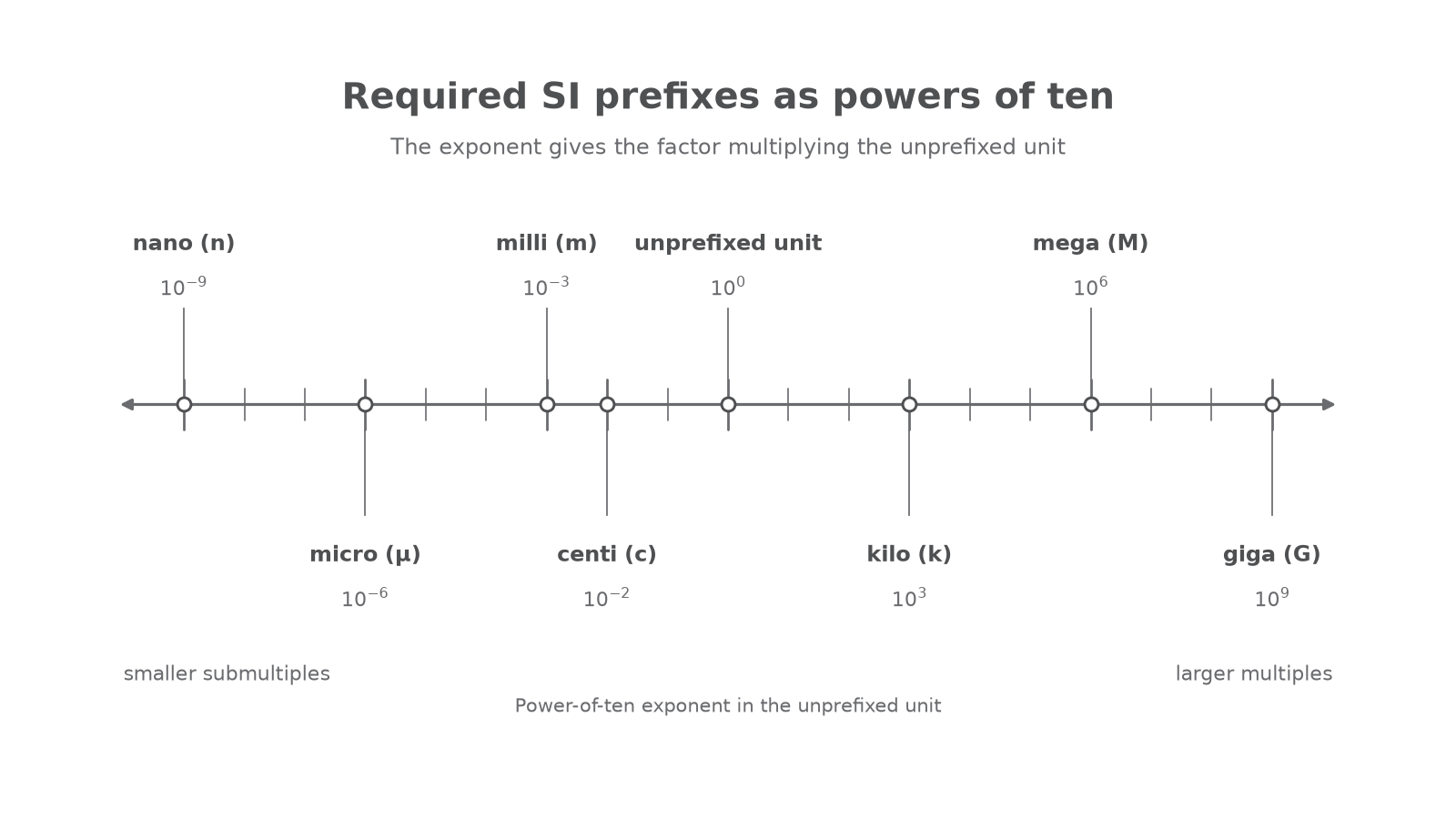
Read each prefixed unit as a multiplication. For example:
- ;
- ;
- .
The physical quantity does not change during a conversion. A length of 3 km and a length of 3000 m are the same length written in different units. Because metres are smaller than kilometres, more metres are needed to describe that same length.
Treat the symbol as part of the number's scale. M means multiply by , but m means multiply by : confusing their case changes a value by a factor of .
Converting between units
A reliable conversion keeps the factor visible. To remove a prefix and write the value in the unprefixed unit, multiply by the power of ten represented by that prefix:
The direction provides a useful check. Converting from a larger unit to a smaller unit should make the numerical value larger; converting from a smaller unit to a larger unit should make it smaller.
Worked example: converting a prefixed time
A sensor responds in 6.4 ms. Express this time in seconds.
The prefix milli means , so
.
The answer is less than one second, which is sensible for a response measured in milliseconds.
Time conversions that do not use SI prefixes still need a conversion factor:
1 min = 60 s
1 h = 60 min = 3600 s
Worked example: hours to seconds
A data logger runs for 2.5 h. Express this time in seconds.
The hour units cancel, leaving seconds. The answer is larger than 2.5 because the second is the smaller unit.
The reverse conversion divides by the prefix factor. For example, . Converting between two prefixes is safest in two steps: . These are different numerical labels for the same current, not changes to the current itself.
Using standard form
Very large and very small values are easier to compare and calculate with in standard form.
A positive number is in standard form when it is written as , where 1 ≤ a < 10 and n is an integer. For a negative value, place the minus sign in front, for example .
The coefficient a shows the significant digits. The exponent n shows how far and in which direction the decimal point moves:
- ;
- ;
- ;
- .
For positive values in standard form, a positive exponent gives a value greater than or equal to 10; a negative exponent gives a value between 0 and 1. An expression such as is not in standard form because its coefficient is not less than 10. Rewrite it as .
Prefixes and standard form describe the same powers of ten. For example,
.
For multiplication, multiply the coefficients and add the exponents. For division, divide the coefficients and subtract the exponents. Then adjust the coefficient if necessary so it is at least 1 and less than 10.
Worked example: a ratio of small lengths
One length is and another is . Find how many times larger the first is.
.
The first length is 400 times larger. Subtracting a negative exponent increases the exponent, which agrees with the first length being larger.
Significant figures and final answers
Significant figures communicate the precision of a reported value. Start counting at the first non-zero digit:
- all non-zero digits are significant;
- zeroes between non-zero digits are significant;
- leading zeroes only position the decimal point and are not significant;
- trailing zeroes after a decimal point are significant.
For example, 0.004 070 has four significant figures: 4, 0, 7, 0. The first three zeroes are placeholders. In a whole number such as 1200, trailing zeroes can be ambiguous; standard form removes the ambiguity. has two significant figures, while has four.
To round to a stated number of significant figures:
- identify the last digit to keep;
- inspect the next digit;
- leave the kept digit unchanged if the next digit is
0-4, or increase it by one if the next digit is5-9; - preserve the size of the original value with placeholding zeroes or standard form.
Thus 0.006248 to two significant figures is 0.0062, while 54 650 to three significant figures is 54 700, or more clearly .
When a calculation asks for an appropriate number of significant figures, match the precision justified by the measured data. For multiplication and division at GCSE, the value with the fewest significant figures is a reliable guide. Keep extra calculator digits during the working and round only the final answer.
Worked example: combining the skills
A time is measured as 3.45 ms. Express it in seconds and give the result to two significant figures in standard form.
First convert without rounding:
.
The first two significant digits are 3 and 4; the next digit is 5, so round the 4 up:
to two significant figures.
The exponent remains -3, so the order of magnitude is unchanged and the result is still a few milliseconds.