3.9-3.12 - Reducing waste and improving efficiency
A warm bearing or a cooling room reveals an energy transfer. Learn how lubrication and insulation reduce unwanted transfers, how walls affect cooling, and how efficiency measures the useful fraction of an input.
Reducing unwanted energy transfers
When a motor turns a shaft, the intended output is mechanical work on a load. During startup this may increase the kinetic energy store of moving parts; during steady operation it may lift or move a load without further increasing the shaft's kinetic store. If the motor and bearings also become warm, some energy has been transferred into thermal stores instead. That transfer is unwanted for the motor's purpose, but the energy has not disappeared: total energy is still conserved.
Whether a transfer is useful depends on the purpose and the system boundary. Heating a room is useful for a space heater, while heating the casing and surroundings of an electric motor is usually unwanted.
Lubrication
Surfaces that slide over one another experience friction. Work must be done against this friction, transferring energy into thermal stores of the surfaces and surroundings.
A lubricant such as oil forms a layer between the moving surfaces and makes them slide past one another more easily. This reduces friction, so less work is done against friction and less energy is transferred mechanically into thermal stores of the rubbing surfaces. The warmer surfaces then transfer less energy by heating to their surroundings. Lubrication reduces the unwanted transfer; it does not remove friction completely or supply extra energy.
Thermal insulation
If a building, pipe or hot-water tank is warmer than its surroundings, energy is transferred from the warmer region to the cooler surroundings. Thermal insulation uses materials and structures that make this transfer slower. For example, loft insulation and cavity-wall insulation reduce the rate at which energy is transferred out of a heated building.
Insulation does not stop energy transfer completely. It reduces the rate of transfer, so a heated object or building takes longer to cool under the same external conditions.
How walls affect the rate of cooling
The rate of cooling describes how quickly a building's temperature falls. To compare two walls fairly, consider the buildings at the same inside temperature, with the same outside conditions and the same wall area, then change one wall property at a time.
Thermal conductivity describes how readily a material conducts thermal energy. A material with low thermal conductivity conducts energy slowly and is a good thermal insulator. A material with high thermal conductivity conducts energy more readily.
For walls made from the same material, a thicker wall gives a slower rate of energy transfer through the wall, so the building cools more slowly. A thinner wall gives a faster transfer and faster cooling.
For walls with the same thickness, a material with lower thermal conductivity gives slower energy transfer and slower cooling. A material with higher thermal conductivity gives faster energy transfer and faster cooling.
| Controlled comparison | Faster rate of cooling | Slower rate of cooling |
|---|---|---|
| Same material and conditions | thinner wall | thicker wall |
| Same thickness and conditions | higher thermal conductivity | lower thermal conductivity |
[DIAGRAM: asset_name: 11_1PH0-P1-03C_3.9-3.12 - Reducing waste and improving efficiency - diagram 01; asset_slug: 11_1ph0-p1-03c_3-9-3-12-reducing-waste-improving-efficiency_diagram_01; recommended_method: image_gen; description: two-panel monochrome building-wall cross-section comparing a thin high-conductivity wall with faster outward thermal transfer against a thick low-conductivity wall with slower outward transfer under identical conditions]
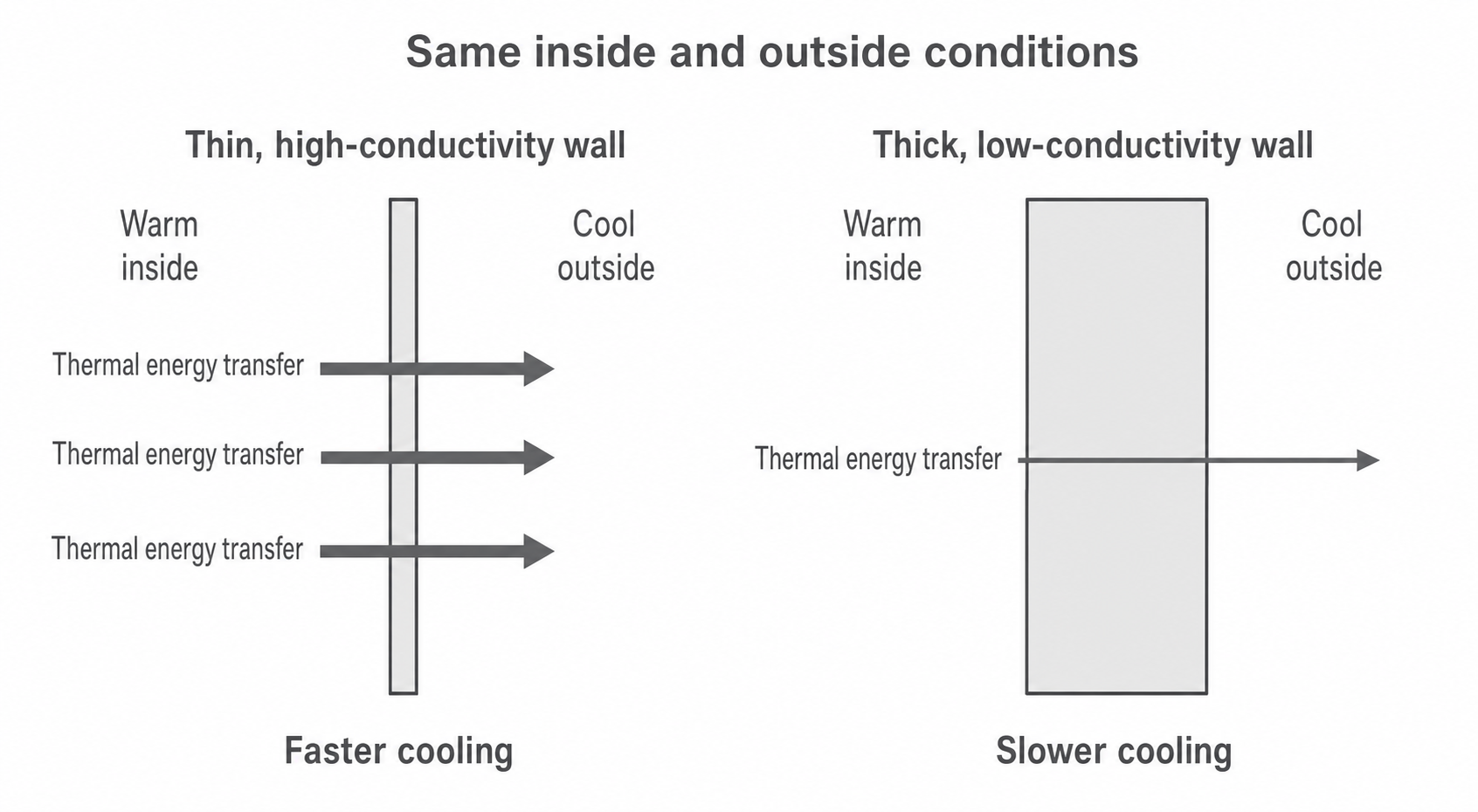
The arrows in the diagram represent the direction and relative rate of energy transfer, not the paths of particles. The comparison combines two helpful changes, but in an investigation each factor would be changed separately to identify its effect.
Calculating efficiency
Draw an imaginary boundary around the device being considered. Over the same time or process, identify:
- the total energy supplied across the boundary;
- the useful energy transferred in the intended way;
- any energy transferred in unwanted ways.
For a complete operating interval with no net energy retained inside the device, conservation links these quantities:
total energy supplied = useful energy transferred + unwanted energy transferred
Efficiency is the fraction of the total supplied energy transferred usefully.
efficiency = useful energy transferred by the device / total energy supplied to the device
efficiency (%) = (useful energy transferred / total energy supplied) × 100
The two energy values must use the same unit before division. Efficiency itself has no unit because it is a ratio. It can be written as a decimal from 0 to 1, or as the equivalent percentage from 0% to 100%.
For example, 0.72 and 72% are the same efficiency. Writing 0.72% would mean 0.0072, which is a different value. The Edexcel equation sheet provides the ratio equation, but the device boundary and the useful transfer still have to be selected correctly.
Worked example
A food mixer is supplied with 2.40 kJ of electrical energy and transfers 1.62 kJ usefully to moving the mixture. Calculate its efficiency as a decimal and a percentage.
Both values are already in the same unit. Equivalently, and .
efficiency = useful energy transferred / total energy supplied
efficiency = 1620 J / 2400 J = 0.675
efficiency = 0.675 × 100 = 67.5%
The answer is given to three significant figures, matching the data. It is physically plausible because it lies between 0 and 1 (or 0% and 100%). The other 32.5% of the supplied energy is transferred in unwanted ways; it has not been destroyed.
To find useful energy when efficiency and total input are known, rearrange the ratio:
useful energy transferred = efficiency × total energy supplied
Convert a percentage efficiency to a decimal before using this form. For example, .
Increasing efficiency: Higher tier
This section covers Higher-only statement 3.12.
For the same total energy supplied, efficiency increases when a larger amount is transferred usefully. Since energy is conserved, this usually means reducing unwanted transfers so that a greater fraction of the same input reaches the intended output.
| Device | Total supplied energy | Useful transfer | Unwanted transfer | Efficiency |
|---|---|---|---|---|
| A | 1000 J | 600 J | 400 J | |
| B | 1000 J | 750 J | 250 J |
Device B has the same input as A but a smaller unwanted transfer. Its useful transfer is therefore larger and its efficiency is higher.
The mechanism must be explained, not merely named. Lubricating moving parts can reduce friction, so less energy is transferred thermally and a larger share can reach the intended mechanical output. Insulating a heating system can reduce transfer to unintended surroundings before the energy reaches the place where heating is wanted, increasing the useful fraction for the chosen system boundary.
Reducing the total input alone does not prove that efficiency has increased. If useful output and total input both fall in the same proportion, their ratio is unchanged. A valid comparison must identify the same intended output and use a consistent system boundary.