3.7B - 3.8B - Protein synthesis
Higher tier: follow genetic information from DNA through transcription and translation to a folded protein. Connect the jobs of RNA polymerase, mRNA, ribosomes and tRNA to the order of amino acids.
3.7B — From base order to protein shape
This whole lesson is Higher-tier content for GCSE Biology only. The B in each specification code identifies Biology-only content; Pearson separately marks both points as Higher tier.
At the molecular scale, a gene is a section of DNA with bases arranged in a particular order. The bases do not turn into amino acids. Instead, their order stores information that the cell reads in two stages, using messenger RNA as an intermediate:
DNA base order -> mRNA base order -> amino-acid order
The amino acids are linked into a chain called a polypeptide. The order of the amino acids affects how the chain folds, and the folded chain produces a protein with a specific three-dimensional shape. Shape matters because it affects how the protein interacts with other molecules.
Polypeptide
A polypeptide is a chain of amino acids linked together. One or more folded polypeptides form a protein.
Enzymes are a useful example. An enzyme's folded shape includes its active site. That shape allows particular substrate molecules to bind, so a change to the amino-acid order can change folding, alter the active site and change the enzyme's activity.
There are therefore two different features to keep separate:
- protein quantity: how many molecules of the protein are made;
- protein activity: how effectively the protein molecules carry out their function.
The next lesson uses these differences to explain how genetic variants can affect a phenotype.
3.8B — Transcription: DNA to mRNA
In a cell with a nucleus, the DNA remains in the nucleus while protein synthesis is taking place. The first stage, transcription, produces a mobile copy of a gene's information as messenger RNA, or mRNA.
Transcription
Transcription is the production of an mRNA strand using one DNA strand in a gene as a template.
The process has a definite order:
- RNA polymerase binds in front of the gene. RNA polymerase is an enzyme. It binds to a non-coding DNA control region before the coding region of the gene. This binding region is often called the promoter.
- The DNA in the gene unwinds. The two DNA strands separate locally, exposing their bases.
- RNA polymerase builds mRNA. The enzyme moves along one DNA strand in the coding region. This strand acts as a template, so RNA nucleotides are joined in a complementary order. In RNA, uracil (
U) replaces the thymine (T) found in DNA. - The mRNA leaves the nucleus. It carries the gene's base sequence to a ribosome in the cytoplasm.
The phrase complementary mRNA refers to the relationship between mRNA and the one DNA strand used as the template. The mRNA is not complementary to both DNA strands, and RNA polymerase does not make the protein during transcription.
[DIAGRAM: asset_name: 3.7B-3.8B - Protein synthesis - transcription-dna-to-mrna; asset_slug: edexcel-gcse-biology-protein-transcription-phone; recommended_method: image_gen; description: Focused portrait transcription sequence: polymerase at the control region before the gene; mRNA made using one DNA template; mRNA exits the nucleus towards a cytoplasmic ribosome.]
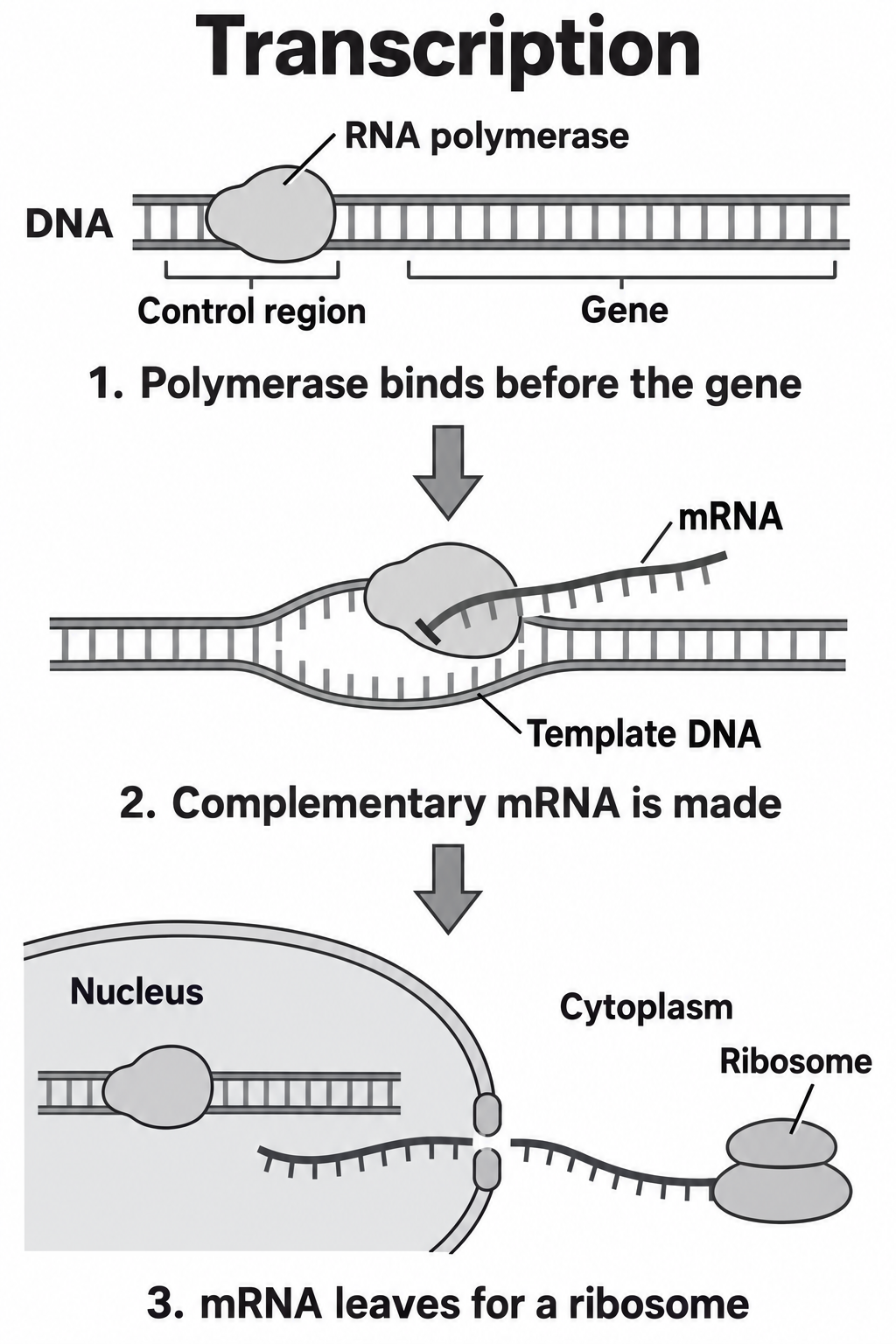
Read down the panels: the control region is where RNA polymerase first binds; the template is the one DNA strand copied; mRNA carries that information out to a ribosome. The shapes and distances are schematic.
3.8B — Translation: mRNA to polypeptide
The second stage is translation. Here, the base sequence in mRNA is converted into an amino-acid sequence at a ribosome in the cytoplasm.
Translation
Translation is the use of the mRNA base sequence at a ribosome to assemble amino acids in a particular order.
Follow the information rather than treating mRNA, tRNA and the ribosome as an unconnected list:
- mRNA attaches to a ribosome. The ribosome holds the mRNA while its bases are read in order.
- The ribosome reads codons. A codon is a triplet of three bases in the mRNA. The codons considered here each specify a particular amino acid. Some other codons signal the end of translation.
- tRNA transfers amino acids. Each transfer RNA, or tRNA, carries a specific amino acid to the ribosome. A matching three-base region on the tRNA pairs with the mRNA codon, so the appropriate amino acid is placed next in the sequence.
- A polypeptide forms. The amino acids are linked together in the codon-determined order, producing a growing polypeptide chain.
- The chain folds. The polypeptide folds to form a specifically shaped protein, returning the process to the relationship taught in 3.7B.
The information has changed representation, but its order has been preserved: the DNA base sequence determined the mRNA codon sequence, which determined the amino-acid sequence.
[DIAGRAM: asset_name: 3.7B-3.8B - Protein synthesis - translation-mrna-to-polypeptide; asset_slug: edexcel-gcse-biology-protein-translation-phone; recommended_method: image_gen; description: Focused portrait translation sequence: mRNA and a three-base codon at a ribosome; amino-acid-carrying tRNA; amino acids joined as a polypeptide; schematic folded protein.]
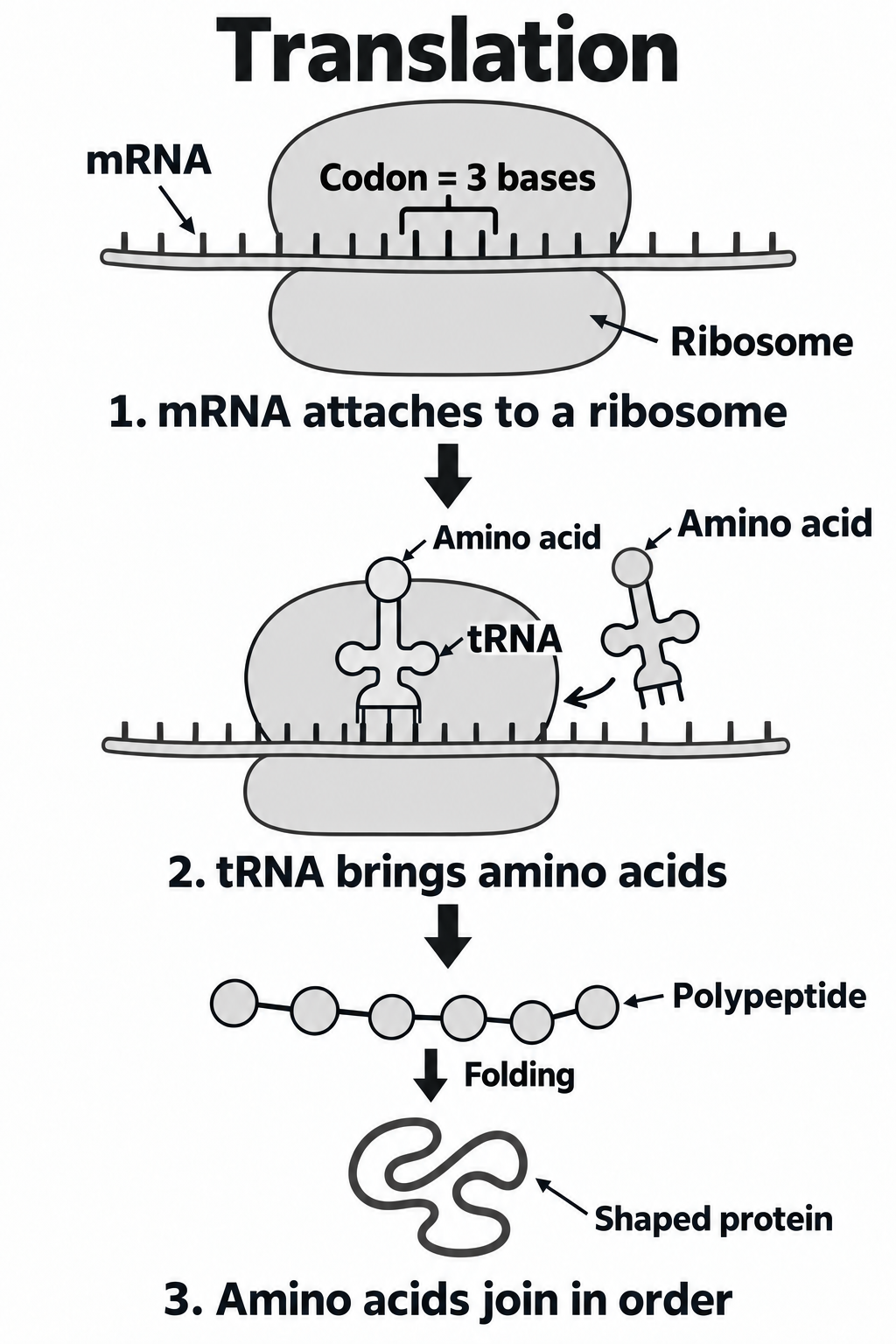
The short ticks represent mRNA bases; one codon contains three. Each tRNA carries an amino acid, shown as a circle. Amino acids join into a polypeptide; the final outline represents its folded shape, not a count of atoms or amino acids.