1.15 - Cell transport
Compare diffusion, osmosis and active transport by what moves, the direction of net movement and the need for energy. Apply these mechanisms to cells and to changes in potato tissue.
1.15 — Routes across a cell membrane
The cell membrane is the boundary between a cell and its surroundings. It controls which
substances can cross, so any explanation of transport into or out of a cell needs three
details: what moves, the direction of net movement and whether the cell must supply energy.
Concentration gradient
A concentration gradient is a difference in the concentration of one substance between two
regions.
Particles are in constant random motion. If there are more particles of a substance on one
side of a membrane than the other, and the membrane is permeable to that substance, particles cross in both directions, but more cross from
the higher-concentration side to the lower-concentration side. The overall result is net
movement down the concentration gradient. When the concentrations become equal,
particles still move, but there is no net movement.
The three transport processes can now be separated precisely.
| Process | What moves? | Direction of net movement | Membrane condition | Energy supplied by the cell? |
|---|---|---|---|---|
| Diffusion | particles of a substance | from higher to lower concentration, down that substance's concentration gradient | the membrane must allow that substance through | no |
| Osmosis | water molecules only | from higher water concentration to lower water concentration | through a partially permeable membrane | no |
| Active transport | a particular substance | from lower to higher concentration, against that substance's concentration gradient | across the cell membrane | yes |
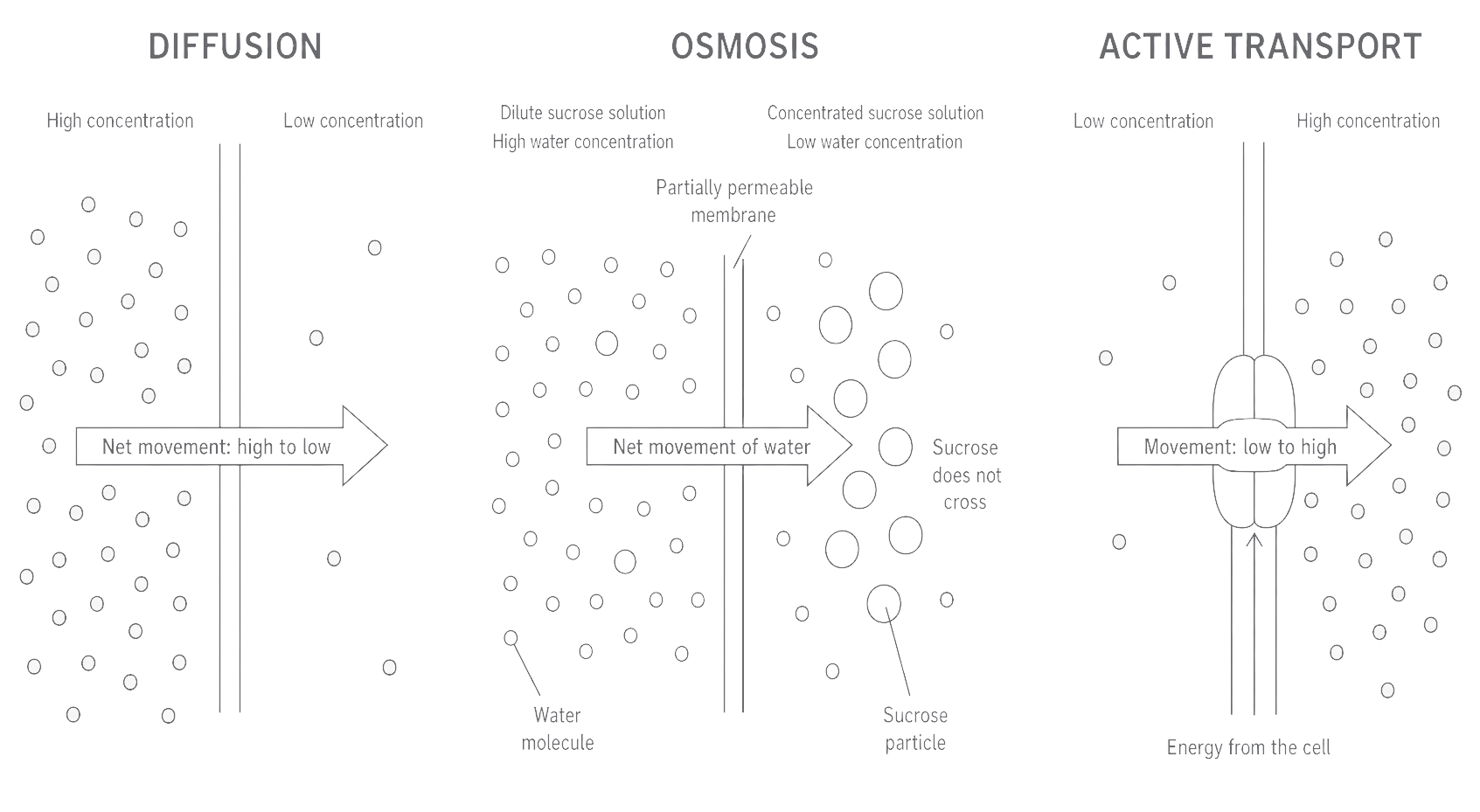
Diffusion can therefore move a substance into a cell when its concentration is higher
outside, or out when its concentration is higher inside. Osmosis is a special case because
the moving particles are always water molecules and a partially permeable membrane is
required. Active transport is different: the cell supplies energy, released by respiration,
to move a substance against its concentration gradient. Membrane carrier proteins bind the substance and use energy to transfer it across; this allows uptake even when diffusion would produce net movement in the opposite direction. For example, oxygen can diffuse into a respiring cell, while mineral ions can enter root hair cells by active transport when their concentration is lower in the soil than in the cells.
[DIAGRAM: asset_name: 1.15-1.17 - Cell transport and osmosis - diagram 01; asset_slug: edexcel-gcse-biology-1-15-transport-membrane-routes; recommended_method: image_gen; description: A simple monochrome textbook comparison of three aligned cell-membrane panels. Diffusion panel: many identical solute particles on the high-concentration side, fewer on the low-concentration side, and an unmistakable net arrow from high to low. Osmosis panel: a labelled partially permeable membrane, a dilute/high-water-concentration side and concentrated/low-water-concentration side, small water molecules crossing towards the lower water concentration while larger sucrose particles do not cross. Active-transport panel: fewer particles on the starting side, more on the destination side, an arrow from low to high concentration and a clearly labelled energy input. Use only white, #6A6B6E linework/text and very light neutral fills; exclude organelles, ATP chemistry, named pumps, facilitated diffusion and decorative elements.]
1.15 — Why potato mass changes
A potato cylinder is a piece of tissue made of many plant cells. Each cell has a partially
permeable cell membrane: water molecules can cross it, but sucrose does not cross it in this
investigation. Water molecules move through the membrane in both directions, and the
difference in water concentration determines the net direction.
A dilute sucrose solution contains a lower concentration of dissolved sucrose and therefore
a higher concentration of water than a concentrated sucrose solution. This gives three
predictions.
| Sucrose solution around the potato | Water concentration outside compared with inside the cells | Net movement of water | Expected potato mass change |
|---|---|---|---|
| more dilute than the cell contents | higher outside | into the potato cells by osmosis | mass gain |
| more concentrated than the cell contents | lower outside | out of the potato cells by osmosis | mass loss |
| isotonic to the potato tissue | equal on average | no net movement; equal movement in both directions | approximately no mass change |
The measured mass changes because the tissue gains or loses water. Sucrose is not moving
by osmosis. At the isotonic concentration, water molecules have not stopped moving; their
movements in opposite directions balance, so the potato shows zero percentage change in
mass.
For an osmosis explanation, name water, a partially permeable membrane, and movement from
higher to lower water concentration. A change in potato mass is the evidence for that net
water movement.