3.4 - 3.5 - DNA, genes and genomes
Build a DNA molecule from nucleotides and complementary base pairs, then distinguish a protein-coding gene from an organism’s whole genome.
3.4 — Building DNA from nucleotides
Start at the molecular scale. A DNA molecule is a polymer: a large molecule made by joining many repeating smaller units. The repeating units in DNA are nucleotides.
DNA nucleotide
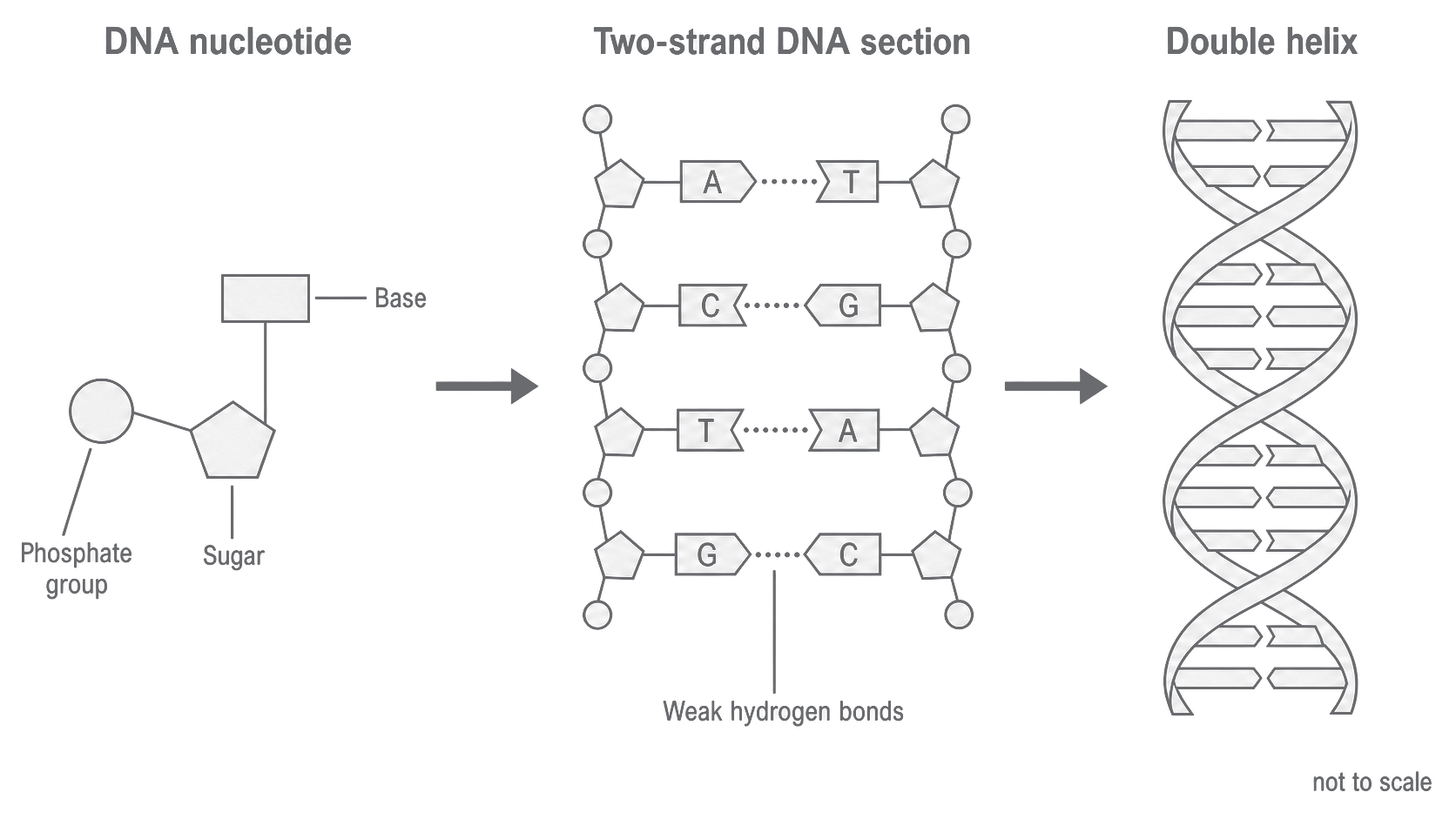
A DNA nucleotide consists of a sugar, a phosphate group and one of four different bases attached to the sugar.
The four bases are adenine (A), thymine (T), cytosine (C) and guanine (G). Many nucleotides join to form a DNA strand. The sugar and phosphate groups repeat along the outside of the strand, while the bases point inwards.
This distinction matters: a base is one component of a nucleotide. A nucleotide contains the base and its sugar and phosphate group.
3.4 — From base pairs to a double helix
One DNA molecule contains two nucleotide strands. A base on one strand pairs with a base on the other, so the paired bases link the two strands like the rungs of a ladder. The pairing is complementary, meaning that each base has one particular partner:
- adenine pairs with thymine: A-T
- cytosine pairs with guanine: C-G
The complementary bases are joined by weak hydrogen bonds. These bonds act across the two strands, between paired bases; they do not make the repeating sugar-phosphate chain along a strand. The two linked strands coil around each other to form a double helix, like a twisted ladder.
[DIAGRAM: asset_name: 3.4-3.6 - DNA, genes and extraction - diagram 01; asset_slug: edexcel-gcse-biology-3-4-3-6-dna-structure-scale; recommended_method: image_gen; description: A simple monochrome textbook schematic connecting the required structural scales. Show one enlarged DNA nucleotide labelled phosphate group, sugar and base, with the base visibly attached to the sugar; then a short untwisted two-strand DNA section with repeating sugar-phosphate strands, correctly paired A-T and C-G bases, and weak hydrogen bonds labelled only between paired bases; then show the same two strands coiling into a double helix. Add not to scale. Use a white background, #6A6B6E linework and text, and minimal neutral fills. Exclude atomic structures, hydrogen-bond counts, 5-prime/3-prime labels, antiparallel arrows, chromosomes, histones, replication, RNA, protein synthesis and decorative elements.]
Worked example: applying complementary pairing
Suppose one DNA strand contains this sequence:
A C T G G A
Match each base using A-T and C-G:
first strand:         A C T G G A
complementary strand: T G A C C T
Every position is determined by the same complementary pairing rule.
3.5 — Genes and the genome
The words gene and genome describe DNA at very different scales.
| Term | Scale | Meaning |
|---|---|---|
| gene | one section | a section of a DNA molecule that codes for a specific protein |
| genome | the whole | the entire DNA of an organism |
A genome contains many genes, but genome does not mean only the genes. It means all of the organism's DNA. A gene is therefore one defined section within that much larger whole, not a whole DNA molecule and not a whole genome.