3.1B - 3.3 - Reproduction and meiosis
Compare how sexual and asexual reproduction balance speed with genetic variation. Learn how meiosis produces genetically different haploid cells and why halving the chromosome number matters for sexual reproduction.
3.1B, 3.2B — Two routes to offspring
Reproduction is the production of new organisms. At the scale of a population, the
important difference between the two reproductive routes is where the offspring's genetic
information comes from.
In asexual reproduction, one parent produces offspring without needing to find a mate.
The offspring are genetically identical to that parent and to one another; genetically
identical organisms are called clones. Asexual reproduction itself therefore does not generate new combinations of parental alleles.
These offspring are clones unless a mutation changes their DNA; the comparisons below
assume no new mutation. Mutation is explored later in this topic.
In the usual two-parent model of sexual reproduction considered here, genetic information from two parents is brought together in
reproductive cells called gametes. The offspring are genetically different from one
another, so sexual reproduction produces genetic variation in the population.
| Feature | Asexual reproduction | Sexual reproduction |
|---|---|---|
| Parents contributing genetic information | One | Two |
| Need to find a mate | No | Yes |
| Genetic outcome | Genetically identical offspring | Genetically different offspring |
| Effect on variation | Does not generate variation among offspring | Produces variation in the population |
The two routes are not simply "good" and "bad". Each has an advantage and a disadvantage
that follows from its genetic outcome and from whether a mate is required.
3.1B — Asexual reproduction: speed without variation
An organism that reproduces asexually does not need to spend time finding a mate. It can
reproduce even when it is isolated from other members of its species, so a reproductive
cycle can begin quickly. A rapid reproductive cycle can produce many offspring in a
short time and allow the population to increase rapidly.
The same route has a disadvantage. Because the offspring are genetically identical, there
is no genetic variation among them. If the existing characteristics remain suitable for the
conditions, making the same genetic type can be useful. However, if conditions change or a
new disease affects that genetic type, many or all of the genetically similar offspring may
be affected in the same way. There are no differently inherited versions among those
offspring that might respond better.
The consequence is conditional: lack of variation creates a risk when a harmful condition
appears; it does not mean that every asexual population is always harmed.
3.2B — Sexual reproduction: variation at a cost
Sexual reproduction brings together genetic information from two parents. Their gametes
are genetically different, so the offspring receive different combinations of genetic
information. This creates genetic variation within the population.
Variation is an advantage if conditions change. Different individuals may respond
differently to a new condition or disease, so some may have inherited characteristics that
help them survive and reproduce. Variation increases this possibility; it does not
guarantee that any particular individual will survive.
In this two-parent model, the disadvantage is that an organism must find a mate. Finding a mate can take time, and
sexual reproduction cannot take place if no suitable mate is found. This can make the
reproductive cycle slower than an asexual cycle.
| Route | Main advantage | Main disadvantage |
|---|---|---|
| Asexual | No mate is needed, so reproduction can be rapid | No genetic variation is generated among offspring |
| Sexual | Genetic variation is produced in the population | A mate must be found, which can slow reproduction |
3.3 — Meiosis makes haploid gametes
Chromosomes are structures that carry genetic information in a cell. A cell with two sets
of chromosomes is diploid. Meiosis starts with a diploid parent cell and is the type of
cell division that forms gametes for sexual reproduction.
By the end of meiosis, one parent cell has produced four daughter cells. These are two
separate quantities that must not be confused:
- four is the number of daughter cells;
- each daughter cell has half the number of chromosomes found in the diploid parent
cell.
A cell with one set of chromosomes, which is half the diploid number, is haploid.
Therefore, the four daughter cells made by meiosis are haploid. They are also genetically
different from one another, so meiosis results in the formation of genetically different
haploid gametes.
At fertilisation, two haploid gametes fuse and restore the diploid chromosome number.
Halving the number during meiosis prevents it doubling in each generation. For example,
a species with 12 chromosomes in a diploid cell makes gametes with 6; fertilisation
combines 6 + 6 to restore 12. The number of cells produced (four) is different from
the number of chromosomes in each cell (six in this example).
The complete outcome is:
one diploid parent cell -> meiosis -> four genetically different haploid gametes
This connects meiosis to the advantage of sexual reproduction: genetically different
gametes contribute to genetic variation in the offspring and therefore in the population.
Only the outcome and role of meiosis are required here; the named stages of meiosis are not
required.
[DIAGRAM: asset_name: 3.1B-3.3 - Reproduction and meiosis - diagram 01; asset_slug: edexcel-gcse-biology-3-1b-3-3-meiosis-outcome; recommended_method: image_gen; description: Simple monochrome textbook schematic showing one diploid parent cell on the left, one arrow labelled meiosis, and four separate daughter cells on the right. Label the parent cell diploid: two chromosome sets; label the group of products four genetically different haploid gametes; and label each product half the parent's chromosome number. Use small whole-chromosome symbols only to make chromosome-number halving visible; state genetic difference in the product-group label, but do not encode crossing over, independent assortment, alleles, or any variation mechanism in the symbols. Do not show or name meiotic phases, crossing over, independent assortment, spindle fibres, human chromosome numbers, fertilisation, mitosis, or any extra cellular detail.]
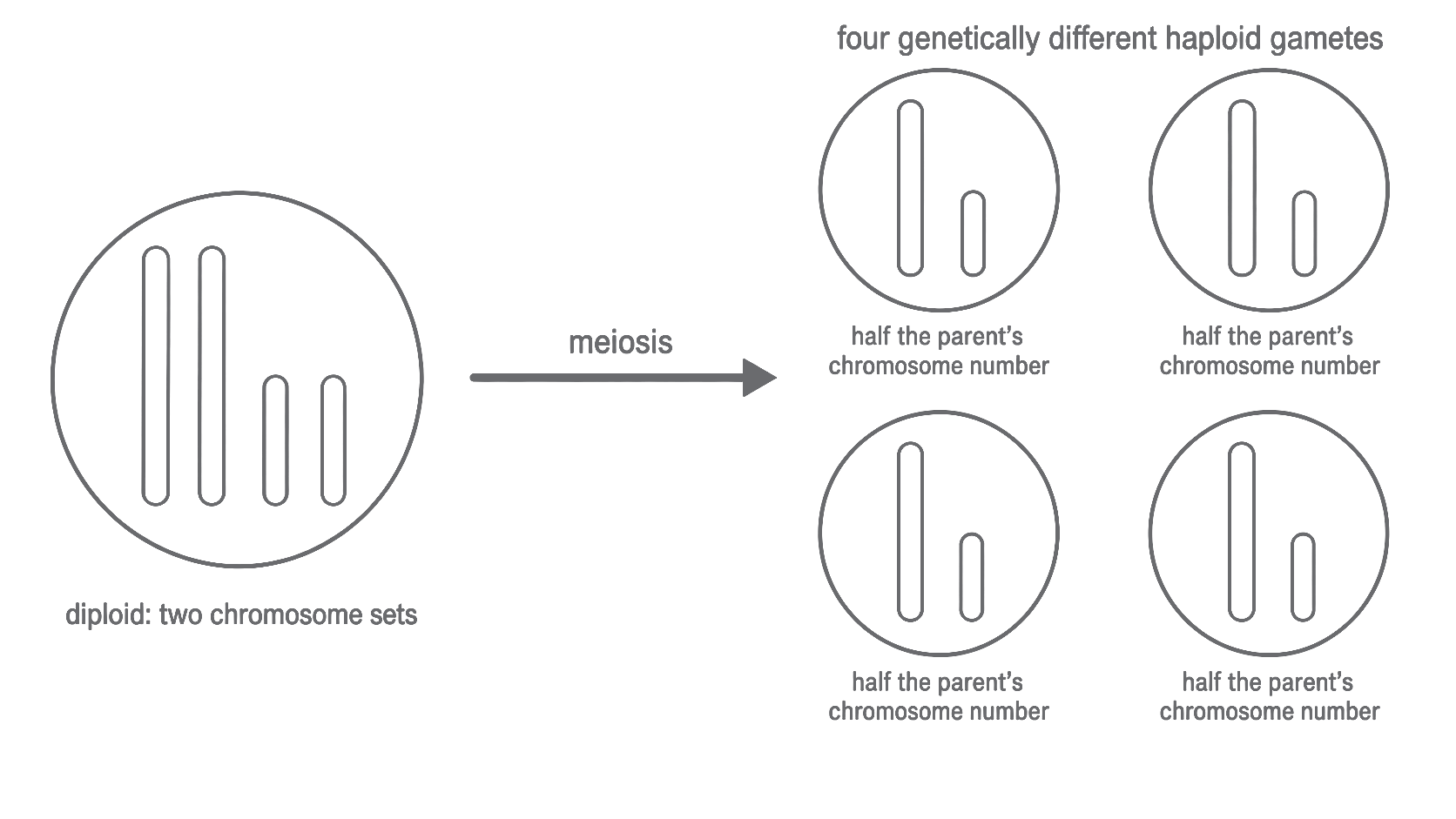
The chromosome rods are count symbols only: their identical outlines do not mean that the gametes are genetically identical.