2.1 - 2.4 - Mitosis and cell division
Follow the cell cycle from chromosome copying to two genetically identical daughter cells. Explain why controlled mitosis supports growth, repair and asexual reproduction, and how loss of that control can lead to cancer.
2.1 — Preparing to Divide
A new body cell does not appear in a single step. A parent cell passes through an ordered cell cycle in which it grows, prepares its genetic material, divides its nucleus and finally divides the rest of the cell.
Cell cycle
The cell cycle is the ordered series of events through which a cell grows and divides to produce new cells.
The first required stage is interphase. During interphase:
- the cell grows;
- its DNA is replicated, so every chromosome is copied;
- more cell structures, including organelles, are made;
- the cell prepares for division.
At the end of interphase there is still one cell with one nucleus. Its chromosomes have been copied, ready for the copies to be separated accurately. This matters because copying the chromosomes and separating the copies are different jobs: copying happens in interphase, while separation happens during mitosis.
The cell-cycle route is interphase -> mitosis -> cytokinesis. Interphase prepares and copies; mitosis divides the nucleus; cytokinesis divides the cell.
2.1 — Mitosis in Order
Mitosis is the part of the cell cycle in which the nucleus divides. The copied chromosomes must be arranged and separated so that one complete set reaches each end of the cell. Its four required stages always follow the order prophase, metaphase, anaphase, telophase.
[DIAGRAM: asset_name: 2.1-2.6 - Mitosis, growth and differentiation - diagram 01; asset_slug: edexcel-gcse-biology-2-1-2-6-mitosis-sequence; recommended_method: image_gen; description: Six-panel monochrome textbook schematic of one representative body cell moving from left to right through interphase, prophase, metaphase, anaphase, telophase and cytokinesis; use consistent simple chromosome symbols rather than a literal species chromosome count; show chromosome copying during interphase, condensed visible chromosomes and nuclear-membrane breakdown in prophase, replicated chromosomes aligned at the equator in metaphase, identical chromosome halves moving to opposite poles in anaphase, a nuclear membrane reforming around each equal chromosome set in telophase, and two separate daughter cells after cytokinesis; include clear stage labels and directional arrowheads, and exclude meiosis, prometaphase, molecular regulators, photorealism and micrograph styling]
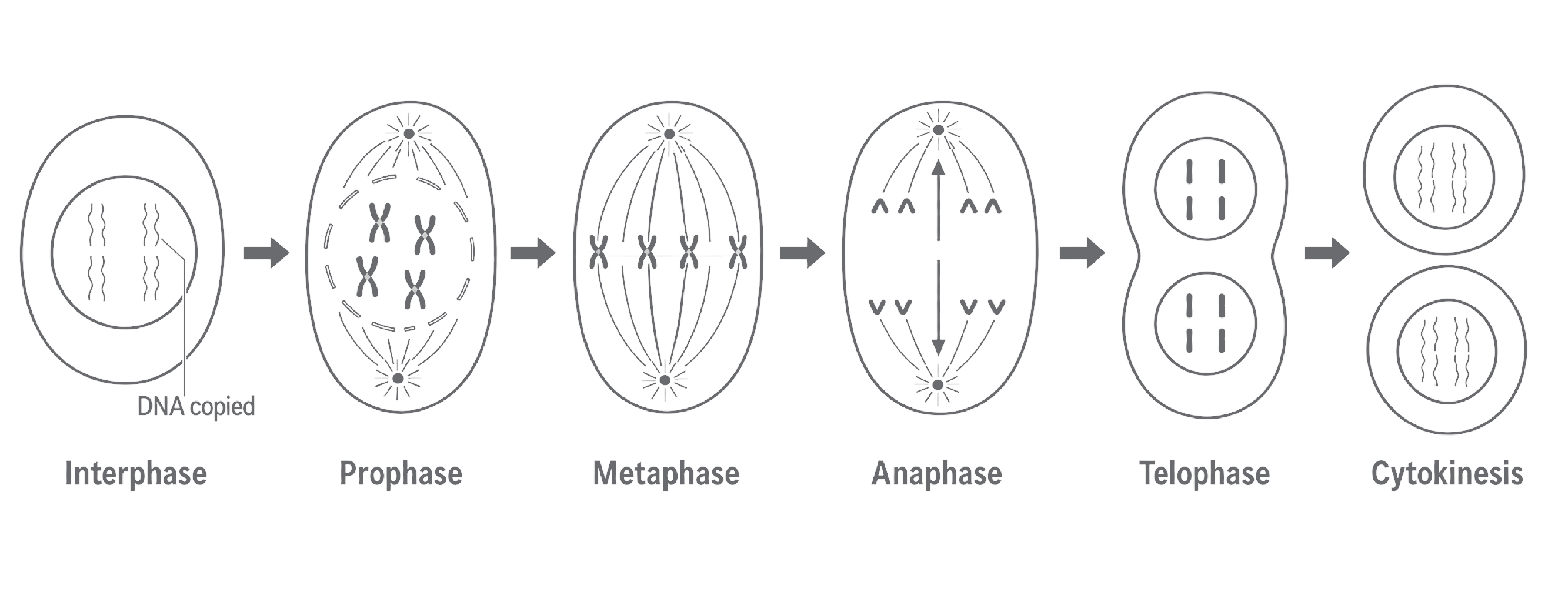
The identical halves of a copied chromosome are called sister chromatids; once they separate, each is a chromosome in its own right.
- Prophase: the copied chromosomes condense, becoming shorter, thicker and visible. The nuclear membrane breaks down and spindle fibres form.
- Metaphase: the copied chromosomes line up across the equator, or middle, of the cell. This arrangement places the two identical halves of each copied chromosome where they can be separated to opposite sides.
- Anaphase: the identical chromosome halves separate. Spindle fibres pull one copy towards each opposite pole of the cell, producing an equal chromosome set at each end.
- Telophase: a nuclear membrane reforms around each chromosome set. The cell now contains two nuclei with matching sets of chromosomes.
Finally, cytokinesis divides the cytoplasm and separates the parent cell into two daughter cells. Cytokinesis completes cell division; it is not another stage in which chromosomes are copied.
2.2–2.3 — Matching Chromosome Sets
The result of mitosis depends on three linked events. First, interphase makes a copy of every chromosome. Next, anaphase separates the copies into equal groups. Then telophase encloses each group in a nucleus before cytokinesis separates the cell. Because each new nucleus receives one complete matching set, the two daughter cells have chromosome sets identical to the parent cell and to each other.
Diploid
A diploid cell has two complete sets of chromosomes. When a diploid parent body cell divides by mitosis, its daughter cells are also diploid.
For example, a human body cell has 46 chromosomes. DNA replication produces two joined copies of each chromosome; after the copies separate and the cell divides, each daughter cell has 46 chromosomes, not 23. The simple stage diagram uses four chromosomes to make the sequence readable, rather than showing a human chromosome count.
One diploid body cell therefore produces two genetically identical diploid body cells. Genetically identical means that the daughter cells carry the same genetic information; diploid describes the two complete chromosome sets in each daughter nucleus. The daughter cells are not half-cells and do not receive half the parent's chromosome set.
This reliable outcome makes mitosis important in three contexts:
| Context | Why mitosis is useful |
|---|---|
| Growth | Repeated divisions increase the number of cells in an organism. |
| Repair | New cells replace damaged or lost body cells, helping restore tissue. |
| Asexual reproduction | In some organisms, mitotic divisions produce cells that develop into offspring genetically identical to the single parent. |
Mitosis is a cell-division process, not a synonym for reproduction. It contributes to asexual reproduction in some organisms, while most mitotic divisions in a multicellular body are used for growth, replacement or repair.
2.4 — When Division Loses Control
Normal growth and repair require cell division to be controlled: cells divide when new cells are needed and stop when they are not. A change in a cell can disrupt this control. The changed cell then divides when it should not, and its daughter cells can continue the same repeated divisions. This uncontrolled cell division is the basis of cancer.
Fast division alone does not define cancer. Cells may divide rapidly during normal growth or repair while the process remains controlled. The key change in cancer is that division is no longer kept under the body's normal control.