1.1 - Cell structures and functions
Compare animal, plant and bacterial cells, and explain how each required sub-cellular structure helps the cell function. Use structure and function together to interpret unfamiliar cells.
1.1 — Two ways to organise a cell
A cell is the smallest living unit of an organism. Inside it are sub-cellular structures: components smaller than the whole cell that perform particular functions. The arrangement of these structures separates the cells in this lesson into two broad types.
Eukaryotic and prokaryotic cells
A eukaryotic cell has its main genetic material enclosed inside a nucleus. A prokaryotic cell does not have a nucleus, so its main chromosomal DNA is not enclosed by a nuclear membrane.
Animal and plant cells are eukaryotic in origin. A typical cell has a nucleus, although some specialised cells, such as mature mammalian red blood cells, lose it. The nucleus keeps the main DNA together, while other structures carry out functions elsewhere in the cell. Bacteria are prokaryotic: their chromosomal DNA lies within the cell but not inside a nucleus.
These cell types are different, but they are not completely unrelated. Animal cells, plant cells and bacteria all have a cell membrane, which controls movement of substances into and out of the cell, and ribosomes, which make proteins. This shared machinery is needed whether the cell is part of a large organism or is itself a complete bacterium.
1.1 — Animal and plant cell functions
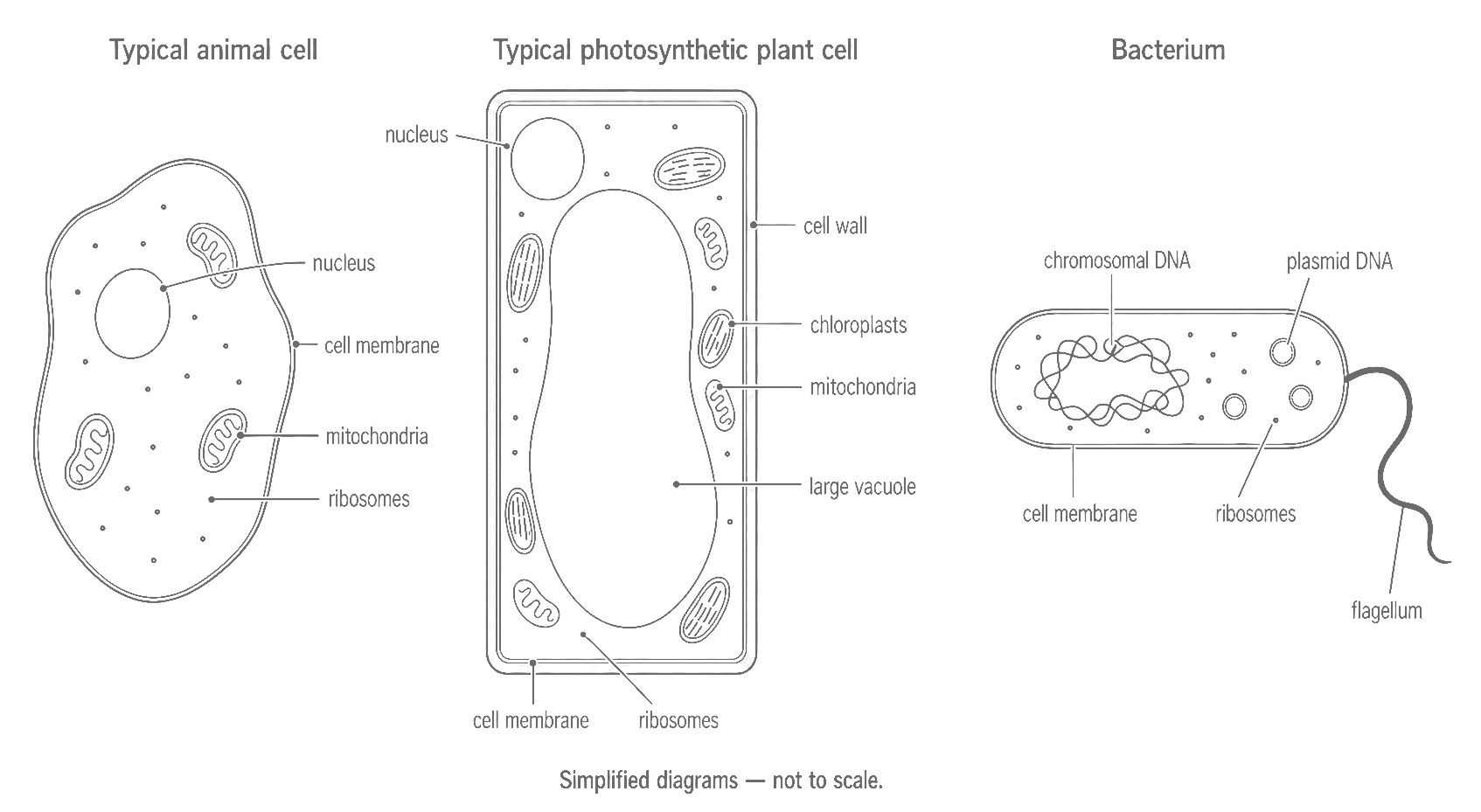
A typical animal cell has four structures required here. A typical photosynthetic plant cell has all four as well, so their functions are shared.
| Structure | How its structure is related to its function |
|---|---|
| Nucleus | It contains the cell's main DNA. These genetic instructions control cell activities by directing which proteins are made. |
| Cell membrane | Its selectively permeable boundary controls which substances enter and leave, allowing the cell to maintain suitable internal conditions. |
| Mitochondria | Their folded inner membranes provide a large surface for reactions of aerobic respiration, which releases energy for the cell's processes. Energy is released, not created or stored, by mitochondria. |
| Ribosomes | They are the sites of protein synthesis. The proteins made include enzymes and structural proteins needed by the cell. |
Plant cells also have structures that support photosynthesis and help the cell remain firm.
| Plant-cell structure | Feature -> consequence -> outcome |
|---|---|
| Cell wall | A rigid cellulose layer outside the cell membrane strengthens and supports the cell, helping it keep its shape. |
| Chloroplasts | They contain chlorophyll, which absorbs light energy. This allows photosynthesis to make sugars. |
| Large vacuole | It contains cell sap. When full, it presses outwards against the cell wall, helping support the cell and keep it firm. |
A structure-function explanation does more than match a label to a job: it states what the feature permits and the biological result that follows.
1.1 — Bacterial cell functions
A bacterium is a whole organism made from one prokaryotic cell. Its organisation is simpler than that of an animal or plant cell, but each named structure still has a specific function.
| Bacterial structure | Function |
|---|---|
| Chromosomal DNA | This main loop of DNA carries most of the genetic instructions that control the cell's activities. It is not inside a nucleus. |
| Plasmid DNA | These small, separate loops of DNA carry additional genes. |
| Cell membrane | It controls movement of substances into and out of the bacterium. |
| Ribosomes | They make the proteins needed by the bacterium. |
| Flagellum | This long, thread-like structure propels the bacterium, allowing it to move. The plural is flagella. |
Typical bacteria have chromosomal DNA, a cell membrane and ribosomes. Many also contain plasmids, and some have one or more flagella, so a diagram is a model rather than a promise that every bacterium looks identical.
[DIAGRAM: asset_name: 1.1-1.2 - Cells and specialised cells - diagram 01; asset_slug: edexcel-1bi0-1-1-1-2-cell-types-comparison; recommended_method: image_gen; description: A side-by-side simple textbook schematic of a typical animal cell, a typical photosynthetic plant cell and a bacterium. Label only the specification structures. For the animal cell label the nucleus, cell membrane, mitochondria and ribosomes. For the plant cell label the nucleus, cell membrane, cell wall, chloroplasts, mitochondria, large vacuole and ribosomes. For the bacterium label chromosomal DNA, plasmid DNA, cell membrane, ribosomes and one flagellum. Show the plant cell wall outside its cell membrane and show bacterial chromosomal DNA not enclosed in a nucleus, with separate small plasmid loops. Include a clear not-to-scale note. Exclude cytoplasm labels, bacterial cell-wall labels, copied micrograph appearance, extra organelles and any claim that every cell has the exact illustrated shape.]