1.14B - Food calorimetry
Measure energy transferred from burning food to water, calculate an estimate per gram of food burned and explain why simple calorimetry usually underestimates food energy.
1.14B — Following energy through a calorimeter
Food contains stored chemical energy. When a dry food sample burns, combustion releases some of this energy. In a simple school calorimeter, energy transfers from the flame through the container to a known mass of water, increasing the water's temperature. Measuring that temperature rise gives an estimate of the energy transferred to the water.
[DIAGRAM: asset_name: 1.13B-1.14B - Food tests and calorimetry - diagram 01; asset_slug: edexcel-gcse-biology-food-calorimetry-apparatus-1-13b-1-14b; recommended_method: image_gen; description: Simple monochrome textbook apparatus schematic on a white background showing a boiling tube or small metal calorimeter clamped above a heatproof mat, a measured mass of water inside, a thermometer dipping into the water without touching the bottom, and a burning food sample on a mounted needle directly below at a labelled fixed gap. Include clear labels for clamp stand, calorimeter, water, thermometer, burning food, mounted needle and heatproof mat, plus one upward arrow labelled energy transferred to water. Show an optional plain draught shield as a separate improvement callout. Do not show food-test reagents, numerical data, a Bunsen flame under the ethanol test, photorealism, colour coding or off-scope combustion chemistry.]
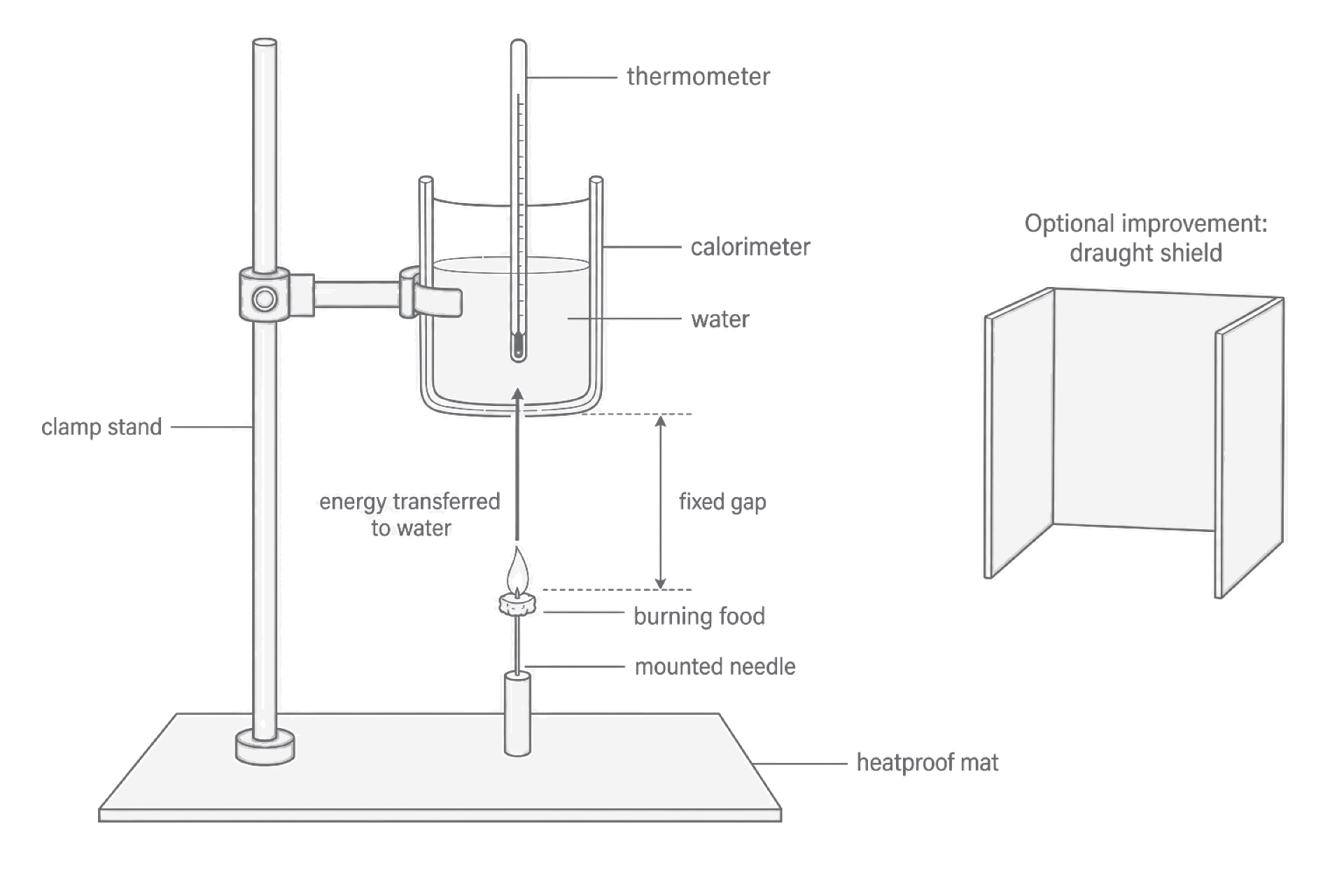
A workable method follows the energy route and measures every quantity needed later:
- Measure the mass of the food before burning. If residue will remain, plan to reweigh it so the mass actually burned can be found.
- Measure a known volume of water into the calorimeter. For this practical, of water is treated as having a mass of
1 g. - Record the initial water temperature. Clamp the calorimeter securely and keep the food a fixed distance below it.
- Ignite the food and immediately place it beneath the calorimeter. Keep the flame under the container and gently stir the water so its temperature is more even.
- When burning finishes, record the highest water temperature. Reweigh any food left and subtract this from the starting mass.
- Calculate the temperature rise, the energy transferred to the water and then the energy transferred per gram of food burned.
- Repeat with fresh samples, calculate energy per gram for each repeat, identify any anomalous result and calculate a mean from the consistent repeats.
If food type is changed, food type is the independent variable. The dependent variable is the calculated energy transferred to the water per gram of food burned, not temperature rise alone. Keep the water mass, starting water temperature, calorimeter, food-to-calorimeter gap and stirring method constant. These controls make the comparison valid because each food is tested under the same heat-transfer conditions.
Use eye protection, a stable clamp and a heatproof mat; keep hands away from the mounted needle, flame and hot apparatus. Check allergy risks and avoid using known allergens. The food is a laboratory sample and must not be eaten.
1.14B — Calculating and evaluating food energy
Water needs 4.2 J to raise the temperature of 1 g by 1 degree C. The more water there is, or the larger its temperature rise, the more energy it has received.
Energy transferred in food calorimetry
Use water mass in grams and temperature rise in degrees C to obtain in joules. Divide by the mass of food actually burned in grams to obtain J/g. To convert joules to kilojoules, divide by 1000.
Worked example
A food sample heats of water from 21.0 degrees C to 46.0 degrees C. The food has a mass of 1.80 g before burning and 0.60 g remains. Calculate the estimated energy transferred to the water per gram of food burned, in kJ/g to 3 significant figures.
The requested quantity is energy per gram. The given water volume is , so the water mass is 25.0 g.
First find both changes:
Now calculate the energy transferred to the water:
Divide by the mass burned, then convert to kilojoules:
To 3 significant figures, the estimated energy transferred is 2.19 kJ/g. The value is positive, as expected because the water warmed. It is an estimate of energy captured by the water, not an exact measurement of all the chemical energy in the food.
Simple food calorimetry usually underestimates energy content:
- Some released energy heats the air, clamp, calorimeter and thermometer instead of the water. The measured temperature rise is therefore too small. A close-fitting lid, insulation and a draught shield reduce these losses.
- Incomplete combustion can leave carbon-rich products containing chemical energy, so less energy is released per gram consumed. Simply leaving part of the food unburnt is a separate issue: subtracting its remaining mass corrects the mass denominator, but does not recover energy lost through incomplete combustion. Use a dry sample that burns steadily, relight it when safe, and measure the remaining mass.
- Different food-to-calorimeter gaps change how much energy reaches the water. Fix the gap with the same clamped apparatus for every trial.
- Repeats and a mean reduce the effect of random variation, but they do not remove systematic heat loss. Using a lidded, insulated metal calorimeter improves energy transfer and makes the estimate closer to the food's energy content.