1.7 - 1.9 - Enzyme action and conditions
Explain how an enzyme’s active site makes its action specific, then use that mechanism to interpret changes in activity with temperature, pH and substrate concentration.
1.7 — How enzymes act
At the molecular scale, living organisms carry out many chemical reactions. An enzyme makes one of these reactions happen faster without being used up by the reaction, so it is a biological catalyst. The molecule an enzyme acts on is its substrate, and the molecule or molecules made are the products.
Active site
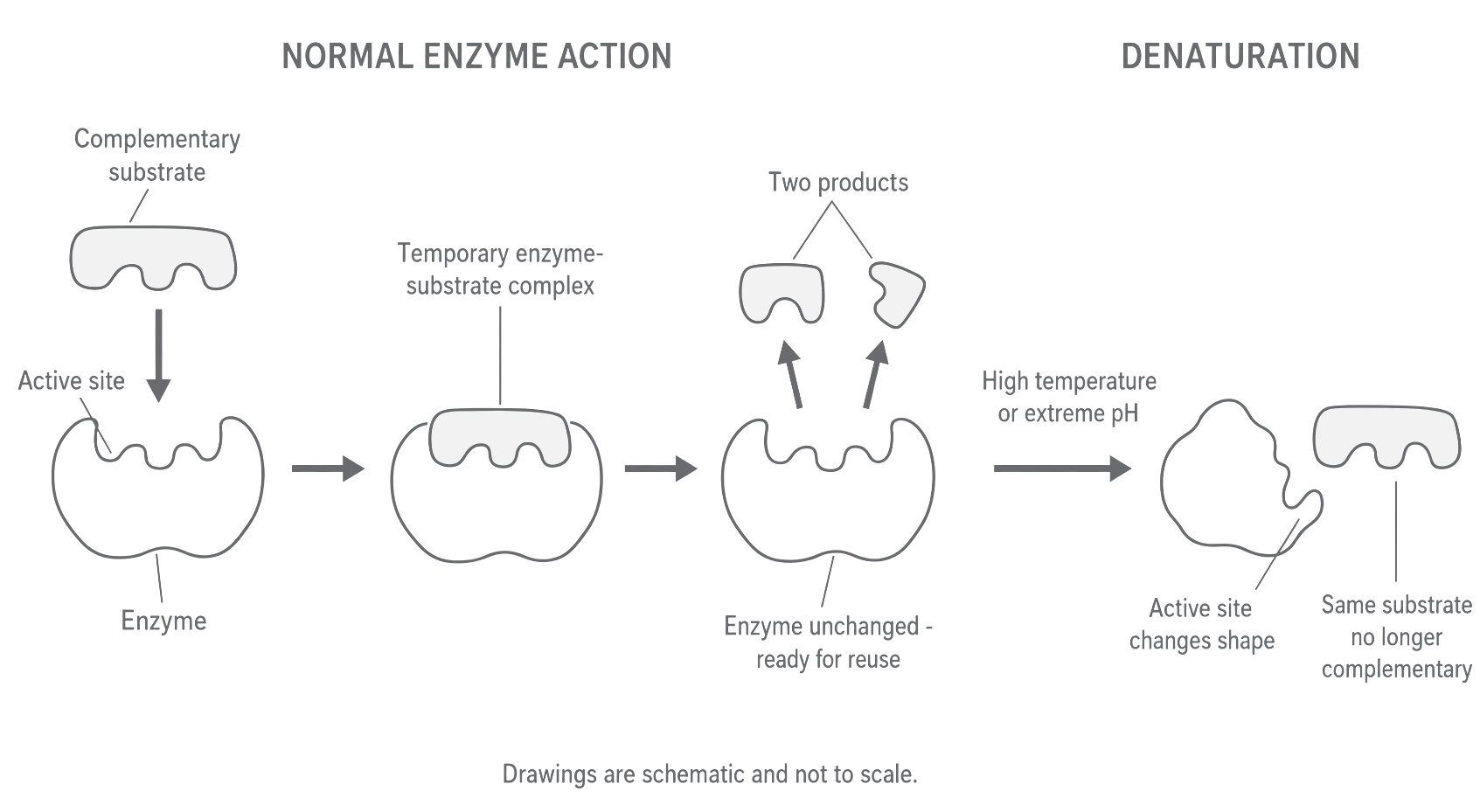
The active site is the region of an enzyme where its substrate binds and the reaction is catalysed.
The shape of the active site is a structural feature with a direct consequence: only a substrate with a complementary shape can bind effectively. Complementary means that the shapes fit together; it does not mean that the enzyme and substrate have identical shapes. This selective fit gives an enzyme its specificity.
Enzyme action follows a short sequence.
- Substrate molecules move and collide with the enzyme.
- A substrate with a complementary shape binds temporarily at the active site, forming an enzyme-substrate complex.
- While the substrate is bound, the enzyme catalyses the reaction. Bonds may be broken to make smaller products, or substrates may be joined to make a larger product.
- The products leave the active site. The enzyme is not consumed, so it can bind another suitable substrate.
Specificity concerns a complementary substrate: a different molecule is not automatically unsuitable if it also fits that enzyme's active site. In the comparisons here, the alternative substrate is explicitly non-complementary. The active site belongs to the enzyme, not the substrate. A non-complementary molecule may collide with the enzyme, but it does not bind effectively, so that enzyme does not catalyse its conversion into product.
1.8–1.9 — Conditions and denaturation
Enzyme activity can be measured as a reaction rate: how much substrate is used, or how much product is formed, in a given time. A faster rate means that more successful enzyme-substrate interactions lead to product each second.
An enzyme's activity depends on its conditions. On a graph, reaction rate or enzyme activity belongs on the y-axis; the condition being changed belongs on the x-axis. Describe the graph's pattern first, then explain it using collisions, active sites and denaturation.
| Factor changed | Pattern in rate | Mechanism |
|---|---|---|
| Temperature | Rate rises to an optimum temperature, then usually falls steeply. | At first, higher temperature gives particles more kinetic energy, so enzyme and substrate collide more frequently and more enzyme-substrate complexes form. Above the optimum, high temperature can denature the enzyme, so fewer suitable complexes form. |
| Substrate concentration | Rate rises, then levels off at a plateau if enzyme concentration is fixed. | More substrate particles per unit volume cause more frequent collisions with active sites. At high substrate concentration, the active sites are occupied most of the time; enzyme availability is now limiting, so extra substrate has little or no effect on rate. |
| pH | Rate is highest at the enzyme's optimum pH and lower on either side. The peak need not be symmetrical. | Away from the optimum, the active site functions less effectively, so fewer substrates bind successfully. An extreme pH can change the active-site shape and denature the enzyme. |
The optimum is the condition at which the measured activity is highest. It is not always 37 degrees C, and different enzymes can have different optimum temperatures and pH values.
Denaturation
Denaturation is a change in an enzyme's structure that changes the shape of its active site, so the substrate is no longer complementary and activity decreases or stops.
Low temperature normally slows an enzyme because particles move more slowly and collide less frequently. It does not usually denature the enzyme: warming it again can restore the faster rate. High temperature or an extreme pH can alter the active-site shape, so this is a structure-function failure rather than the enzyme being killed.
[DIAGRAM: asset_name: 1.7-1.12 - Enzymes and reaction rates - diagram 01; asset_slug: edexcel-gcse-biology-1-7-1-12-active-site-action-denaturation; recommended_method: image_gen; description: Simple monochrome textbook schematic with a normal enzyme sequence and a denatured comparison. Show and label enzyme, active site, one complementary substrate, temporary enzyme-substrate complex, two products leaving, and the unchanged enzyme ready for reuse; beside it show a high-temperature or extreme-pH condition changing the active-site shape so the same substrate is no longer complementary. Arrows must show substrate entering and products leaving. State that drawings are schematic and not to scale. Do not add induced-fit detail, activation-energy profiles, inhibitors, cofactors, atomic structures or decorative lock-and-key objects.]