2.10B - Brain structure and function
Locate the cerebral hemispheres, cerebellum and medulla oblongata, and relate each to its functions. Explain how different regions can contribute to the same activity. This Biology-only lesson applies to both tiers.
2.10B — A map of the brain
The brain is an organ in the central nervous system. It is protected by the skull, but it is not one uniform control centre: different regions make distinct contributions and communicate with one another.
This lesson is Biology-only and applies to both Foundation and Higher tier.
[DIAGRAM: asset_name: 2.10B-2.12B - Brain structure and medical imaging - diagram 01; asset_slug: edexcel-gcse-biology-2-10b-brain-regions-functions; recommended_method: image_gen; description: Simple monochrome textbook-style side view of a human brain showing the spatial relationship among only the cerebral hemispheres, cerebellum and medulla oblongata; use unambiguous leader lines to label the large folded upper cerebral hemispheres, the smaller folded rear-lower cerebellum and the medulla oblongata at the base of the brainstem where it continues towards the spinal cord; include three compact function callouts: conscious thought, memory and voluntary action for the cerebral hemispheres; coordination of movement and balance for the cerebellum; automatic control of breathing rate and heart rate for the medulla oblongata; white background, #6A6B6E linework and minimal neutral fills; exclude cerebral lobe names, other brain regions, colour coding, photorealism and any appearance of a clinical scan]
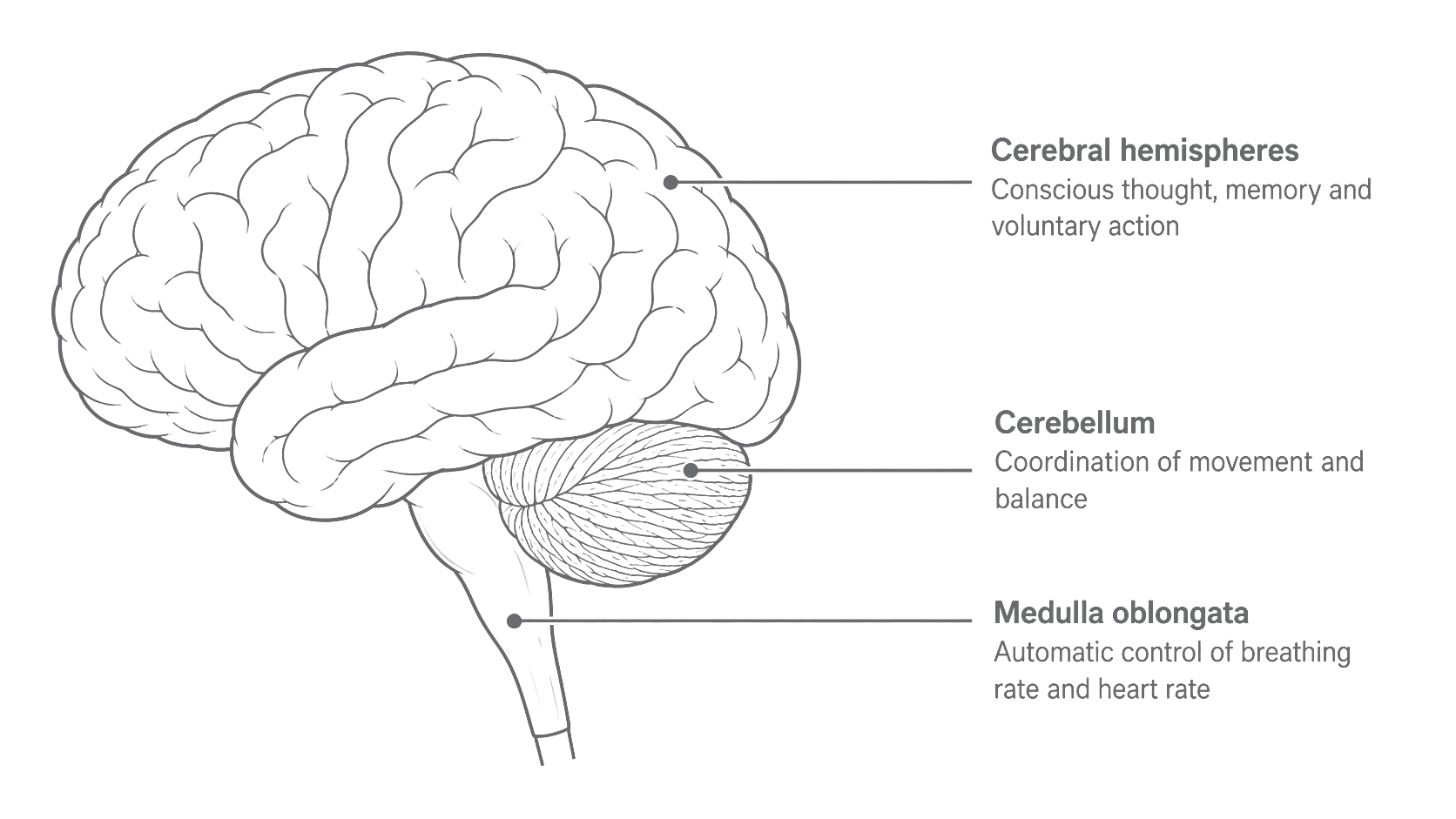
| Structure | Structural location | Main functions |
|---|---|---|
| Cerebral hemispheres | Two large, folded halves that form most of the upper brain | Conscious thought and intelligence; memory and language; processing sensory information; initiating voluntary actions |
| Cerebellum | A smaller, highly folded region at the rear, beneath the cerebral hemispheres | Coordinates muscle activity so voluntary movement is smooth and precise; helps maintain balance and posture |
| Medulla oblongata | The lowest part of the brainstem, between the rest of the brain and the spinal cord | Automatically regulates vital, involuntary functions including breathing rate and heart rate |
These roles can operate at the same time. When a person reaches for a glass, the cerebral hemispheres initiate the voluntary action. The cerebellum coordinates the timing and strength of muscle contractions so the reach is controlled, while the medulla oblongata continues to regulate breathing and heart rate without a conscious decision.
A loss of coordination is therefore different from losing the ability to decide to move. A damaged cerebellum may make a chosen movement unsteady even when the cerebral hemispheres can still initiate it. Losing one function does not mean that every region has stopped working.