3.3.1 - Work and conservation of energy
Work, energy and power are everyday words, but in physics they have precise meanings. In this lesson you will learn what it means for a force to do work, why the angle of the force matters, and how work links directly to energy transfer. You will also practise the energy-accounting language needed for conservation of energy questions.
Work as energy transfer
A force does work on an object when the force transfers energy while the object is displaced. The displacement must matter: a large force with no displacement does no work in this mechanical sense.
Work done by a force
Work done by a force is the energy transferred by that force when its point of application moves through a displacement with a component in the direction of the force.
The unit of work done is the joule, symbol J. One joule is one newton metre:
Joule
This is why work done and energy can be measured in the same unit. If a motor does 500 J of work lifting a load, 500 J of energy has been transferred to the load and the surrounding system. If a brake does work on a moving wheel, energy is transferred away from the wheel's kinetic store and into internal energy stores of the brake and surroundings.
Do not treat "work" as a new substance that objects contain. It is a transfer process: energy is moved from one store to another by a force acting through a displacement.
The angle in the work equation
For a constant force, the work done depends on the component of the force parallel to the displacement. OCR writes the relationship as:
Work done by a constant force
Here W is the work done in joules, F is the force in newtons, x is the displacement in metres, and theta is the angle between the force and the displacement.
[DIAGRAM: asset_name: Lesson 3.03.1: Work and Conservation of Energy - diagram 01; asset_slug: 3_03_1_work_and_conservation_of_energy__diagram_01; recommended_method: drawn_physics; description: 16:9 vector diagram on a pure white background showing an object displaced horizontally through x, an applied force F at angle theta above the displacement, the resolved parallel component F cos theta, the perpendicular component labelled as doing no work for this horizontal displacement, and the formula W = F x cos theta.]
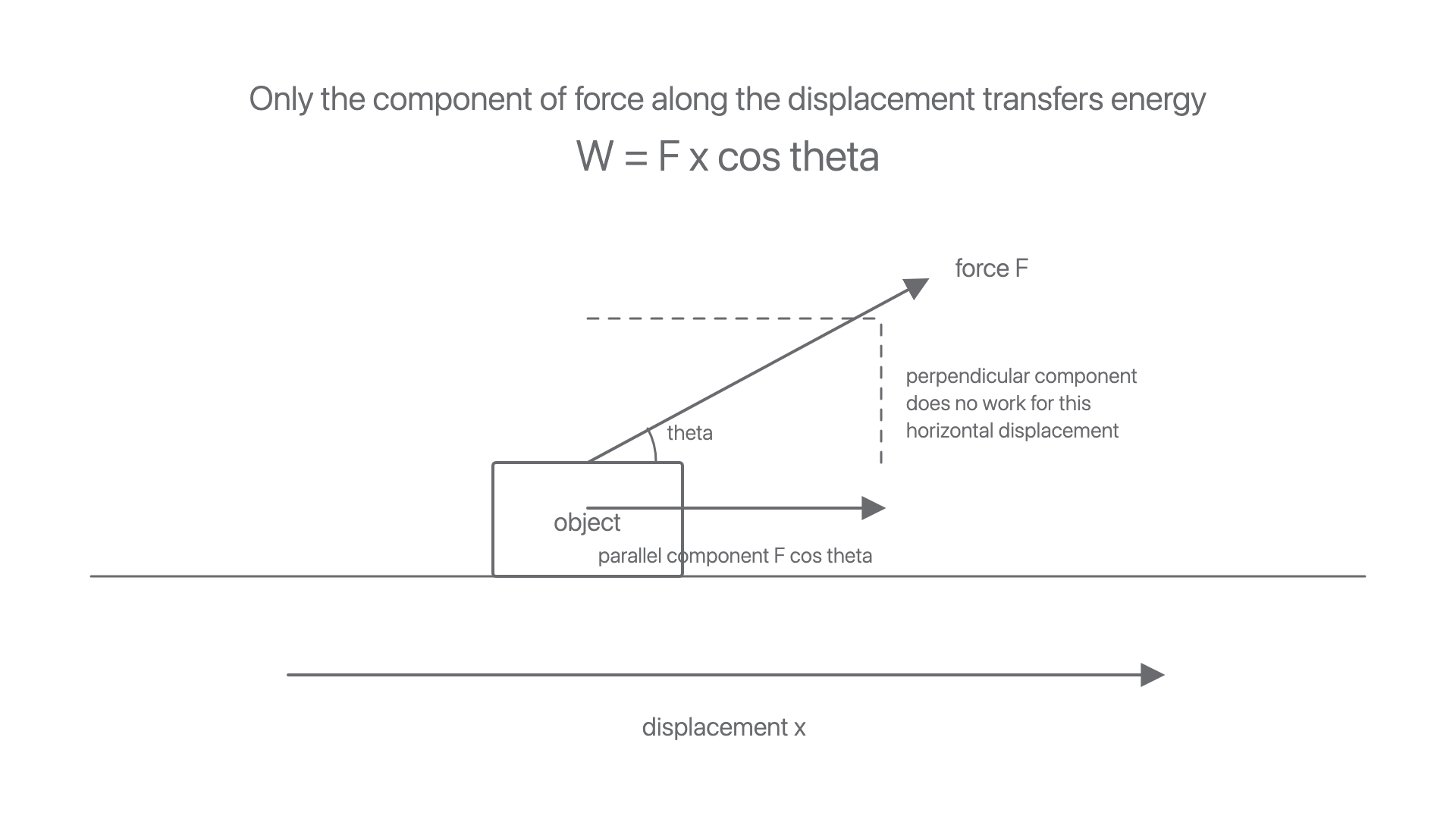
If the force is in the same direction as the displacement, theta = 0 degrees, so cos theta = 1 and W = Fx. If the force is perpendicular to the displacement, theta = 90 degrees, so cos theta = 0 and that force does no work for that displacement. If the force is opposite to the displacement, the work done by that force is negative; it transfers energy away from the object.
This sign is an accounting choice, not a new kind of energy. A resistive force on a moving object often does negative work on the object, while the same interaction transfers energy to internal energy stores of the surroundings.
Worked example: a student pulls a trolley for 4.0 m with a force of 65 N at 25 degrees above the horizontal. The trolley moves horizontally.
The angle between the force and displacement is 25 degrees, so:
The vertical component of the pulling force does not do work for the horizontal displacement. The horizontal component transfers about 240 J of energy.
Conservation as accounting
The principle of conservation of energy says that energy cannot be created or destroyed. In a closed system, the total energy remains constant, although energy can be stored in different ways and transferred between stores.
Principle of conservation of energy
Energy cannot be created or destroyed; it can only be transferred between stores or transformed from one form to another. The total energy of a closed system stays constant.
Common energy stores and forms in this part of the course include kinetic, gravitational potential, elastic potential, internal or thermal, chemical, electrical, sound and radiation. This lesson is not about calculating each store with separate formulae; it is about tracking transfers correctly.
For example, when a cyclist brakes, the kinetic energy store of the cyclist and bicycle decreases. Work is done by frictional braking forces, and energy is transferred to internal energy stores of the brake pads, wheel rims, tyres, road and surrounding air. The total energy has not vanished, but it has become less useful for keeping the bicycle moving.
The phrase "energy is used up" is therefore imprecise. A better physics statement is: energy is transferred to less useful stores, often internal energy stores, and becomes more spread out.
Work-energy calculations
The OCR wording "transfer of energy is equal to work done" is a powerful shortcut. Once you have calculated work done by a force, you have calculated the energy transferred by that force.
For a constant force parallel to the displacement:
For a constant force at an angle:
Worked example: a car is brought to rest by a constant braking force of 1.8 kN acting over 12 m. The braking force is opposite to the displacement.
First convert the force:
Taking the car's displacement direction as positive, the braking force has theta = 180 degrees:
The braking force does -2.2 x 10^4 J of work on the car. In energy-transfer language, about 2.2 x 10^4 J is transferred from the car's kinetic energy store to internal energy stores of the brakes, tyres, road and air.
When a question asks for the energy dissipated by friction or braking, it often wants the positive magnitude of this transfer. When it asks for work done by the force on the object, the sign can matter.
Force-displacement graphs
For a constant force parallel to the displacement, W = Fx is the area of a rectangle on a force-displacement graph. For a changing force, the same idea becomes the area under the force-displacement graph.
[DIAGRAM: asset_name: Lesson 3.03.1: Work and Conservation of Energy - diagram 02; asset_slug: 3_03_1_work_and_conservation_of_energy__diagram_02; recommended_method: drawn_physics; description: 16:9 deterministic graph on a pure white background with vertical axis force F / N and horizontal axis displacement x / m, a rising curved force-displacement line, shaded area under the curve labelled as work done and energy transferred, and unit note N m = J.]
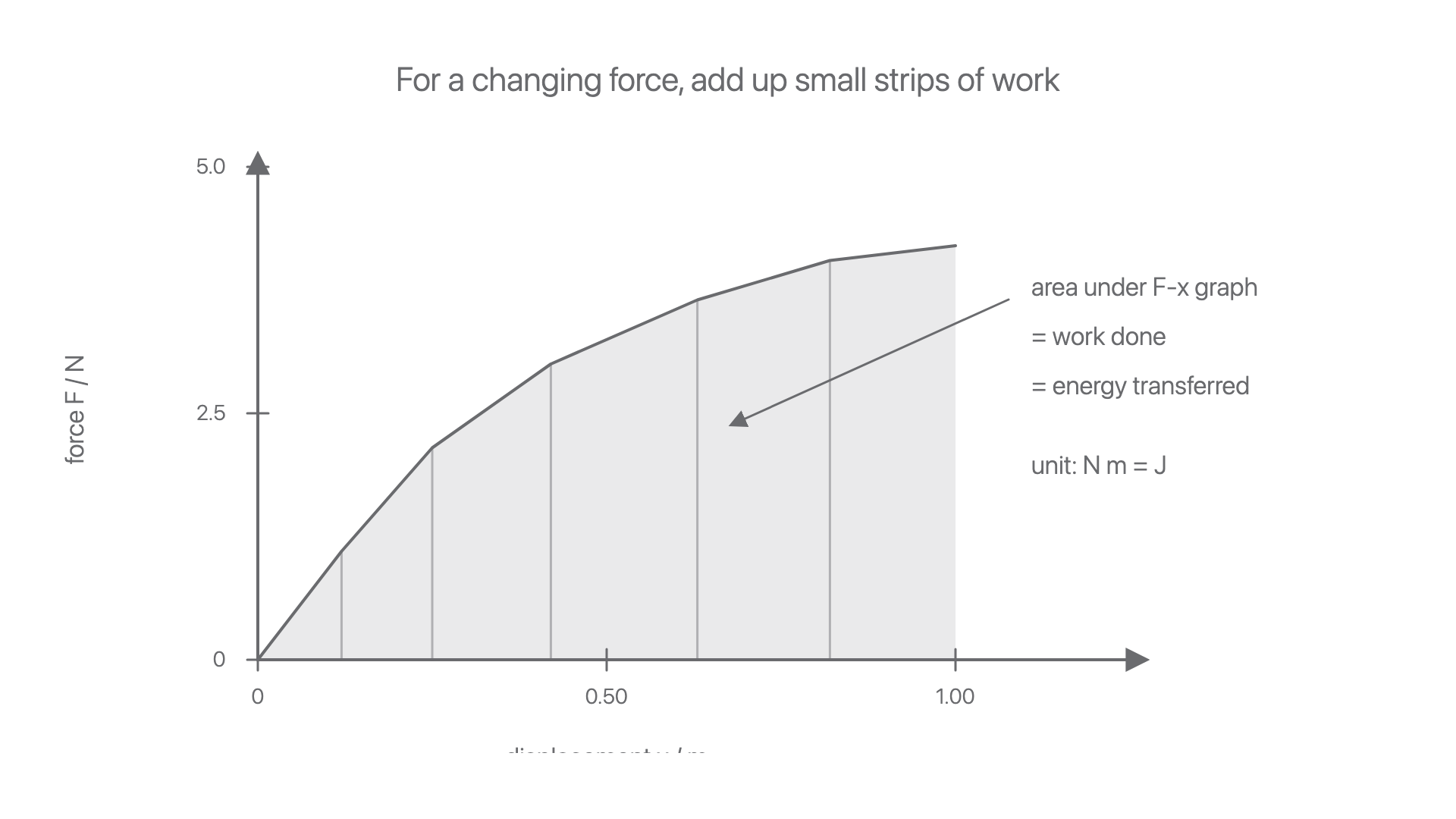
This graph idea matters because real forces are not always constant. Stretching an elastic cord, compressing a spring or crushing a protective mat can involve a force that changes as displacement changes. The work done is found by adding many small strips:
On a graph, that sum is represented by the area under the curve. Its unit is:
Worked example: a force increases linearly from 0.0 N to 6.0 N over the first 0.30 m of displacement, then remains at 6.0 N for the next 0.20 m. Determine the total work done.
The first part is a triangle:
The second part is a rectangle:
So:
In experimental or data questions, be careful with graph language. Use axes with units, read coordinates accurately, use a sensible curve or line of best fit where appropriate, and report the graph area in joules. If a loading curve and unloading curve enclose an area, that area represents energy transferred to internal energy stores during the cycle.
Force-displacement graphs Summary
Whenever a force transfers energy through a displacement, the energy transferred is equal to the work done. Use W = Fx cos theta for a constant force and use graph area for force-displacement data.