2.3.1 - Scalars and vectors
Some quantities in physics are complete once you know their size. Other quantities are incomplete until you also state their direction. In this lesson you will distinguish scalars from vectors, add and subtract vectors using their directions, determine the resultant of two coplanar vectors, and resolve a vector into perpendicular components.
Scalar or vector
A physical quantity tells you something measurable about a system. For this lesson, the key question is whether direction is part of that quantity.
Scalar quantity
A scalar quantity has magnitude but no direction. Magnitude means the size of the quantity, including its numerical value and unit where a unit is needed.
Examples of scalar quantities include mass, time, temperature, energy, distance, speed, density and pressure. If a runner travels a total distance of 400 m, the statement is complete without saying north, south, left or right.
Vector quantity
A vector quantity has magnitude and direction. A complete vector answer states both.
Examples of vector quantities include displacement, velocity, acceleration, force, weight, momentum and electric field strength. If a force is 12 N, that is only the magnitude. A complete force might be 12 N vertically upwards or 12 N to the left.
The difference between distance and displacement is a useful first test. Distance is the total length of the route travelled, so it is a scalar. Displacement is the straight-line change in position from start to finish, with direction, so it is a vector.
Worked example: scalar or vector?
A cyclist rides 300 m east and then 300 m west, returning to the starting point.
- Total distance travelled =
600 m. This is a scalar. - Displacement =
0 m. This is a vector quantity, and here the magnitude is zero because the final position is the starting position.
Do not use the words "has a positive value" as the definition of a scalar. Some scalar changes can be written with a sign using a chosen convention, but a scalar still has no spatial direction.
Adding and subtracting vectors
Vector quantities add by direction as well as magnitude. If two forces of 5 N act in the same direction, the resultant is 10 N in that direction. If they act in opposite directions, the resultant is 0 N. The numbers alone are not enough.
Resultant vector
The resultant vector is the single vector that has the same effect as the vectors being combined.
For a diagram method, use head-to-tail addition:
- Draw the first vector to scale in its correct direction.
- From the head of the first vector, draw the second vector to scale in its correct direction.
- Draw the resultant from the tail of the first vector to the head of the second vector.
[DIAGRAM: asset_name: Lesson 2.03.1: Scalars, Vectors and Components - diagram 01; asset_slug: 2_03_1_scalars_vectors_and_components__diagram_01; recommended_method: drawn_physics; description: Clean 16:9 drawn vector geometry diagram on white background. Top panel: vector A drawn east, vector B drawn north-east from the head of A, resultant R drawn from the tail of A to the head of B, with "head-to-tail addition" label. Bottom panel: show vector B and negative vector -B in opposite directions, then show A - B as A + (-B). Use thin #6A6B6E arrows and labels only.]
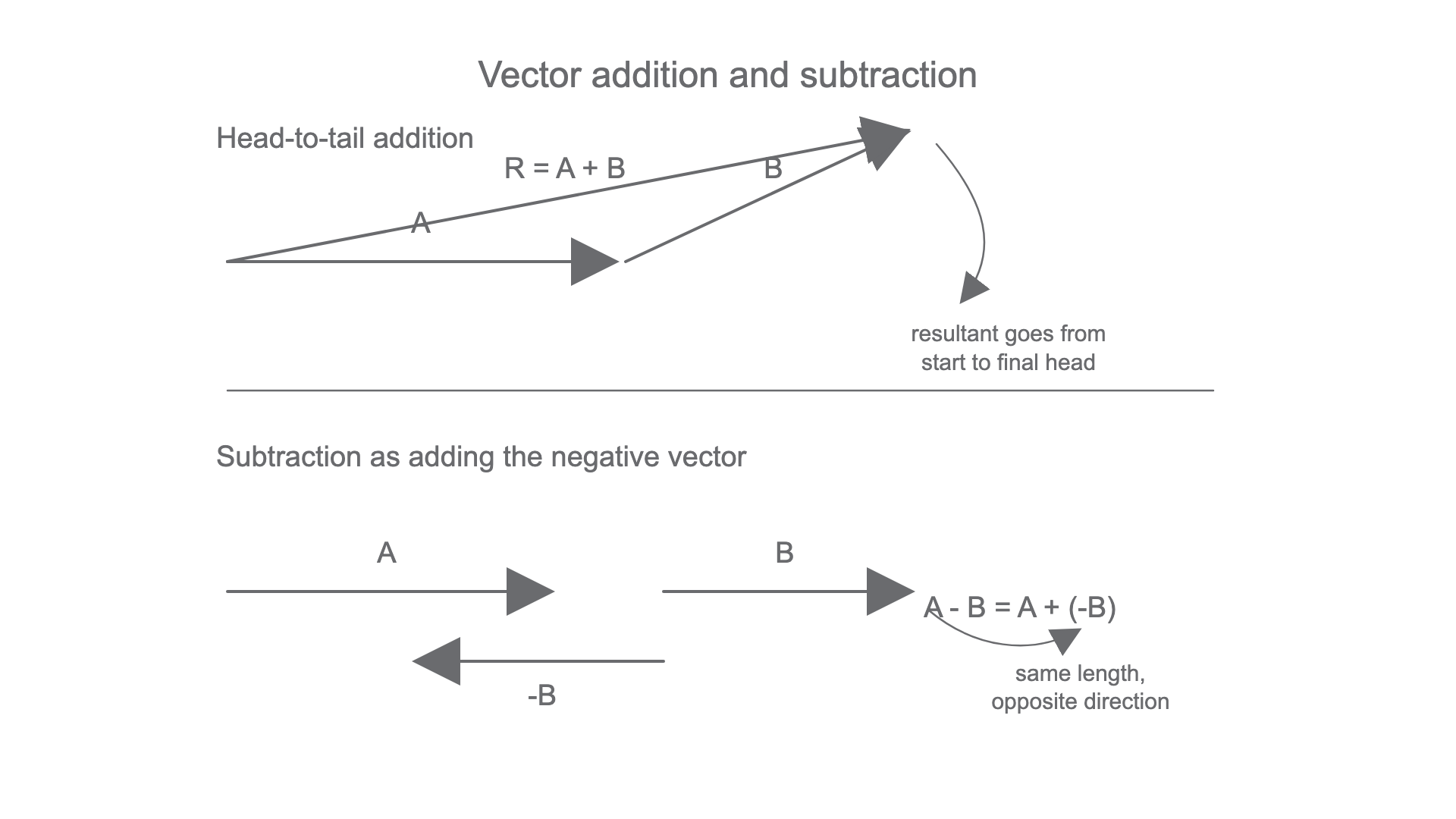
Vector subtraction means adding the negative of a vector:
The vector -\vec{B} has the same magnitude as \vec{B} but the opposite direction. This is why subtracting 4 N east is the same as adding 4 N west.
Worked example: collinear vectors
A force of 18 N acts to the right. A second force of 7 N acts to the left.
Choose right as positive. The resultant is:
The positive sign means the resultant is to the right, so the answer is 11 N to the right.
Resultant by vector triangle
Two coplanar vectors lie in the same plane. Their resultant can be found from a vector triangle by calculation or by scale drawing.
For a scale drawing, choose a sensible scale such as 1 cm represents 2 N, draw the two vectors head-to-tail with a ruler and protractor, then measure the resultant length and direction. The scale must be stated or clear. Small drawing errors can change the answer, so calculation is preferred when the numbers make calculation straightforward.
When the two vectors are perpendicular, the vector triangle is a right-angled triangle. Use Pythagoras for the magnitude and trigonometry for the direction.
Worked example: perpendicular displacement vectors
A student walks 40 m east and then 30 m north. Determine the magnitude and direction of the resultant displacement.
The two displacements are perpendicular, so:
Let theta be the angle north of east:
So the resultant displacement is 50 m at 37 degrees north of east to two significant figures.
For non-perpendicular vectors, the same head-to-tail idea still applies. You can use a scale drawing, or resolve the vectors into perpendicular components and calculate from the components. The next part teaches that component method.
Resolving into components
Resolving a vector means replacing it with perpendicular component vectors. The components have the same combined effect as the original vector.
Component of a vector
A component is the effect of a vector in one chosen direction, usually along a horizontal x-axis or a vertical y-axis.
[DIAGRAM: asset_name: Lesson 2.03.1: Scalars, Vectors and Components - diagram 02; asset_slug: 2_03_1_scalars_vectors_and_components__diagram_02; recommended_method: drawn_physics; description: Clean 16:9 drawn vector component diagram on white background. Show axes labelled x and y. Draw a vector F from the origin at angle theta above the positive x-axis. Draw dashed perpendicular construction lines to form a right triangle. Label horizontal component F_x = F cos theta, vertical component F_y = F sin theta, resultant vector F, and angle theta measured from the x-axis. Include a small caution label: "cos = adjacent to theta; sin = opposite to theta".]
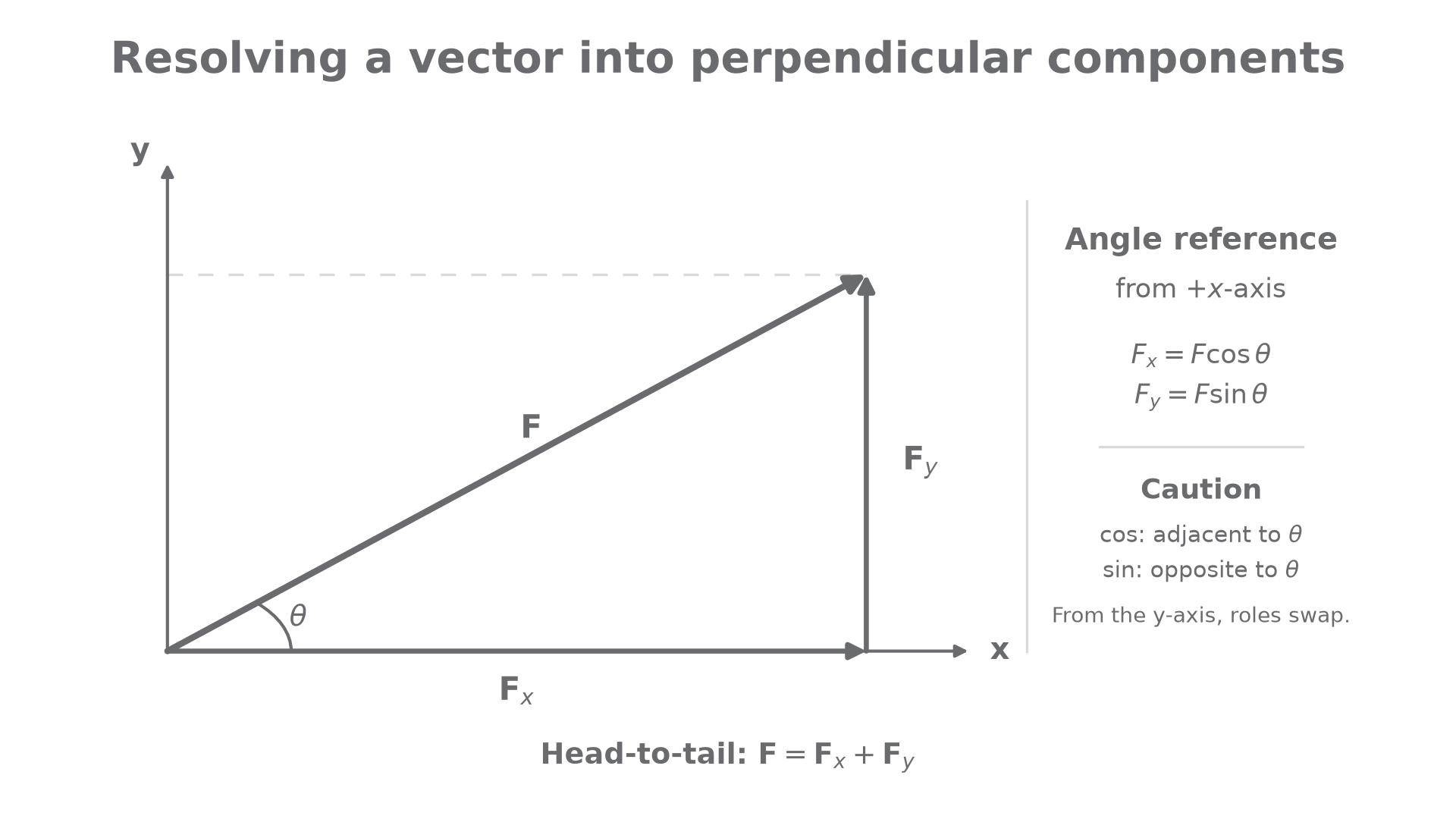
Components when theta is measured from the x-axis
Here F is the magnitude of the original vector, F_x is the component along the x-axis, F_y is the component along the y-axis, and theta is the angle between the vector and the x-axis. The component formulae are given in the data booklet, but you must still choose the correct angle.
The safest rule is not "cos is horizontal" and "sin is vertical". The safe rule is:
- cosine gives the side adjacent to the angle in the right-angled triangle
- sine gives the side opposite the angle in the right-angled triangle
If the angle is measured from the vertical instead of from the horizontal, the adjacent and opposite sides swap.
Worked example: resolving a force
A force of 20 N acts at 35 degrees above the horizontal. Calculate its horizontal and vertical components.
The angle is measured from the horizontal x-axis, so:
To a sensible number of significant figures, the components are 16 N horizontally and 11 N vertically upwards.
Worked example: adding by components
A force of 10 N east acts with a second force of 6.0 N at 60 degrees north of east. Determine the resultant.
Resolve the angled force:
Add like components:
Now calculate the resultant magnitude:
The direction north of east is:
The resultant is therefore 14 N at 22 degrees north of east.