3.2.1 - Dynamics and free-body diagrams
Dynamics links forces to motion. In this lesson you will learn how to model forces on an object, draw free-body diagrams, use F = ma and W = mg, and handle one- and two-dimensional motion when the resultant force is constant. The skill is not just substituting into equations: it is choosing the object, adding the forces correctly, and interpreting what the resultant force says about acceleration.
Net Force and the Newton
A force is a vector. That means it has both a magnitude and a direction. When several forces act on an object, the force that matters for its acceleration is the resultant force, also called the net force.
Resultant Force
The resultant force is the single force that has the same effect as all the forces acting on an object added vectorially.
If the resultant force on an object is zero, the object has zero acceleration. It may be at rest, or it may be moving with constant velocity. If the resultant force is not zero, the object accelerates in the direction of the resultant force.
Net Force
In this equation, F is the resultant force in newtons N, m is the mass in kilograms kg, and a is the acceleration in metres per second squared m s^-2. OCR expects you to recall this equation.
The unit newton follows directly from F = ma.
Newton
One newton is the force that gives a mass of 1 kg an acceleration of 1 m s^-2.
So:
1 N = 1 kg m s^-2
Worked example: acceleration from a resultant force
A trolley of mass 2.4 kg has a horizontal pull of 18 N to the right and a frictional force of 6.0 N to the left.
Choose right as positive.
Resultant force:
F = 18 - 6.0 = 12 N
Apply F = ma:
a = F / m = 12 / 2.4 = 5.0 m s^-2
The acceleration is 5.0 m s^-2 to the right.
Notice the wording: the pull is not automatically the resultant force. You first add the forces with directions, then use F = ma.
Weight and Common Forces
Mass and weight are not the same quantity. Mass is a measure of inertia and is measured in kilograms. Weight is a force caused by a gravitational field and is measured in newtons.
Weight
Here, W is weight in newtons N, m is mass in kilograms kg, and g is gravitational field strength in N kg^-1. Near Earth's surface, g is about 9.81 N kg^-1, which is equivalent to an acceleration of free fall of 9.81 m s^-2 in calculations. OCR expects you to recall W = mg.
Worked example: weight from mass
A student has mass 64 kg. Estimate the student's weight near Earth's surface.
W = mg = 64 x 9.81 = 627.84 N
To a sensible number of significant figures, the weight is about 630 N.
The named forces in this OCR section are:
- tension: a pulling force exerted by a string, rope, cable or wire along its length
- normal contact force: a contact force perpendicular to the surface touching the object
- upthrust: an upward force exerted by a fluid on an object in the fluid
- friction: a contact force parallel to a surface that opposes relative motion or the tendency to slide
These names describe forces acting on the chosen object. For example, if a box is pulled by a rope, the rope exerts tension on the box. If the box rests on a floor, the floor exerts a normal contact force on the box.
A common error is to assume the normal contact force is always equal to weight. It is only equal to weight when the vertical forces balance in that particular situation. If there are extra vertical forces, or if the object accelerates vertically, the normal contact force may be different from mg.
Free-Body Diagrams
A free-body diagram is a force model for one selected object. It strips away the surroundings and shows only the forces acting on that object.
[DIAGRAM: asset_name: Lesson 3.02.1: Dynamics and Free-Body Diagrams - diagram 01; asset_slug: 3_02_1_dynamics_and_free_body_diagrams__diagram_01; recommended_method: drawn_physics; description: Clean 16:9 drawn physics diagram on white background showing three free-body diagram examples: a block on a horizontal surface with normal contact force upward, weight downward, pull right and friction left; a hanging object with tension upward and weight downward; an object moving downward in a fluid with weight downward, upthrust upward and drag upward. Include note that arrows show forces on the selected object only, not velocity arrows.]
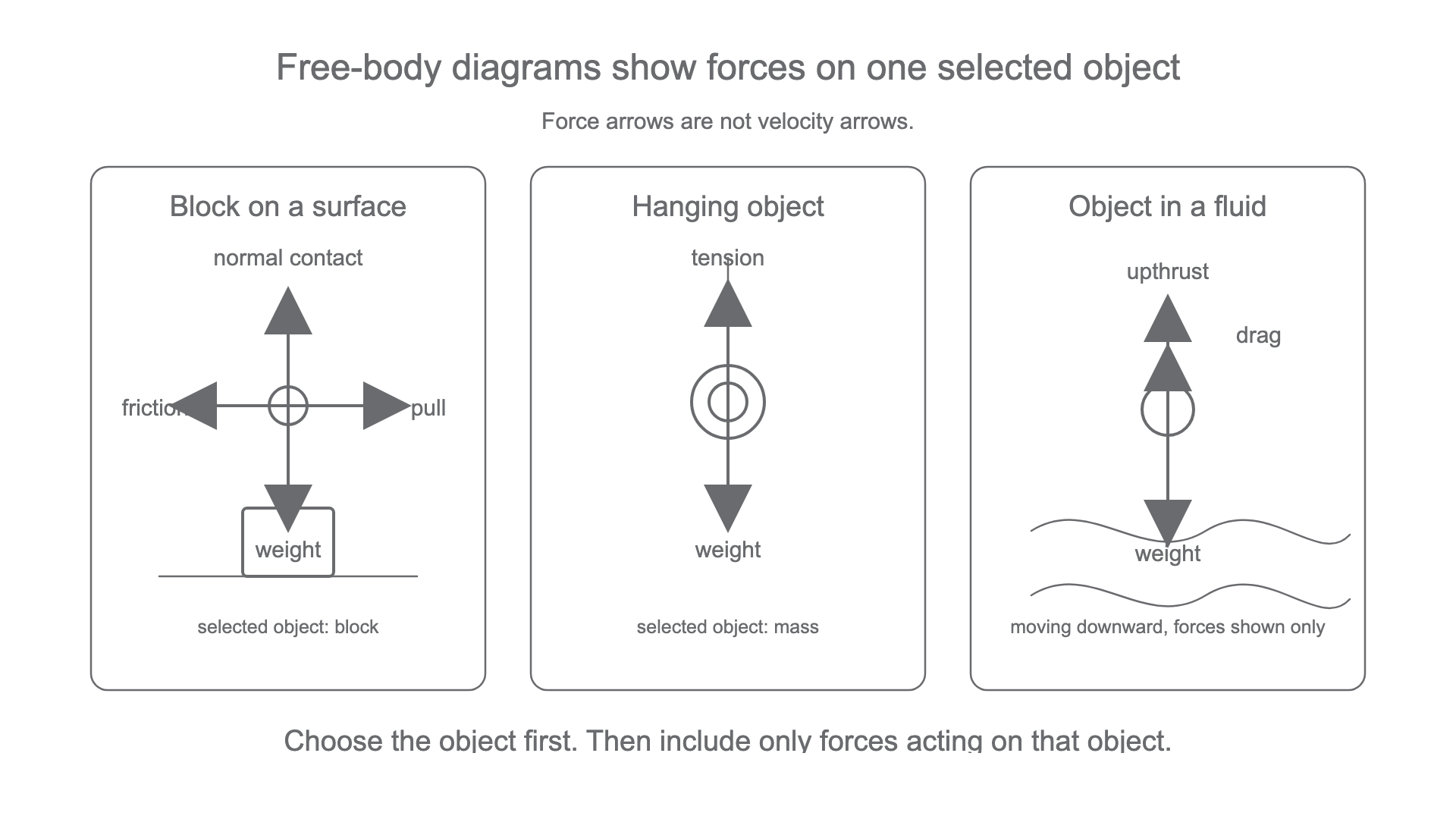
Use this routine whenever a force question feels crowded.
- Choose the object or system.
- Replace it with a dot or simple shape.
- Add only forces acting on that object or system.
- Label each force with a name, symbol and direction where possible.
- Choose axes or a positive direction.
- Add forces along each axis to find the resultant force.
Do not add forces that the object exerts on something else. For example, the weight of a book is the gravitational force of Earth on the book. The book also pulls on Earth gravitationally, but that force acts on Earth, so it does not belong on the book's free-body diagram.
Do not use a velocity arrow as if it were a force. A falling object can be moving downward while its resultant force is upward, in which case it is accelerating upward and slowing down. Velocity direction and acceleration direction are separate ideas.
Worked example: reading a free-body diagram in words
An object is moving downward through water. Its weight is 1.20 N downward. Upthrust is 0.80 N upward and drag is 0.60 N upward.
Take upward as positive.
F = 0.80 + 0.60 - 1.20 = +0.20 N
The resultant force is 0.20 N upward. Therefore the acceleration is upward. Since the object is moving downward but accelerating upward, it is slowing down.
The resultant force gives the direction of acceleration, not necessarily the direction of motion.
Constant Force in One Dimension
When the resultant force on a constant-mass object is constant, its acceleration is constant. In one dimension, choose a positive direction and keep signs consistent.
The calculation route is:
- choose the object or system
- choose a positive direction
- add forces in that direction, subtract forces in the opposite direction
- use
F = ma - interpret the sign of
a
Worked example: upward lift acceleration
A lift of mass 520 kg has tension 5600 N upward in the cable. Its weight is 5100 N downward. Find the acceleration.
Choose upward as positive.
Resultant force:
F = 5600 - 5100 = 500 N
Apply F = ma:
a = F / m = 500 / 520 = 0.96 m s^-2
The acceleration is 0.96 m s^-2 upward.
The lift could be moving upward and speeding up, moving downward and slowing down, or instantaneously at rest and about to move upward. The force calculation tells you acceleration, not the full motion history.
For a connected system, decide whether the forces you are using are external forces on the whole accelerating system. A trolley pulled by a hanging mass is a good example. If the trolley and hanging mass accelerate together and friction is negligible, the driving force is the hanging weight, but the mass being accelerated is the trolley plus the hanging mass.
Suppose a 1.2 kg trolley is pulled by a hanging 0.30 kg mass. The weight of the hanging mass is:
W = mg = 0.30 x 9.81 = 2.94 N
The total mass being accelerated is:
1.2 + 0.30 = 1.5 kg
For the whole system, neglecting friction:
a = F / m = 2.94 / 1.5 = 1.96 m s^-2
Using only the trolley mass would overestimate the acceleration because the hanging mass also has to be accelerated.
Constant Force in Two Dimensions
Two-dimensional dynamics uses the same idea as one-dimensional dynamics, but the forces must be added as vectors. Choose perpendicular axes, usually horizontal and vertical, and apply F = ma separately along each axis.
Component Form of F = ma
Here, sum F_x is the resultant force along the x-axis and sum F_y is the resultant force along the y-axis. The accelerations a_x and a_y are the components of the acceleration.
[DIAGRAM: asset_name: Lesson 3.02.1: Dynamics and Free-Body Diagrams - diagram 02; asset_slug: 3_02_1_dynamics_and_free_body_diagrams__diagram_02; recommended_method: drawn_physics; description: Clean 16:9 drawn vector diagram showing a point mass with perpendicular x and y axes, a resultant force vector at an angle, dashed component arrows labelled sum F_x and sum F_y, and an acceleration vector parallel to the resultant force. Include equations sum F_x = m a_x and sum F_y = m a_y.]
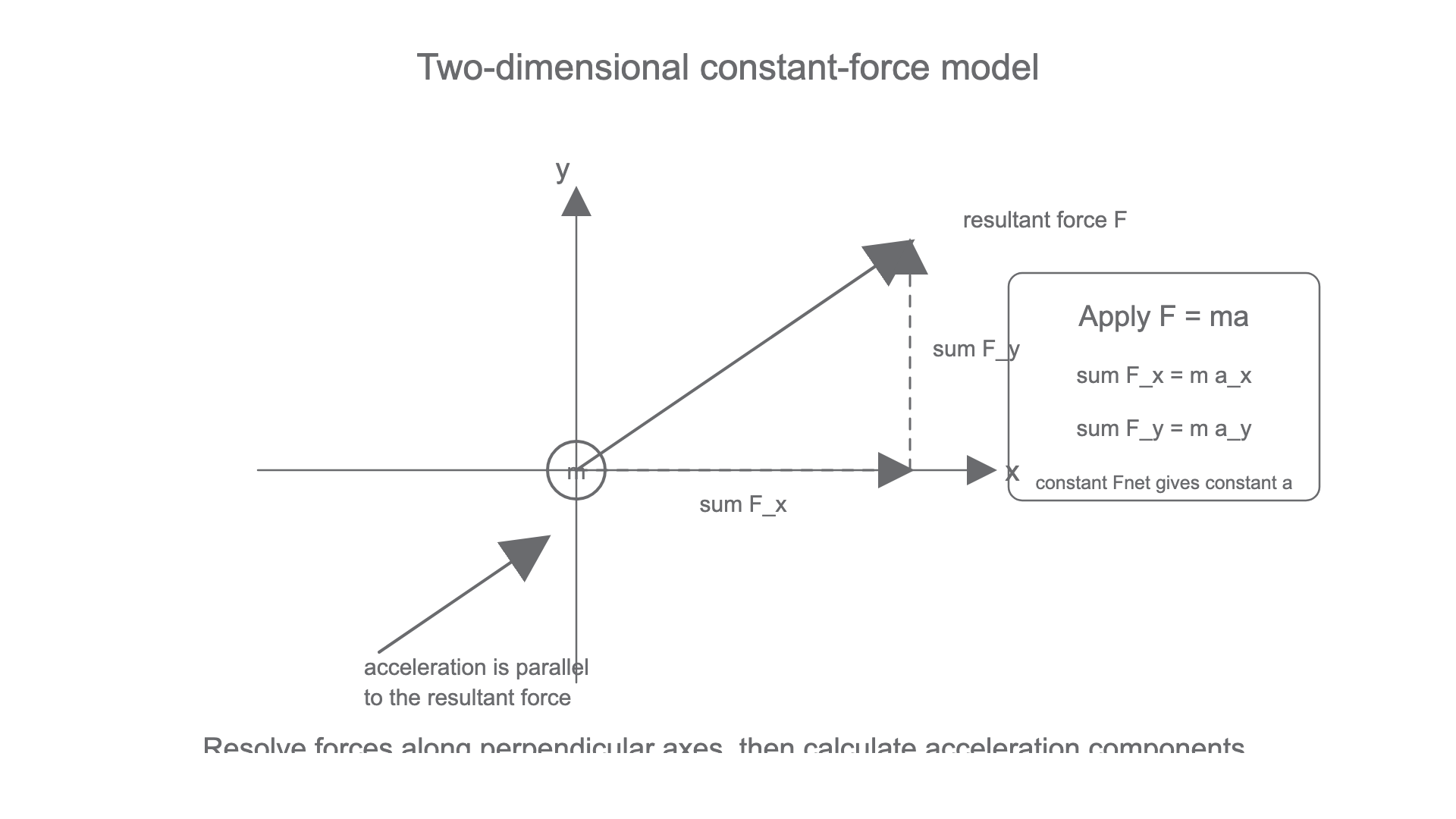
If the resultant force is constant, both acceleration components are constant. That is why constant-force problems can connect naturally to constant-acceleration kinematics: once you know a_x and a_y, you can use the usual constant-acceleration relationships along each axis.
Worked example: perpendicular forces
A small object of mass 0.50 kg experiences a resultant force of 3.0 N east and 4.0 N north.
Acceleration components:
a_x = F_x / m = 3.0 / 0.50 = 6.0 m s^-2 east
a_y = F_y / m = 4.0 / 0.50 = 8.0 m s^-2 north
Magnitude of acceleration:
a = sqrt(6.0^2 + 8.0^2) = 10 m s^-2
Direction:
tan theta = 8.0 / 6.0, so theta = 53 degrees north of east.
You could also first find the resultant force magnitude:
F = sqrt(3.0^2 + 4.0^2) = 5.0 N
Then:
a = F / m = 5.0 / 0.50 = 10 m s^-2
Both routes agree because force and acceleration are parallel vectors for a constant mass.
Data and Exam Traps
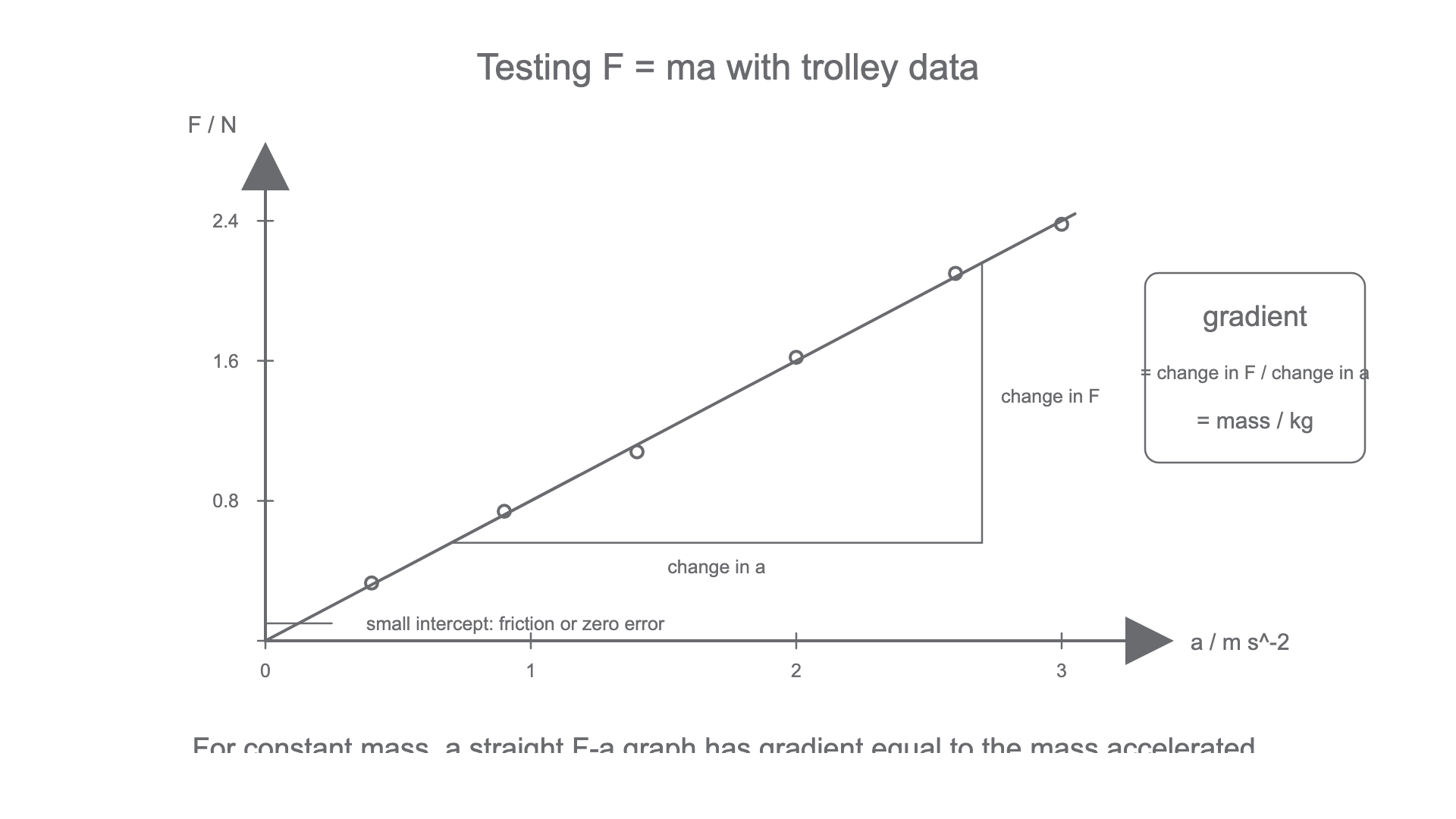
Although 3.2.1 has no explicit PAG reference, OCR can still assess dynamics through practical-style data. A common route is to vary the resultant force on a trolley and measure its acceleration.
[DIAGRAM: asset_name: Lesson 3.02.1: Dynamics and Free-Body Diagrams - diagram 03; asset_slug: 3_02_1_dynamics_and_free_body_diagrams__diagram_03; recommended_method: drawn_physics; description: Clean 16:9 plotted-data diagram showing a straight-line graph of resultant force F/N on the vertical axis against acceleration a/m s^-2 on the horizontal axis. Include points close to a line through the origin, a large gradient triangle, label gradient = mass, and note that a small intercept suggests friction or zero error.]
From F = ma, if mass is constant:
F = m a
A graph of resultant force F on the y-axis against acceleration a on the x-axis should be a straight line. The gradient is:
gradient = change in F / change in a
Since F / a = m, the gradient has units:
N / (m s^-2) = kg
So the gradient gives the mass being accelerated. A small positive intercept may suggest that some force was needed before the trolley accelerated measurably, often because friction or a zero error has not been fully allowed for.
Worked example: graph gradient
A best-fit line on a graph of F against a passes through the points:
a = 0.50 m s^-2,F = 0.40 Na = 2.50 m s^-2,F = 2.00 N
Gradient:
gradient = (2.00 - 0.40) / (2.50 - 0.50)
gradient = 1.60 / 2.00 = 0.80 kg
The mass found from the graph is 0.80 kg.
Exam traps to avoid:
- Do not use mass in kilograms as if it were weight in newtons.
- Do not call a single named force the resultant unless the other forces cancel or are absent.
- Do not assume acceleration is in the direction of velocity.
- Do not include forces on other objects in the selected object's free-body diagram.
- Do not forget the mass of every object in a connected system that shares the acceleration.