3.2.3(a)-(d) - Moments, couples and centres of mass
Forces can make objects move in a straight line, but they can also make extended objects turn. In this lesson you will learn how to calculate the turning effect of a force, how a couple produces a pure turning effect, and how moments explain the position of an object's centre of gravity. The final section teaches the plumb-line method for finding the centre of gravity of an irregular lamina.
Moment of a force
Push a door near the hinge and it is hard to open. Push the same door at the handle and it opens much more easily. The force may be similar, but the perpendicular distance from the hinge to the force's line of action is different.
Moment Of A Force
The moment of a force about a point is the turning effect of the force about that point. It is equal to the force multiplied by the perpendicular distance from the point to the force's line of action.
Moment Of A Force
Here is the force in newtons, is the perpendicular distance in metres from the pivot to the line of action of the force, and the unit of moment is newton metre, . This equation is given in the OCR data booklet, but you still need to know what the distance means.
[DIAGRAM: asset_name: Lesson 3.02.3a: Moments, couples and centres of mass - diagram 01; asset_slug: 3_02_3a_moments_couples_and_centres_of_mass__diagram_01; recommended_method: drawn_physics; description: Exact force-and-pivot diagram showing a horizontal beam pivoted at the left, an angled downward force applied near the right, the force's dashed line of action, and the shortest perpendicular distance x from the pivot to that line. Label pivot, force F, line of action, perpendicular distance x, and clockwise moment.]
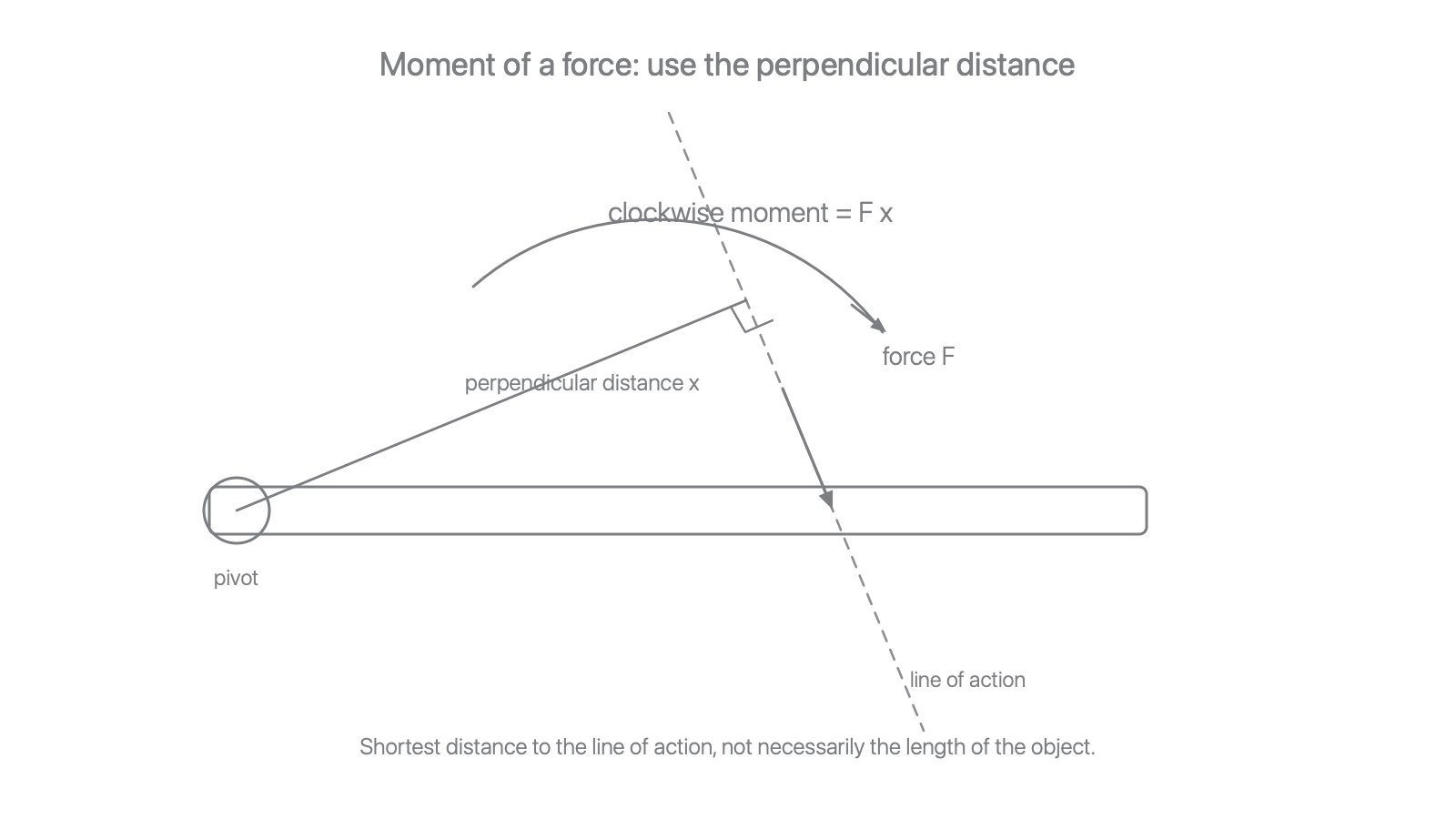
The distance is not always the length of the object. It is the shortest distance from the pivot to the line of action of the force. If a force acts directly through the pivot, its perpendicular distance is zero, so its moment about that pivot is zero.
Moments also have a sense: clockwise or anticlockwise. In calculations, state or imply a consistent convention. For example, a downward force to the right of a pivot produces a clockwise moment about the pivot.
Worked example: spanner moment
A force of acts at right angles to a spanner. The perpendicular distance from the centre of the bolt to the line of action of the force is . Calculate the moment about the centre of the bolt.
Use:
Substitute:
To two significant figures:
The moment is larger if the same force is applied further from the bolt or if the perpendicular distance is increased by applying the force more nearly at right angles.
Principle of moments
If an object is not rotating and is not starting to rotate, the clockwise and anticlockwise turning effects balance.
Principle Of Moments
For an object in rotational equilibrium, the sum of the clockwise moments about a point is equal to the sum of the anticlockwise moments about the same point.
The principle works about any point. A good calculation pivot is often a point where an unknown force acts, because that force has zero perpendicular distance from the pivot and therefore no moment about it.
This lesson uses the principle of moments for rotational balance. Full equilibrium of several coplanar forces is treated in the next split lesson, so keep the focus here on turning effects and the line of action of weight.
Worked example: balanced metre rule
A metre rule is balanced on a pivot at its mark. The rule's own weight acts through the pivot, so it has no moment about the pivot. A weight is placed at the mark. A force is applied downwards at the mark to keep the rule balanced. Calculate .
First find perpendicular distances from the pivot:
- left weight:
- right force:
For balance:
The left-hand weight produces an anticlockwise moment; the right-hand force produces a clockwise moment.
The equal distances make the answer simple: equal moments require equal forces.
Now change the geometry. If the same weight remains at , but acts at , the right-hand distance is only :
Halving the distance doubles the force needed for the same moment.
Couples and torque
A single force can cause both translation and rotation. A couple is different: it has no resultant force, but it still has a turning effect.
Couple
A couple is a pair of equal and opposite parallel forces acting along different lines of action.
Because the forces are equal and opposite, their resultant force is zero. Because their lines of action are separated, their moments add to give a turning effect. The moment of a couple is called its torque.
Torque Of A Couple
Here is the magnitude of one of the two forces and is the perpendicular separation of their lines of action. The unit is again . This equation is also given in the OCR data booklet.
[DIAGRAM: asset_name: Lesson 3.02.3a: Moments, couples and centres of mass - diagram 02; asset_slug: 3_02_3a_moments_couples_and_centres_of_mass__diagram_02; recommended_method: drawn_physics; description: Exact couple diagram with a rectangular plate, two equal parallel opposite forces on different lines of action, perpendicular separation d marked between the lines of action, curved arrow showing clockwise rotation, and labels F, F, zero resultant force, torque = Fd.]
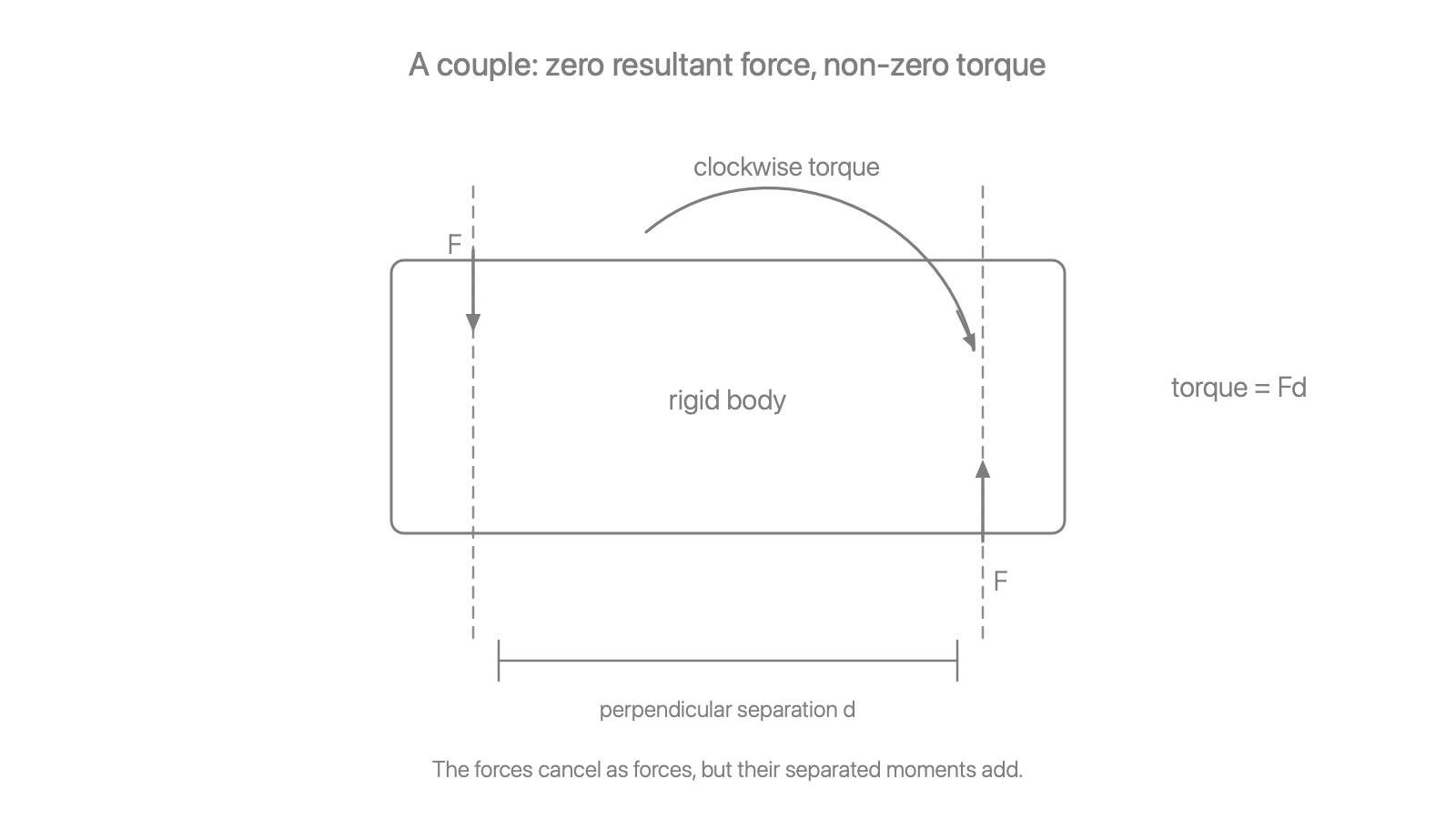
A couple's torque does not depend on which point you choose as a pivot. That is why a screwdriver, steering wheel or tap handle can be turned by two equal and opposite forces applied on different sides.
Worked example: screwdriver blade
Two equal and opposite forces of act at the ends of a screwdriver blade. The perpendicular separation between the two forces is . Calculate the torque of the couple.
Use:
Substitute the force and the separation:
To two significant figures:
Notice that is the magnitude of one force, not the sum of the two forces. The separation is the distance between the two lines of action.
Centre of mass and centre of gravity
When using moments for an extended object, its weight can be treated as acting at one point. This point is the centre of gravity.
Centre Of Mass
The centre of mass of an object is the point that represents the average position of its mass distribution.
Centre Of Gravity
The centre of gravity of an object is the point through which the object's resultant weight acts.
In a uniform gravitational field, such as the field across a normal laboratory object, the centre of gravity and centre of mass are at the same position. The distinction still matters: centre of mass depends on mass distribution, while centre of gravity depends on how the weight of the object acts in the gravitational field.
For a uniform symmetrical object, the centre of mass is at the geometrical centre. For an irregular or non-uniform object, it is shifted towards the region with more mass.
Worked example: locating a centre of gravity using moments
An irregular sign has weight . It is supported at a pivot. A load is hung to the left of the pivot and balances the sign. The sign's centre of gravity is to the right of the pivot. Calculate the horizontal distance of the centre of gravity from the pivot.
The sign's weight acts at its centre of gravity, so the clockwise moment of the sign is:
The load produces an anticlockwise moment:
For balance:
The centre of gravity is to the right of the pivot.
Finding centre of gravity experimentally
The specification includes experimental determination of centre of gravity. The standard laboratory method uses a thin irregular lamina, such as a card shape, a pin, and a plumb line.
[DIAGRAM: asset_name: Lesson 3.02.3a: Moments, couples and centres of mass - diagram 03; asset_slug: 3_02_3a_moments_couples_and_centres_of_mass__diagram_03; recommended_method: drawn_physics; description: Exact apparatus diagram for finding centre of gravity of an irregular lamina. Show lamina suspended from a pin, plumb line hanging vertically from same pin, a marked vertical line on the lamina, two further previously marked vertical lines from different suspension points, and their intersection labelled centre of gravity.]
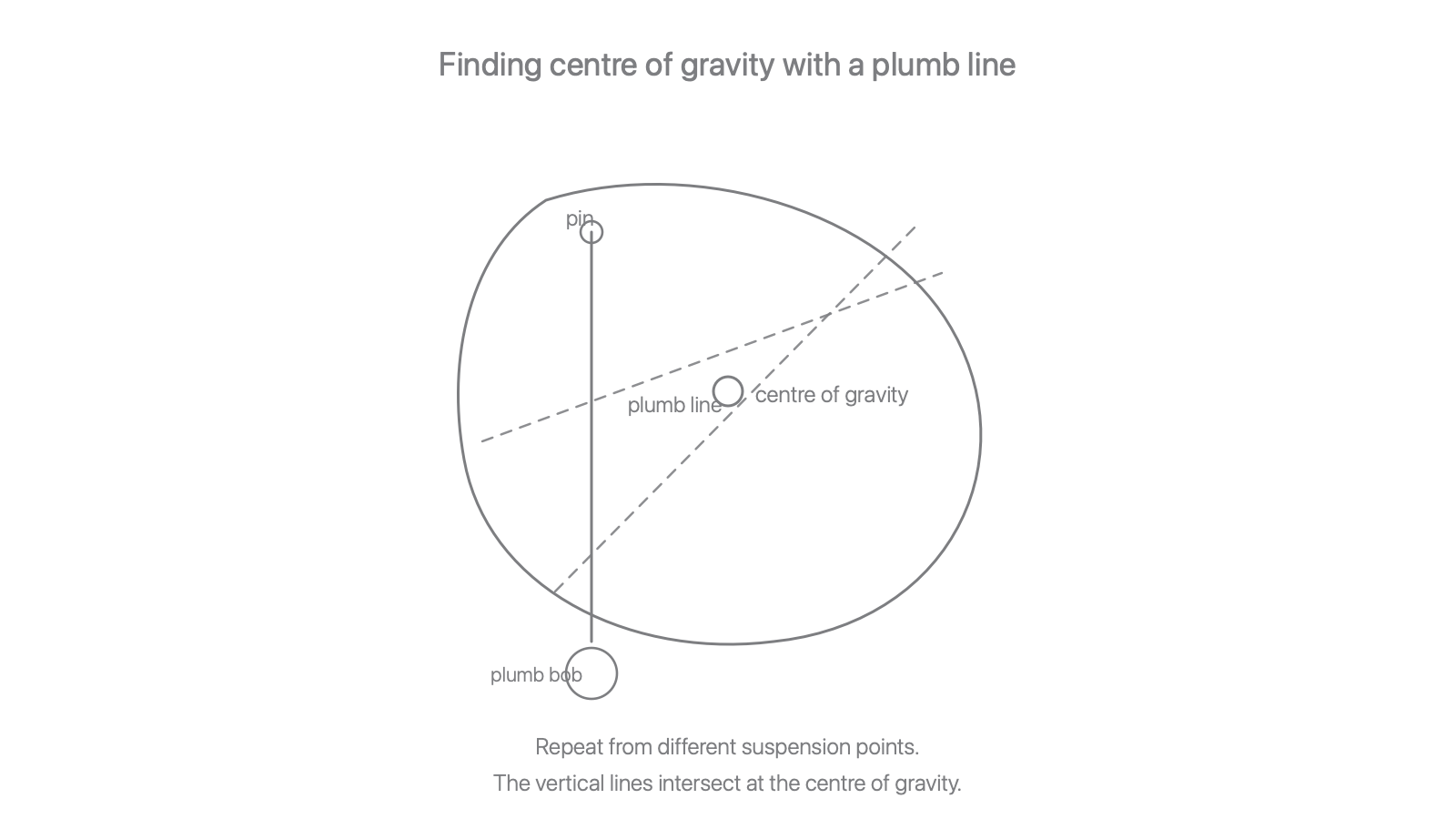
Method:
- Make a small hole near the edge of the lamina and suspend it freely from a pin.
- Hang a plumb line from the same pin.
- Wait until the lamina and plumb line are at rest.
- Mark the vertical line shown by the plumb line on the lamina.
- Repeat from at least two different suspension points.
- The intersection of the vertical lines gives the position of the centre of gravity.
The method works because, when the lamina is freely suspended and at rest, its centre of gravity must lie vertically below the suspension point. If it did not, the weight would have a moment about the pin and the lamina would rotate. Each plumb-line mark is therefore a possible line containing the centre of gravity. The intersection of several such lines locates the point.
Practical details matter:
- The lamina must swing freely, with little friction at the pin.
- Wait for oscillations to die away before marking the line.
- Use a sharp pencil and view the plumb line square-on to reduce parallax.
- Repeat from several holes; if the lines do not meet exactly, quote a small region or best estimate.
- Punch holes before doing the measurement, because removing material changes the mass distribution slightly.
- The main uncertainty is often the width and placement of the drawn lines, not the precision of the ruler itself.
Finding centre of gravity experimentally Summary
Moments let you replace an extended object's weight by a single force acting at its centre of gravity, then reason about rotation using perpendicular distances.