3.2.4 - Density, pressure and upthrust
Density tells you how much mass is packed into a volume. Pressure tells you how a force is spread over an area. In fluids, these ideas combine: pressure increases with depth, and the pressure difference around an object produces upthrust. By the end of this lesson, you should be able to use the equations accurately and explain floating, sinking and apparent weight using Archimedes' principle.
Density
Density is a property of a material or object that compares its mass with the volume it occupies. A small object can have a large mass if its material is dense; a large object can have a small mass if it contains a lot of empty space.
The density and pressure relationships in this lesson are supplied in the OCR data booklet, but you still need to choose the correct equation, use consistent SI units, and explain the physical meaning of the symbols.
Density
Density is mass per unit volume.
Density
Here, rho is density in kg m^-3, m is mass in kg, and V is volume in m^3. The same equation can be rearranged to m = rho V or V = m/rho.
The SI unit kg m^-3 matters. Many density values are first measured using grams and cubic centimetres, especially in school laboratory work, but OCR calculation answers normally need SI units unless the question states otherwise.
Useful conversions:
1 g = 1 x 10^-3 kg1 cm^3 = 1 x 10^-6 m^31 g cm^-3 = 1000 kg m^-3
Worked example: finding density from mass and volume
A metal cube has mass 0.432 kg and volume 54.0 cm^3. Calculate its density in kg m^-3.
First convert the volume:
54.0 cm^3 = 54.0 x 10^-6 m^3 = 5.40 x 10^-5 m^3
Now use the density equation:
The density is 8.00 x 10^3 kg m^-3.
In practical work, the method depends on the shape.
- For a regular solid, measure dimensions with a ruler, vernier caliper or micrometer, calculate volume from geometry, and measure mass with a balance.
- For an irregular solid that does not dissolve or absorb liquid, measure mass with a balance and find volume from the rise in water level in a measuring cylinder, or from displaced water.
- For a liquid, measure mass of a known volume. Use the mass of the empty container and the mass of container plus liquid, then subtract.
Common uncertainty points are meniscus reading, parallax, zero error in measuring instruments, trapped air bubbles around an object, and judging the volume of an irregular object from a scale with limited resolution.
Pressure
Pressure is not just another word for force. It tells you how concentrated a normal force is over a surface area. A force spread over a large area gives a smaller pressure than the same force acting over a small area.
Pressure
Pressure is normal force per unit area.
Pressure
Here, p is pressure in pascals, Pa, F is the force normal to the surface in newtons, N, and A is the area in square metres, m^2. One pascal is one newton per square metre:
The force must be perpendicular to the area. If a book rests flat on a table, its weight acts normally on the table. If a gas pushes on the wall of a container, the pressure force on each small part of the wall is normal to that wall.
Worked example: pressure on a floor
A box has weight 240 N. It rests on a rectangular base of area 0.080 m^2. Calculate the pressure on the floor.
The pressure is 3.0 x 10^3 Pa.
Now imagine the same box placed on a smaller face with area 0.020 m^2.
The weight has not changed, but the pressure has increased because the area is smaller.
This same idea applies to solids, liquids and gases, but the mechanism differs. A solid may press because of its weight or an applied force. A fluid exerts pressure because its particles transfer force to surfaces, and in a gravitational field the weight of fluid above a point affects the pressure at that depth.
Pressure In A Fluid
In a fluid at rest, pressure increases with depth. The deeper point has more fluid above it, so the weight of that fluid column is larger. This is why a diver feels increasing pressure under water and why a dam must be stronger near the bottom than near the top.
The pressure due to a column of fluid is:
Pressure Due To A Fluid Column
Here, p is the pressure due to the fluid in Pa, h is the vertical depth below the fluid surface in m, rho is the fluid density in kg m^-3, and g is gravitational field strength in N kg^-1 or m s^-2.
[DIAGRAM: asset_name: Lesson 3.02.4: Density, Pressure and Upthrust - diagram 01; asset_slug: 3_02_4_density_pressure_and_upthrust__diagram_01; recommended_method: drawn_physics; description: Clean 16:9 NovaLearn-style drawn diagram on white background showing a tank of static liquid. Show a small horizontal area A at depth h below the liquid surface, a vertical bracket labelled h, a shaded fluid column above A, downward weight of fluid column rho A h g, and pressure force on A labelled F = pA. Include side note p = h rho g and same-depth points labelled equal pressure.}]
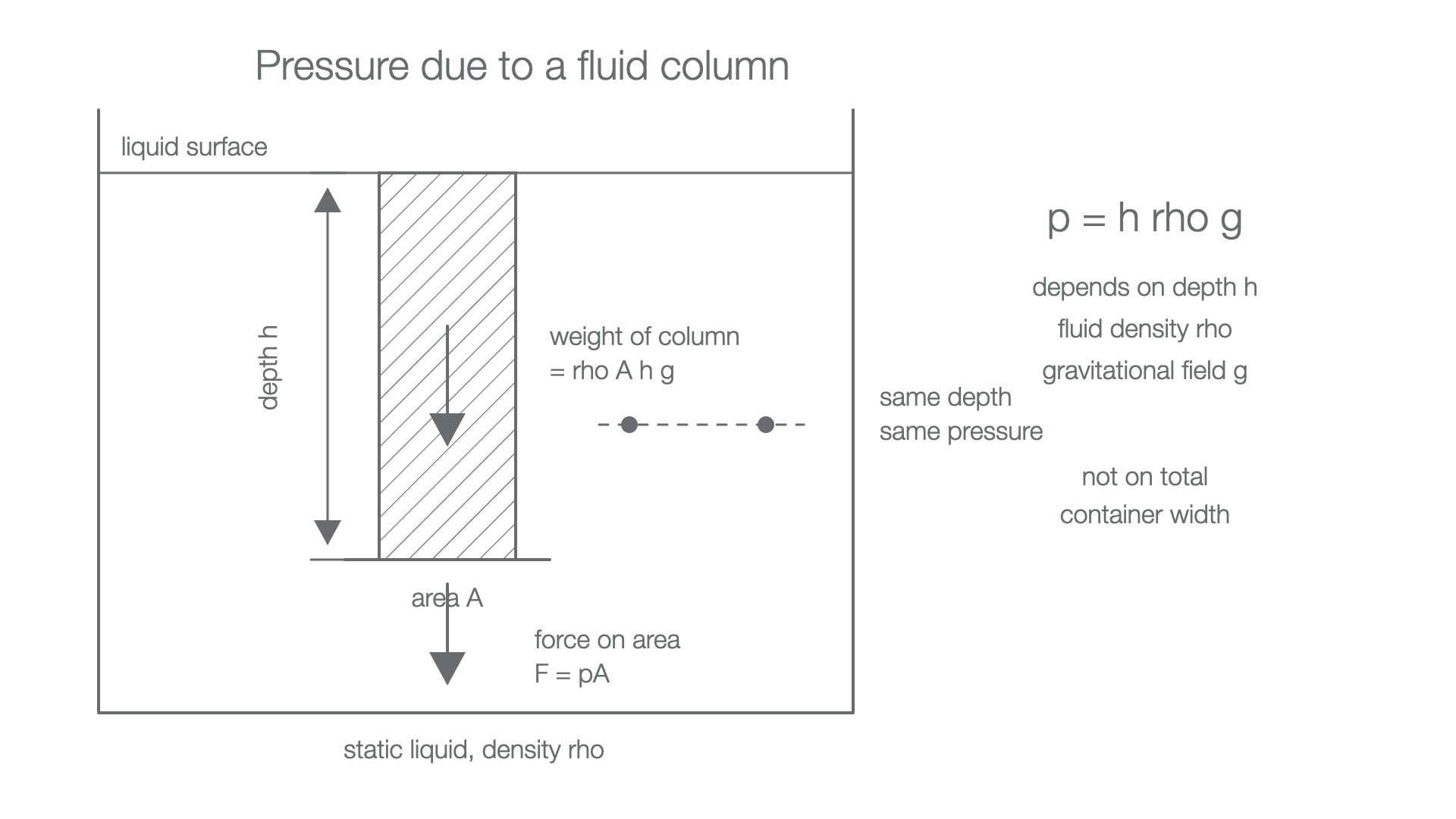
You can derive the equation from p = F/A.
For a fluid column of height h and cross-sectional area A:
The mass of fluid in the column is:
Its weight is:
The pressure on the base of the column is force divided by area:
The area cancels. That cancellation is important: in a static fluid, the pressure at a depth depends on h, rho and g, not on the shape or total width of the container. Two points at the same depth in the same static fluid have the same pressure due to the fluid, even if one side of the container is wide and the other is narrow.
Boundary note: p = h rho g gives the pressure due to the fluid column. If a question asks for total pressure in an open liquid, atmospheric pressure at the surface would also be included. In this lesson, unless a question explicitly says total or absolute pressure, treat p = h rho g as the pressure due to the fluid.
Worked example: pressure and force under water
A small hatch on a tank is 1.80 m below the water surface. The density of water is 1000 kg m^-3. Take g = 9.81 N kg^-1.
Pressure due to the water:
If the hatch has area 0.0250 m^2, the force due to this pressure is:
The pressure is set by depth, density and g; the force also depends on the area being pushed.
Upthrust And Archimedes' Principle
An object in a fluid experiences pressure on all its surfaces. The pressure is greater lower down, so the upward pressure force on the bottom of the object is larger than the downward pressure force on the top. The horizontal pressure forces on opposite sides cancel if the object is surrounded symmetrically by the fluid. The resultant fluid force is upward: this is upthrust.
Upthrust
Upthrust is the resultant upward force exerted by a fluid on an object in the fluid.
[DIAGRAM: asset_name: Lesson 3.02.4: Density, Pressure and Upthrust - diagram 02; asset_slug: 3_02_4_density_pressure_and_upthrust__diagram_02; recommended_method: drawn_physics; description: Clean 16:9 NovaLearn-style drawn diagram on white background showing a cuboid fully submerged in a fluid. Label top depth h1 and bottom depth h2, smaller downward pressure force on the top, larger upward pressure force on the bottom, equal horizontal side forces cancelling, weight W downward through the object, and upthrust U upward. Include note U = weight of displaced fluid = rho_fluid g V_displaced.}]
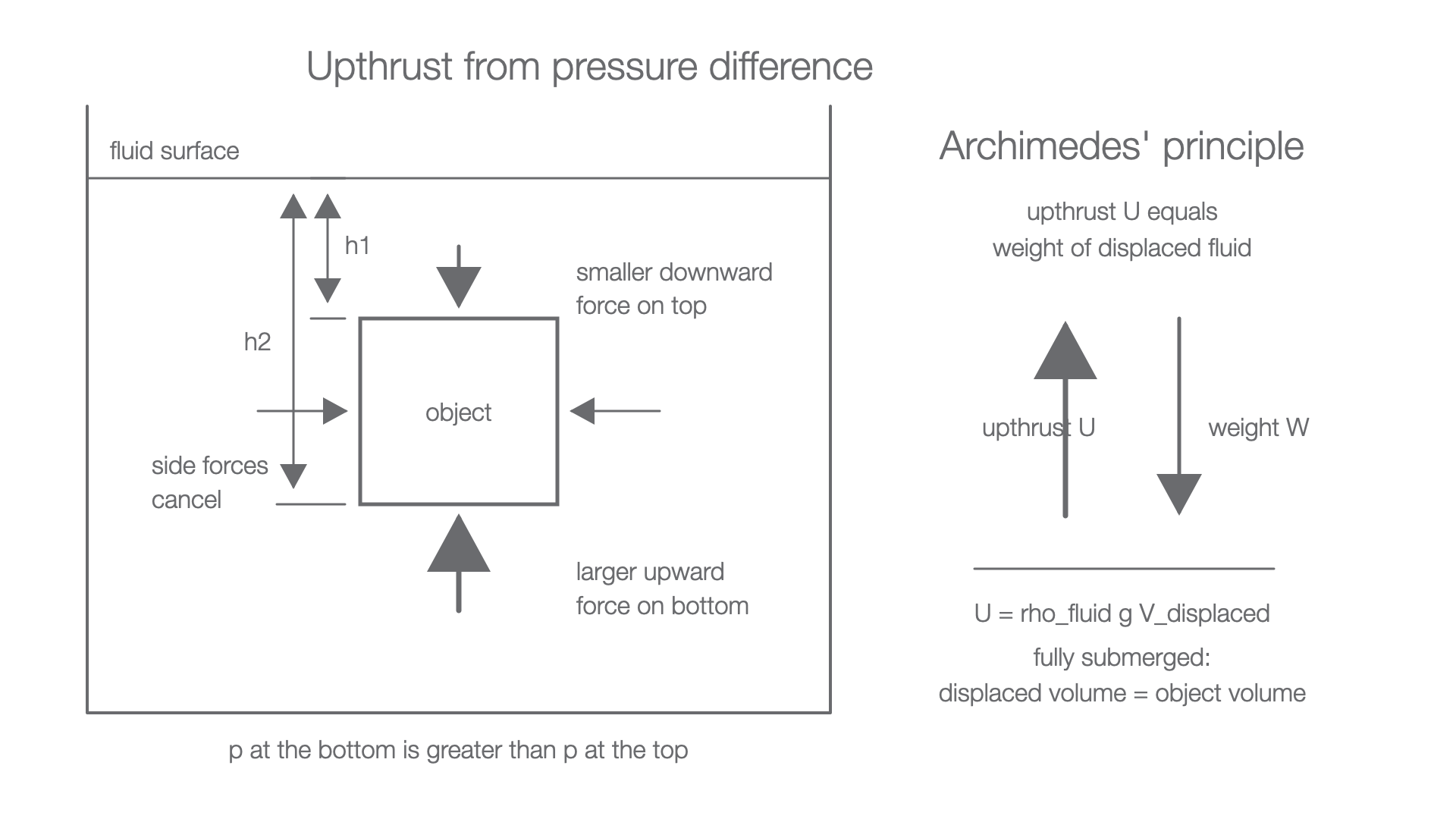
Archimedes' principle gives the size of the upthrust without needing to add up all the pressure forces on every surface.
Archimedes' Principle
Archimedes' principle states that the upthrust on an object immersed in a fluid is equal to the weight of the fluid displaced by the object.
This means:
If the displaced fluid has density rho_f and the displaced volume is V_d, then:
This expression is not a new law separate from Archimedes' principle; it is just "weight of displaced fluid" written using m = rho V and W = mg.
Two details decide many answers.
- Use the density of the fluid that has been displaced, not the density of the object.
- Use the displaced volume. If the object is fully submerged, this is the whole object volume. If it is floating partly above the surface, this is only the submerged volume.
Worked example: upthrust on a fully submerged object
A solid object of volume 3.40 x 10^-4 m^3 is fully submerged in water of density 1000 kg m^-3. Calculate the upthrust.
The displaced volume is the full object volume:
V_d = 3.40 x 10^-4 m^3
Using Archimedes' principle:
The upthrust is 3.34 N upward.
If the object's weight is greater than this, it has a resultant downward force and sinks. If its weight is less than this maximum possible upthrust, it rises until it floats with only part of its volume submerged.
Floating, Sinking And Practical Evidence
Floating and sinking are force-equilibrium questions. For an object in a fluid, the main vertical forces are usually weight downward and upthrust upward. If the object is stationary or floating at rest, the resultant force is zero.
For a floating object:
So:
This does not mean the object has displaced its whole volume. A floating object displaces just enough fluid for the upthrust to equal its weight.
For a fully submerged object:
- if
W > U, the resultant force is downward and the object sinks; - if
U > W, the resultant force is upward and the object rises; - if
U = W, the object is in vertical equilibrium.
Average density is a useful way to predict floating. If an object's average density is less than the density of the surrounding fluid, it can float. A steel ship floats because its overall volume includes air; its average density is much lower than solid steel. A helium balloon rises in air because the gasbag and helium together have lower average density than the displaced air, provided the upthrust exceeds the total weight.
Worked example: floating fraction
A wooden block has density 640 kg m^-3 and floats in water of density 1000 kg m^-3. Find the fraction of the block's volume below the water surface.
Let the block's total volume be V and the submerged volume be V_s.
The block's weight is:
The upthrust is the weight of displaced water:
For floating equilibrium, U = W:
Cancel g and rearrange:
So 64.0% of the block's volume is submerged.
A practical way to test Archimedes' principle is to measure the apparent weight of an object in air and then when it is fully submerged.
- Measure the object's weight in air with a newton meter.
- Lower it fully into water without touching the bottom or sides of the container.
- Record the smaller apparent weight.
- The loss of weight is the upthrust.
- Compare this with the weight of water displaced, found from the displaced water volume and
rho V g.
Good practical answers mention controlling trapped air bubbles, keeping the object fully submerged when required, reading the newton meter at eye level, avoiding contact with the container, repeating readings, and using a measuring cylinder or displacement can with suitable resolution.
Floating, Sinking And Practical Evidence Summary
For upthrust questions, write the physical link: upthrust equals the weight of displaced fluid. Then decide whether the object is in equilibrium, rising, sinking or only partly submerged.