3.1.3 - Projectile motion
Projectile motion is two-dimensional motion where gravity changes the vertical motion while the horizontal motion continues independently. In this lesson you will learn how to split one flight into two simpler one-dimensional motions, choose the right equation for each direction, and recombine the answers only when a question asks for a resultant distance, speed or angle. This is a classic OCR mechanics skill because a small mistake in axis choice can make an otherwise simple calculation fall apart.
The Projectile Model
A projectile is an object moving through the air after it has been launched, thrown, dropped or released, when the only force we include in the model is its weight. In OCR problems this usually means air resistance is negligible unless the question explicitly says otherwise.
Projectile Motion
Projectile motion is the motion of an object moving under the acceleration due to gravity alone, with air resistance neglected.
In this model, gravity acts vertically downwards. There is no horizontal force, so there is no horizontal acceleration. That gives the central idea:
The horizontal and vertical motions of a projectile are independent, but they share the same time of flight.
Independence means the horizontal velocity does not make the object fall faster or slower. If two balls leave the same height at the same time, one dropped vertically and one launched horizontally, they have the same vertical motion and land at the same time, provided air resistance is negligible.
[DIAGRAM: asset_name: Lesson 3.01.3: Projectile Motion - diagram 01; asset_slug: 3_01_3_projectile_motion__diagram_01; recommended_method: drawn_physics; description: Deterministic 16:9 strobe diagram on a white background showing two balls released from the same height at equal time intervals: one dropped vertically and one projected horizontally. Both rows share identical vertical positions at each time, the projectile has equal horizontal spacing, and labels identify "same vertical drop", "constant horizontal velocity", "vertical acceleration g downward", and "equal time steps".]
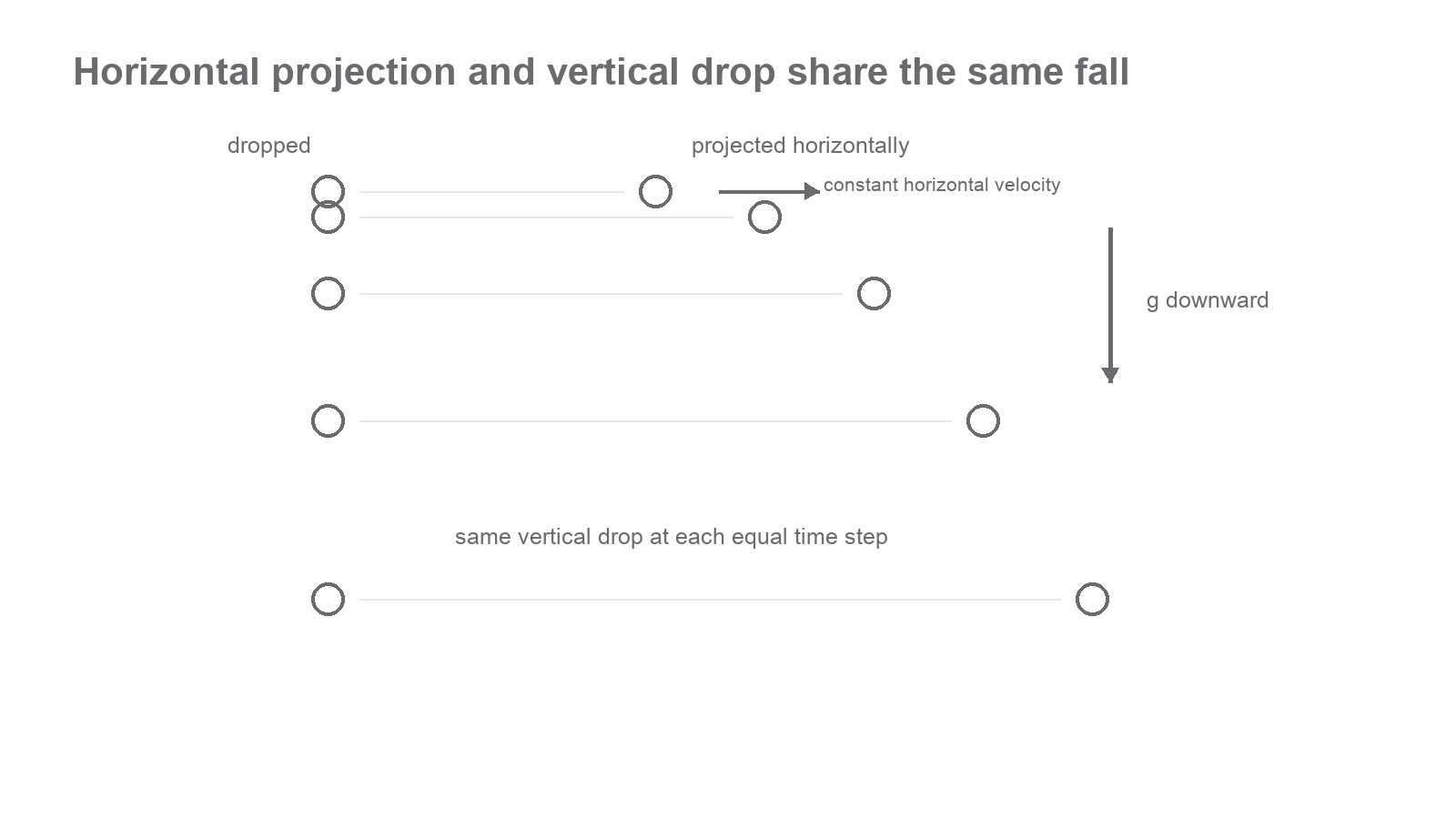
The most common trap is at the highest point of a flight. The vertical velocity is zero for an instant there, but the acceleration is still downwards. The projectile is still a projectile; gravity has not switched off.
Resolving The Launch Velocity
Most projectile questions begin with an initial speed at an angle. Before using any motion equation, split the initial velocity into horizontal and vertical components.
If a projectile is launched with initial speed at an angle above the horizontal:
Initial Velocity Components
Here is the initial horizontal velocity and is the initial vertical velocity. This formula box assumes the angle is measured from the horizontal. If the angle is measured from the vertical, redraw the right-angled triangle before deciding which component uses sine or cosine.
[DIAGRAM: asset_name: Lesson 3.01.3: Projectile Motion - diagram 02; asset_slug: 3_01_3_projectile_motion__diagram_02; recommended_method: drawn_physics; description: Deterministic 16:9 vector and trajectory diagram on a white background showing a projectile launched at angle theta above the horizontal. Include axes x horizontal and y vertical, parabolic path, initial velocity vector u resolved into u cos theta and u sin theta, equal horizontal velocity arrows along the path, downward acceleration arrows labelled g, and a side note "a_x = 0, a_y = -g if up is positive".]
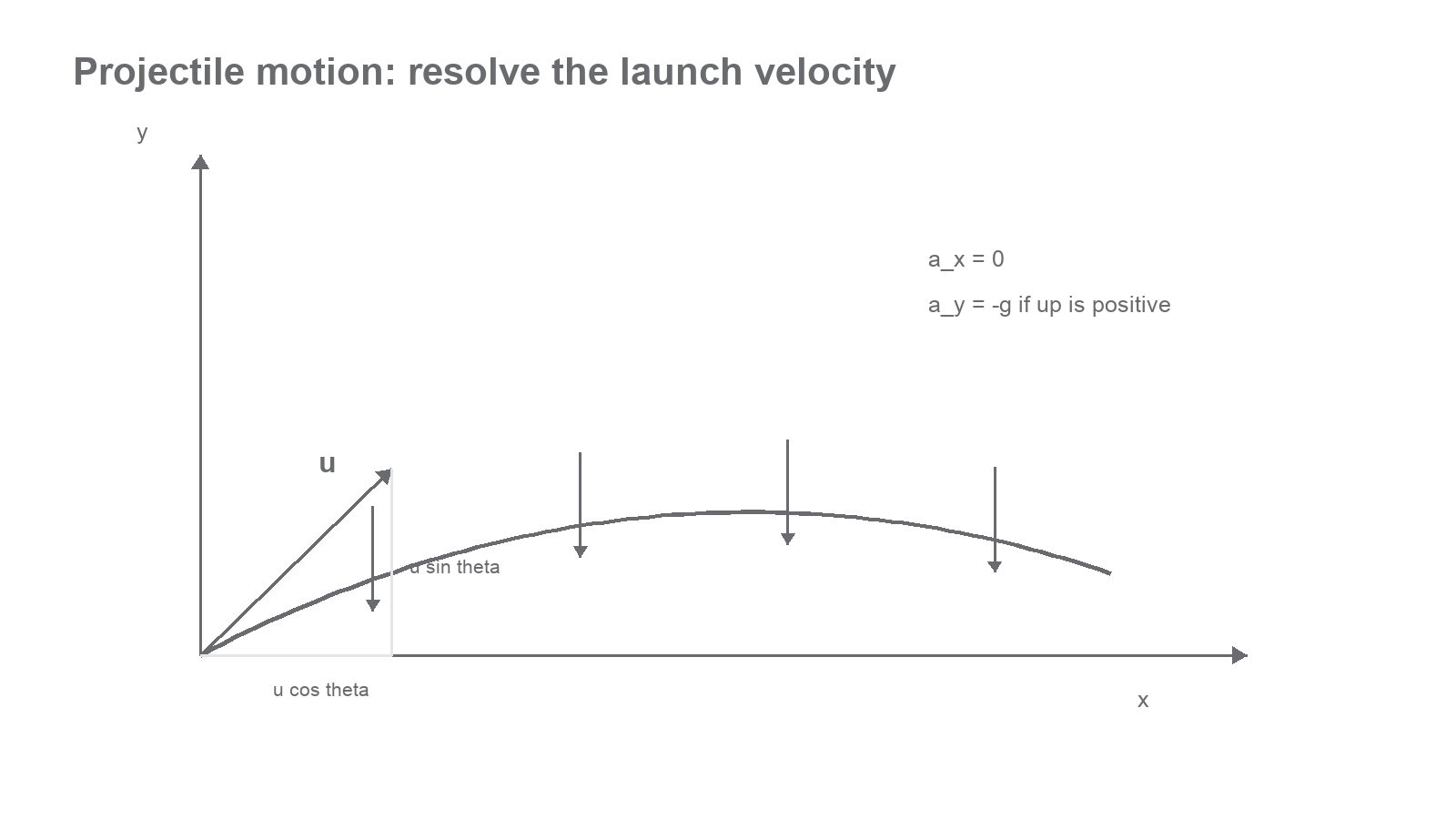
Once the components are known, treat the two directions separately. If up is chosen as positive, then:
Projectile Component Equations
The symbol is horizontal displacement, is vertical displacement, is time, is horizontal velocity, and is vertical velocity. Use unless the question gives another value.
Worked example: a ball is kicked at at above the horizontal. Find its initial horizontal and vertical velocity components.
The horizontal component is larger because the angle is closer to the horizontal than to the vertical.
Horizontal Launches
For a horizontal launch, the initial vertical velocity is zero:
The vertical motion then looks exactly like free fall from rest. The horizontal motion is constant-velocity motion. The time is usually found from the vertical information, then used in the horizontal equation.
Worked example: a small ball rolls horizontally off a bench of height with a horizontal speed of . Calculate the horizontal distance from the bench where it lands. Ignore air resistance.
Choose downward displacement as positive for the vertical part:
Use the vertical equation first:
Now use horizontal constant velocity:
So the ball lands horizontally from the bench.
Notice the logic. The horizontal speed did not affect the time of fall. It only affected how far the ball travelled horizontally during that time.
Angled Projectiles
For a projectile launched at an angle, the vertical velocity changes throughout the flight:
- it starts upward if is positive
- it becomes zero at maximum height
- it becomes downward as the projectile falls
The horizontal velocity stays constant throughout the flight, if air resistance is negligible.
At maximum height:
This is a useful condition, not a new force or a new equation. The acceleration is still downward.
Worked example: the ball from the previous component example is launched at at above the horizontal. It lands at the same vertical height from which it was launched. Calculate the time to maximum height, the maximum height, and the horizontal range.
From earlier:
At maximum height, :
The maximum height above the launch point is:
Because the projectile lands at the same height, the total flight time is twice the time to maximum height:
The horizontal range is:
Do not memorise a special range formula for OCR questions here. The safer method is to resolve, find time from the vertical motion, then use the horizontal motion.
OCR Problem Strategy And Data Skills
OCR projectile questions often hide the route inside a story: a ball detaches from a circular path, an arrow misses a target, or a projectile is filmed frame by frame. The physics route is still the same.
Use this sequence:
- Draw or imagine perpendicular axes.
- Resolve any initial velocity if the launch is angled.
- Write a vertical list and a horizontal list of known quantities.
- Find time from the direction that has enough information.
- Put the same time into the other direction.
- Recombine with Pythagoras or trigonometry only if the question asks for a resultant displacement, speed or angle.
Worked example: a ball is projected at at above horizontal ground. A vertical line is from the launch point. Calculate the height of the ball above the launch level when it reaches that line. Ignore air resistance.
Resolve first:
The horizontal information gives the time to reach the line:
Now use vertical motion:
The ball is about above the launch level at that horizontal position.
Although OCR 3.1.3 has no named PAG, projectile motion can be assessed through practical and data-handling contexts. A sensible school investigation might use a ball launcher, metre rule, vertical screen, video analysis or light gates to record positions at known time intervals. The independent variable might be launch angle or initial speed; the dependent variable might be range or height at a fixed horizontal distance. Control variables could include launch height, launch position, ball type and surface level.
Uncertainty reasoning should match the apparatus. A ruler reading may have an uncertainty based on its scale resolution; a stopwatch measurement is often limited by reaction time; video analysis reduces reaction-time error but introduces scale calibration, frame-rate and parallax uncertainties. Repeating launches, using a fixed launcher, marking the same release point, calibrating the video scale, and measuring over larger distances can reduce percentage uncertainty.