2.2.2 - Protection, tariffs, quotas and subsidies
Learn why governments protect domestic production, compare tariffs, quotas and subsidies, and construct supply-and-demand diagrams showing their effects.
Reasons for protection
Protection uses government measures to favour domestic producers against foreign competition. A government may have several reasons, but a reason does not establish that the measure's benefits exceed its costs.
Preventing dumping means responding to exports sold below their normal value, commonly below the price in the exporter's home market. Cheap imports can undermine domestic producers; an anti-dumping measure can address this unfair competition. A low import price alone does not prove dumping, since foreign producers may simply be more efficient.
Protecting employment can reduce immediate job losses in industries losing sales to imports. It gives workers and firms time to adjust, but consumers and firms using the protected goods may pay more. Protecting infant industries gives a new domestic industry time to develop skills, scale and competitiveness. This case is stronger if protection is temporary and the industry has a realistic prospect of becoming efficient; permanent protection can shelter high costs.
A tariff can raise government revenue on goods that continue to be imported. This may help finance public services, although very restrictive measures reduce the import base. Restrictions or standards can protect consumers from unsafe products, but they should target the safety problem: a general price barrier does not test whether an individual product is safe.
Restricting imports may help reduce a current-account deficit by reducing expenditure on imported goods. The result also depends on export earnings and other current-account items; dearer inputs may damage exporters. Retaliation means responding to another country's trade restrictions with restrictions of one's own, possibly to encourage negotiation. Escalation can damage both countries' exporters.
Tariffs and market supply
A tariff is a tax on imports. It raises the cost of supplying imported goods, which can reduce imports and raise their market price.
Consider an illustrative market for identical containers supplied by domestic and foreign firms. At each price, total market supply is domestic supply plus imports. The table gives quantities per week. The tariff is £2 per imported container; domestic production is not taxed by it. Demand remains unchanged.
| Price paid by buyers (£ per container) | Demand | Domestic supply | Imports without tariff | Total supply without tariff | Imports with tariff | Total supply with tariff |
|---|---|---|---|---|---|---|
| 3 | 100 | 10 | 10 | 20 | 0 | 10 |
| 4 | 80 | 20 | 20 | 40 | 0 | 20 |
| 5 | 60 | 30 | 30 | 60 | 10 | 40 |
| 6 | 40 | 40 | 40 | 80 | 20 | 60 |
| 7 | 20 | 50 | 50 | 100 | 30 | 80 |
Plot quantity horizontally and buyer price vertically. Plot and join the demand points, and separately join each total-supply series. The tariff reduces total supply at a given buyer price, moving its curve left/up. Its effect comes through imported supply; the domestic supply schedule itself stays unchanged.
[DIAGRAM: asset_name: Tariff and total market supply; asset_slug: 4ec1_e47_tariff; caption: A £2 import tariff reduces total supply, raising buyer price from £5 to £5.50 and reducing total sales from 60 to 50 containers; description: Illustrative demand and summed domestic-plus-import supply curves with original and tariff equilibria.]
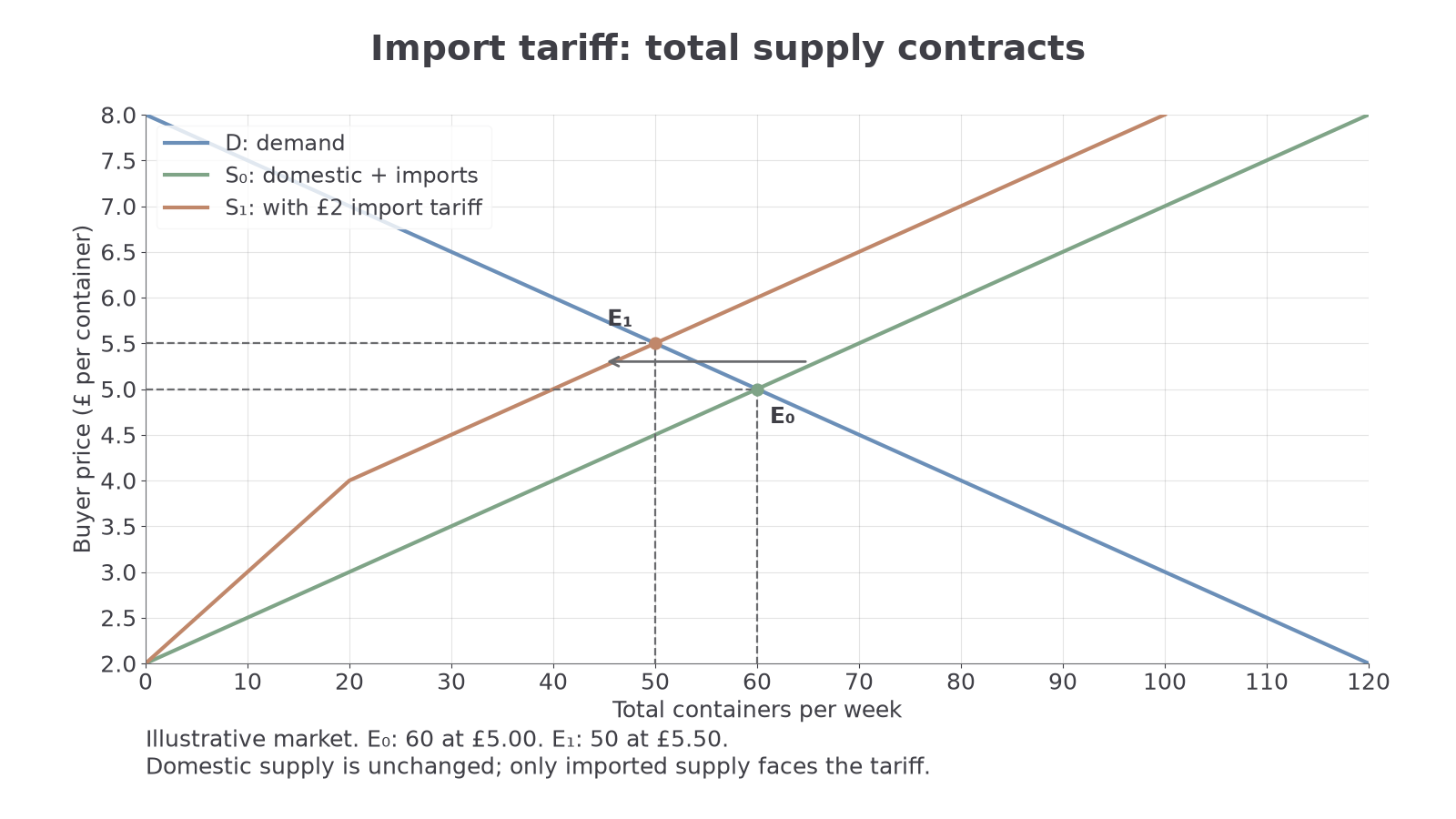
The intersections show price rising from £5 to £5.50 and sales falling from 60 to 50. At £5.50 domestic producers supply 35, while imports fall to 15. Domestic firms gain sales, buyers pay more, and the government collects £2 × 15 = £30 per week. The buyer-price increase is less than the tariff because supply and demand respond; do not assume every tariff passes fully to consumers.
A tariff can protect employment and raise revenue, but it increases consumer prices and input costs for firms using the product. It can shelter inefficient producers and provoke retaliation. Revenue equals the tariff per unit multiplied by imports after the tariff, not all sales or imports before it.
Quotas and market supply
A quota sets a maximum quantity of a good that may be imported over a stated period. A quota only restricts this market when the unrestricted import quantity would exceed its limit.
Using the same container market, a quota of 20 imports per week changes total supply as follows. Domestic supply can still respond to price.
| Buyer price (£ per container) | Demand | Domestic supply | Imports with quota | Total supply with quota |
|---|---|---|---|---|
| 3 | 100 | 10 | 10 | 20 |
| 4 | 80 | 20 | 20 | 40 |
| 5 | 60 | 30 | 20 | 50 |
| 6 | 40 | 40 | 20 | 60 |
| 7 | 20 | 50 | 20 | 70 |
Continue this lesson.
You’re previewing NovaLearn without an account. Create a free account to read the rest.
Create free account