1.2.6 - Policies for externalities
Learn how taxes, subsidies, fines, regulation and pollution permits can change incentives, and why each policy has advantages and practical limitations.
Taxation and external costs
Government can tax an activity that imposes external costs so that its private price better reflects costs borne by others.
An externality affects a third party outside the transaction. Factory pollution, for example, can damage nearby residents' health even when the factory and its customers do not pay that cost. The market can then encourage too much of the harmful activity. A tax per unit of output or pollution makes the activity more expensive and gives firms or consumers an incentive to reduce it.
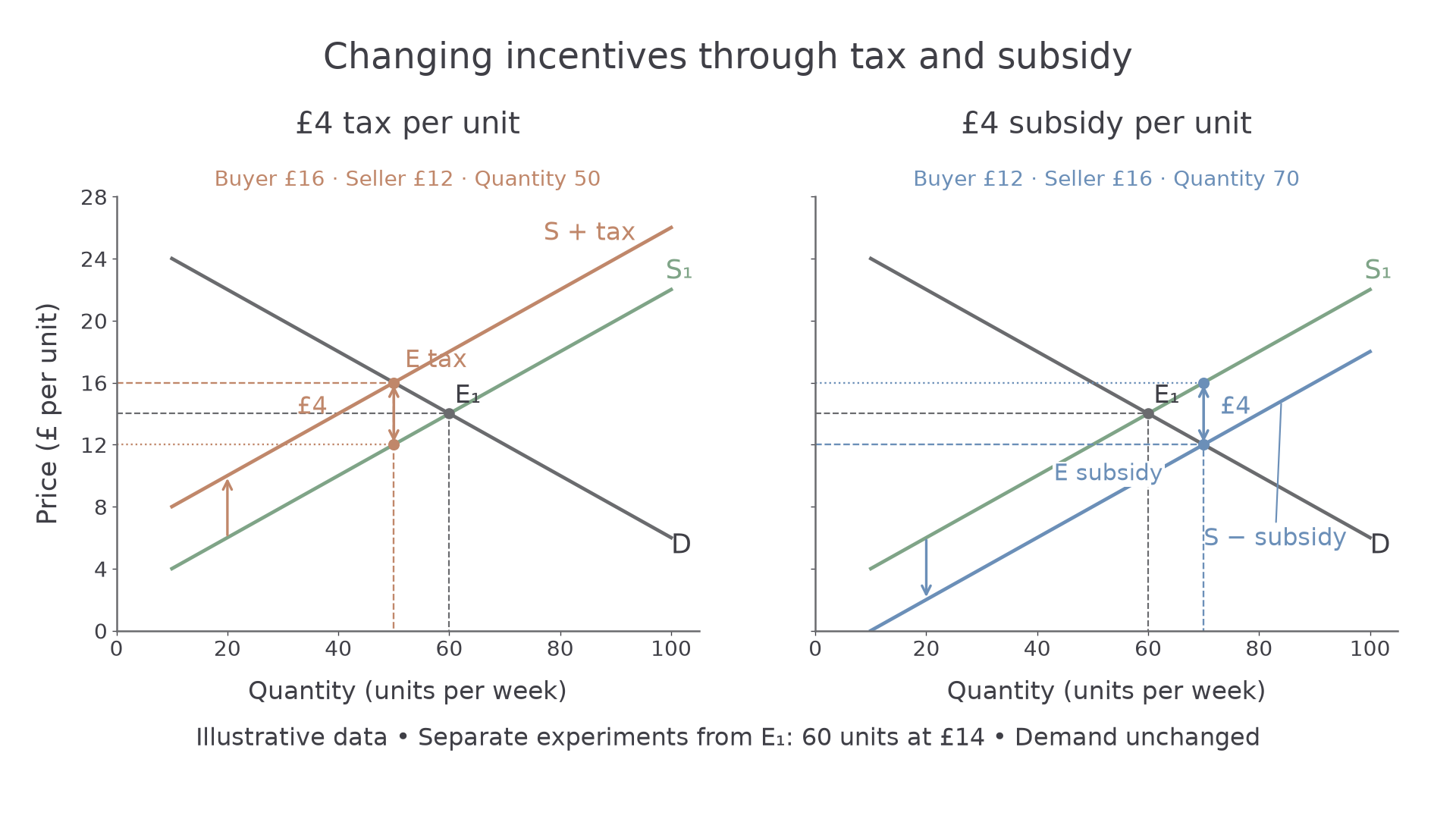
In the illustrative left panel below, a £4 tax per unit raises suppliers' costs and shifts supply from S₁ to S + tax. Demand is unchanged. Quantity falls from 60 to 50 units and the price paid by buyers rises from £14 to £16. Sellers receive £12 after paying the £4 tax. The tax wedge is between the buyer price and seller receipt; the price paid by consumers need not rise by the full tax.
[DIAGRAM: asset_name: Tax and subsidy incentives; asset_slug: 4ec1_e28_tax_subsidy; caption: Illustrative £4 tax and £4 subsidy change market supply in opposite directions; description: The tax panel shows quantity falling from 60 to 50 and a £16 buyer price with £12 seller receipt; the separate subsidy panel shows quantity rising to 70 with a £12 buyer price and £16 seller receipt.]
Tax can reduce harmful activity, encourage cleaner substitutes and raise government revenue for enforcement or other spending. But authorities may struggle to measure the external cost and choose a suitable rate. If buyers or firms have few alternatives, activity may fall little while the tax burdens their incomes or costs. Monitoring collection also costs money. Revenue is a possible benefit, not proof that the externality is removed; the incentive should relate as closely as practical to the harm.
Subsidies and external benefits
A subsidy can encourage an activity whose benefits extend beyond its direct buyer and seller.
A subsidy is government financial support that reduces a producer's cost or a consumer's purchase cost. It may encourage activities with external benefits, such as education or vaccinations, or help people choose a cleaner alternative to a harmful activity. Explain the third-party benefit: education can benefit future colleagues or wider society, while vaccination can reduce transmission to others.
In the separate right panel of the graph, a £4 production subsidy shifts supply from S₁ to S − subsidy. Quantity rises from 60 to 70 units and buyers pay £12 rather than £14. Suppliers receive £16 including the £4 subsidy. The subsidy does not necessarily reduce the consumer price by its full amount. These panels illustrate incentives, not a measurement of the correct externality-adjusting tax or subsidy.
Subsidies can make beneficial products more affordable and encourage production, uptake and investment. Yet they require public funds with an opportunity cost: spending on one subsidy cannot fund something else. Authorities may subsidise people who would already have bought the product, select an ineffective activity or provide more support than needed. Firms can become dependent on assistance rather than improve efficiency. Monitoring eligibility and results is therefore important.
For an illustrative low-emission bus subsidy, cheaper services might encourage travellers to leave cars at home, reducing pollution affecting others. If passengers simply switch from walking to buses, the intended benefit may be smaller. A sound policy analysis identifies the behavioural change as well as the spending.
Continue this lesson.
You’re previewing NovaLearn without an account. Create a free account to read the rest.
Create free account