2.1.1 - Unemployment, measurement and consequences
Learn who counts as unemployed, how the ILO measure and unemployment rate work, why different types occur, and how unemployment affects households, businesses, government and society.
The ILO measure and unemployment data
Not everyone without paid work is unemployed, so a meaningful measure needs to distinguish unemployment from economic inactivity.
Unemployment describes people without work who are willing and able to work and seeking a job. The International Labour Organization (ILO) measure uses a consistent survey-based definition to support comparisons. In the UK's Labour Force Survey implementation, unemployed people have no job, have actively sought work in the previous four weeks and are available to start in the next two weeks. It also includes people without work who have found a job and are waiting to start it within the next two weeks. It does not depend on receiving unemployment benefits.
People who are neither employed nor meeting the unemployment conditions are economically inactive. A retired person not seeking work, or a full-time student not seeking and available for work, is therefore not unemployed in this measure. A discouraged worker who stops looking can leave the measured labour force even though they would like a job. A person working a small number of hours is employed, although they may be underemployed if they want more work. The rate cannot show all these difficulties.
The labour force is employed plus unemployed people. The unemployment rate uses this group as its denominator, rather than the whole population:
| Illustrative year | Employed | Unemployed | Labour force | Unemployment rate |
|---|---|---|---|---|
| 1 | 1.90 million | 0.10 million | 2.00 million | 5% |
| 2 | 1.88 million | 0.12 million | 2.00 million | 6% |
| 3 | 1.84 million | 0.16 million | 2.00 million | 8% |
Year 3's rate is . The rate rises by three percentage points from Year 1 to Year 3, and the number unemployed rises by 60%. Those are different comparisons.
[DIAGRAM: asset_name: Illustrative unemployment rates; asset_slug: 4ec1_e35_unemployment; caption: The share of the labour force unemployed rises from 5% to 8%; description: Illustrative line chart of unemployment rates 5%, 6% and 8% in Years 1 to 3, with a percent axis starting at zero.]
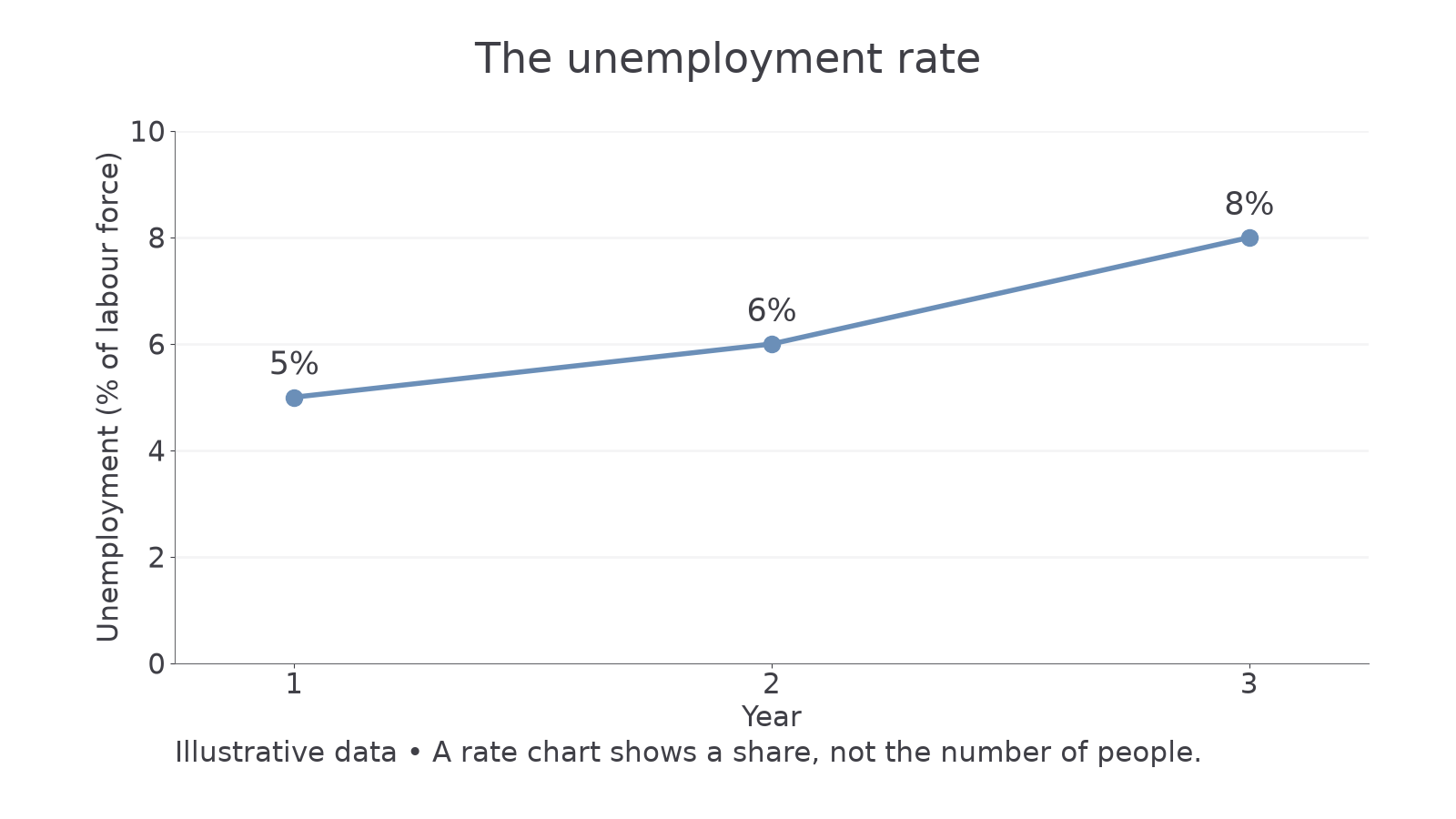
The chart shows rates, not numbers of people. Here the table establishes that the labour force is unchanged, so the rising rate also reflects more people unemployed. Without that denominator evidence, a rate chart alone cannot establish the change in headcount. Survey sampling, classification and changing participation also matter when interpreting estimates.
Five types of unemployment
The cause of a person's joblessness helps explain whether an improvement in national demand would solve it.
Cyclical unemployment results from a downturn in the economic cycle. When customers spend less, firms need fewer workers and may dismiss staff. A hotel losing bookings during a recession is an example. A sustained recovery in demand can restore some of those jobs.
Structural unemployment results from a mismatch between workers' skills or locations and the jobs available as the economy changes. Automation may remove routine factory jobs while vacancies grow in software maintenance. The displaced workers may need training or relocation; rising demand alone need not give them the required skills. It can persist longer than a normal job search.
Seasonal unemployment arises because demand for labour varies with the time of year. A seaside resort may employ fewer staff in winter, and farms may need extra workers only at harvest. A winter fall in employment at a resort is therefore not sufficient evidence of a national recession. Seasonally adjusted figures help separate regular patterns from broader changes.
Frictional unemployment occurs while people move between jobs or search for their first job. Finding a suitable vacancy, applying and arranging a start takes time even when jobs exist. Better information can shorten the search, but some movement remains in a healthy labour market.
Voluntary unemployment describes people choosing not to accept available work at its prevailing pay or conditions. Someone seeking a better-paid job may reject an offer while remaining available and actively searching; they can still meet the ILO unemployment criteria. Someone who stops searching or is unavailable is economically inactive in that measure. “Voluntary” is an explanation of behaviour, not a rule that all non-working people count as unemployed.
Continue this lesson.
You’re previewing NovaLearn without an account. Create a free account to read the rest.
Create free account