1.2.6 - Minimum wages and labour-market intervention
Learn why governments set minimum wages, how to draw the effects of introducing and increasing a wage floor, and why the gains and costs depend on how firms and workers respond.
Reasons for a minimum wage
A minimum wage sets a legal lower limit on the wage employers may pay eligible workers.
Governments may introduce a minimum wage to raise the earnings of low-paid workers, reduce exploitation where individual workers have weak bargaining power and help reduce in-work poverty. It can establish a common basic pay standard so that firms cannot compete simply by paying eligible staff below that floor.
The policy applies to wage rates, not directly to every household's income. Weekly earnings also depend on hours worked and whether a person has a job; take-home pay depends on deductions. A person without paid employment does not receive a wage increase merely because the floor rises. Some poor households have no employed members, while some minimum-wage workers live in higher-income households. The policy can help particular low-paid workers without solving every form of poverty.
A binding minimum wage is above the equilibrium wage in the simple competitive model and affects the market outcome. A floor below the equilibrium wage does not change it because firms already pay more. Eligibility, enforcement and compliance also matter: an unenforced legal limit may fail to protect those it is intended to help.
Introducing a wage floor
A binding wage floor changes the wage at which firms and workers make their decisions without itself shifting labour demand or supply.
The illustrative labour market below has a wage rate in £ per hour on the vertical axis and workers on the horizontal axis. All workers offer the same specified hours. D shows employers' demand; S shows workers' supply.
| Wage (£ per hour) | Workers demanded, D | Workers supplied, S |
|---|---|---|
| 6 | 80 | 40 |
| 8 | 70 | 50 |
| 10 | 60 | 60 |
| 12 | 50 | 70 |
| 14 | 40 | 80 |
First plot the table using even scales: quantity is the horizontal coordinate and wage the vertical coordinate. Join and label D and S; mark equilibrium E at 60 workers and £10 per hour. Without a wage floor, the model permits the wage to adjust towards this intersection.
To show introduction of a £12 minimum wage, add a horizontal line at £12 and label it Wmin₁. Read its intersection with D: employers demand 50 workers. Read its intersection with S: 70 workers want work. Add vertical guides to Qd₁ = 50 and Qs₁ = 70, then mark the horizontal gap: 20 workers of excess labour supply. In this model actual employment is 50, not 70, so employment falls by 10 from the original 60.
[DIAGRAM: asset_name: Introducing and increasing a minimum wage; asset_slug: 4ec1_e30_minimum_wage; caption: Illustrative wage floors of £12 and £14 with unchanged demand and supply; description: The introduction panel shows equilibrium 60 at £10, demand 50 and supply 70 at a £12 floor; the increase panel adds a £14 floor, demand 40 and supply 80, widening excess supply from 20 to 40 workers.]
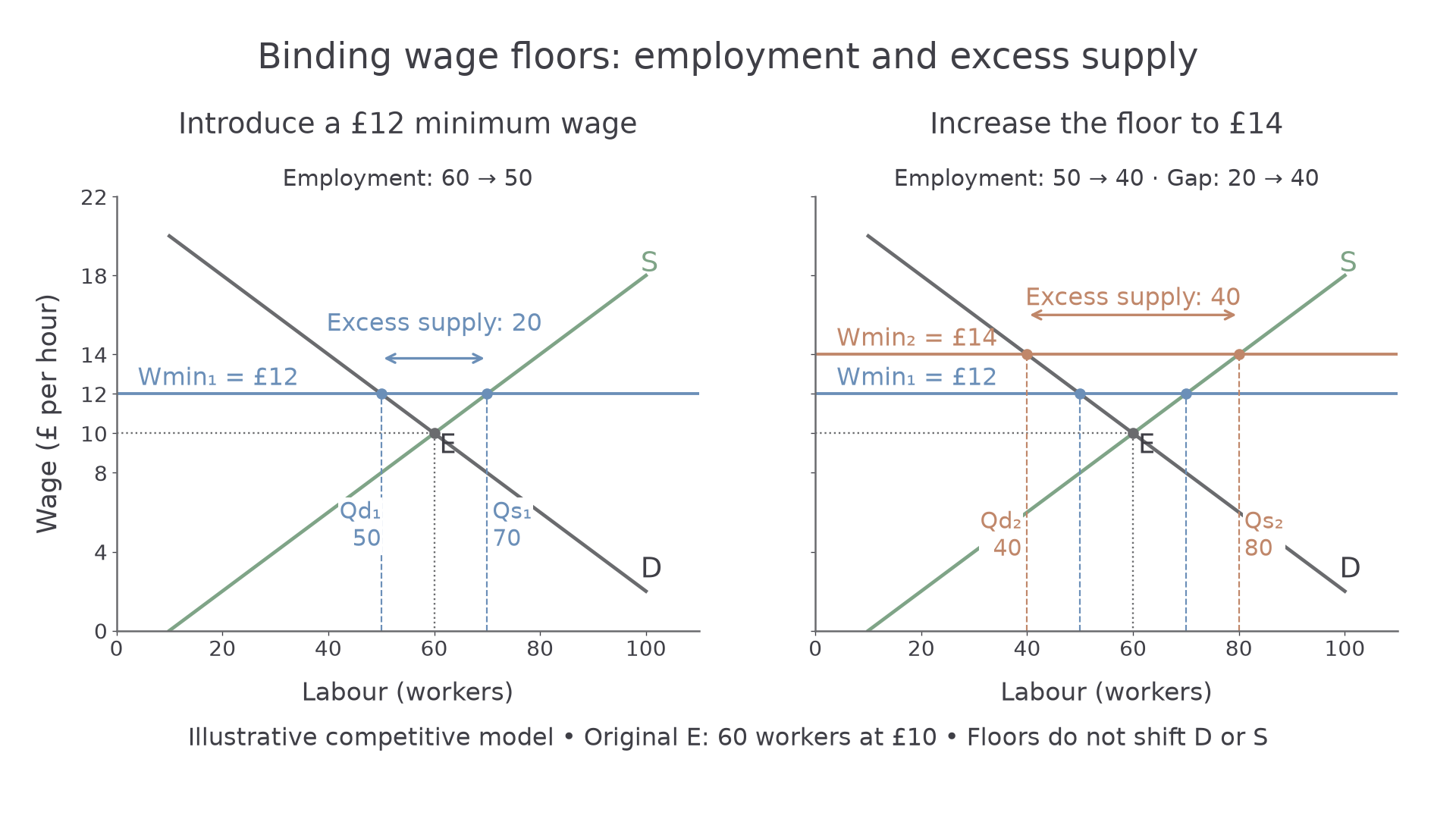
Do not confuse the 20-person gap at the floor with the 10-person fall in employment. The gap combines fewer jobs demanded and more people willing to work. These values describe one market under stated assumptions, not all unemployment in the economy. The wage floor creates movements along unchanged curves, not a rightward shift of labour supply simply because more workers want work at the higher wage.
Increasing the minimum wage
Increasing an already binding minimum wage can widen the difference between labour supplied and demanded in the same model.
Continue this lesson.
You’re previewing NovaLearn without an account. Create a free account to read the rest.
Create free account