3.04.1 Springs, Hooke's law and force-extension graphs
Springs are useful because their deformation can be measured and modelled. In this lesson you will distinguish extension from total length, use Hooke's law in the form F = kx, interpret force-extension graphs, and describe a practical method for investigating springs, wires, rubber bands and polythene strips. The central habit is simple but powerful: measure the change in length, convert it to metres, and link the graph gradient to stiffness.
Deformation, extension and compression
Deformation means a change in shape or size caused by forces. In this topic, the important change is along the length of an object such as a spring, wire, rubber band or strip.
Tensile deformation
Tensile deformation is deformation caused by forces that stretch an object. The object gets longer in the direction of the tensile forces.
Compressive deformation
Compressive deformation is deformation caused by forces that squash an object. The object gets shorter in the direction of the compressive forces.
Extension and compression are both changes in length. They are not the final length of the object.
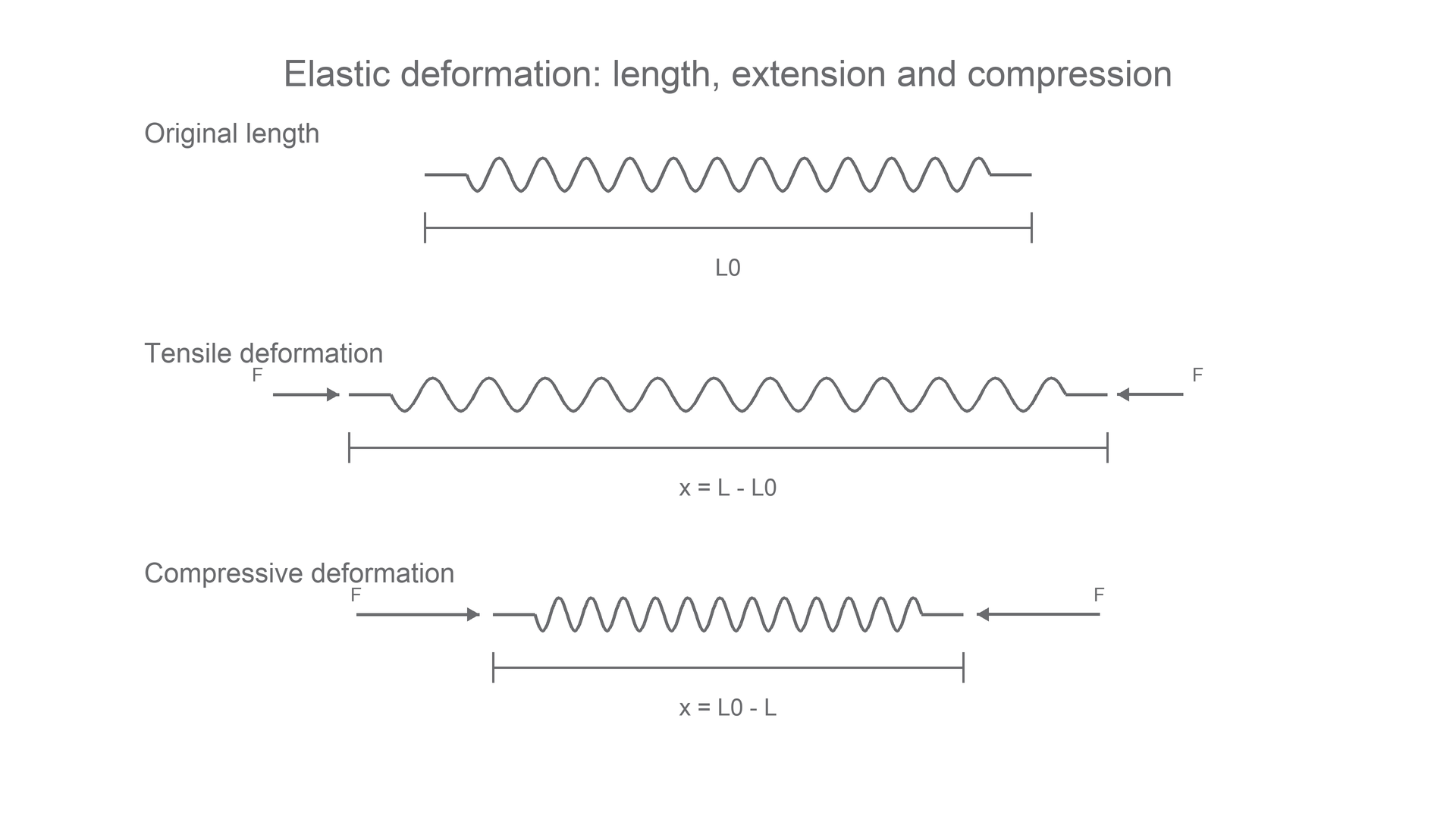
If the original length is and the stretched length is , then:
where is the extension. For compression, is the amount by which the length has decreased.
Worked example: finding an extension
A spring has original length 18.0 cm. When a load is attached, its length is 24.5 cm.
Extension:
Convert to metres before using it in F = kx:
A common error is to substitute 24.5 cm as . That is the loaded length, not the extension.
Hooke's law and force constant
Hooke's law is a proportionality law. It applies only over the range where force and extension, or force and compression, are directly proportional.
Hooke's law
Hooke's law states that the force applied to a spring or wire is directly proportional to its extension or compression, provided the limit of proportionality has not been exceeded.
In this lesson, use the magnitude form:
Hooke's law
Here is the applied force or load in newtons, is the extension or compression in metres, and is the force constant in newtons per metre, N m^-1.
Force constant
The force constant is the force needed per unit extension or compression of a particular spring, wire or arrangement. A larger means a stiffer object.
The force constant is not a pure material property. A short thick wire and a long thin wire made from the same material can have different force constants because their dimensions are different.
Worked example: calculating a force constant
A spring extends by 3.0 cm when a load of 2.4 N is attached.
First convert the extension:
Rearrange Hooke's law:
Substitute:
So this spring needs 80 N for each metre of extension, or 0.80 N for each centimetre of extension while it remains Hookean.
Worked example: using to find extension
A wire has force constant . A force of 12 N is applied within the Hookean range.
That is 8.0 mm. Notice that the calculation used metres first; the conversion to millimetres came at the end.
Force-extension graphs
A force-extension graph shows how the applied force changes with extension. For this topic, plot force on the vertical axis and extension on the horizontal axis. Then the gradient of the straight-line section is the force constant:
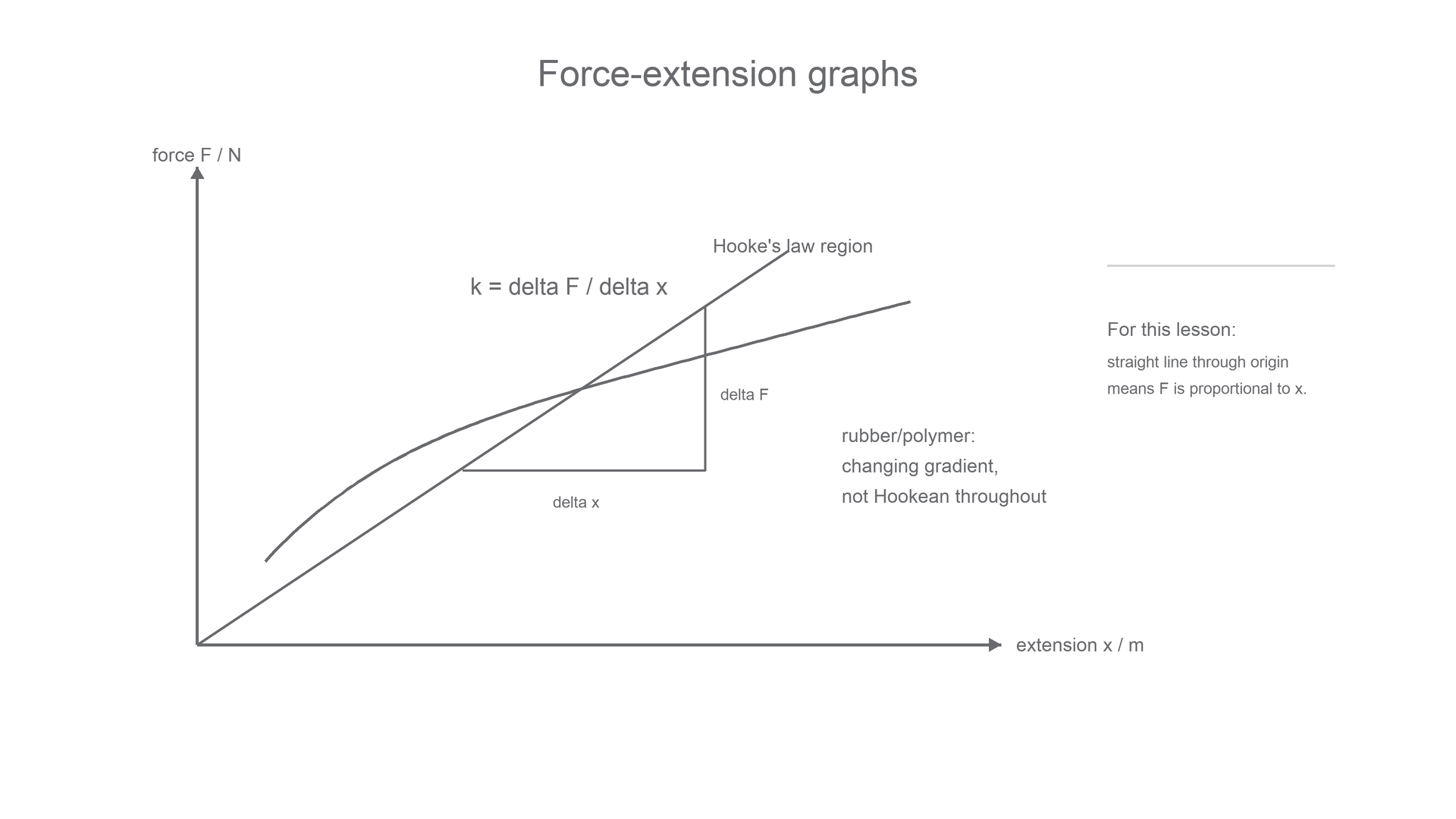
For a spring or wire obeying Hooke's law:
- the graph is a straight line
- the straight line passes through the origin
- doubling the extension doubles the force
- the gradient is constant, so is constant
For a rubber band or polythene strip, the graph often curves. A curved graph means the gradient changes, so there is no single constant for the whole range.
Be careful with axes. If a question gives a graph of extension against force, the gradient is , so the force constant is the reciprocal of that gradient. The cleanest route for this lesson is usually F against x.
Worked example: finding from a graph
A force-extension graph for a spring has a straight-line region. Two points on the best-fit line are:
- ,
- ,
Find the gradient:
Use points far apart on the line, not two cramped plotted points. A large gradient triangle reduces the effect of reading uncertainty.
This lesson uses force-extension graphs for shape, proportionality and gradient. The area under a force-extension graph is a later energy idea, so do not use area when the question is only asking whether Hooke's law applies or what is.
Investigating force-extension characteristics
A force-extension investigation must produce reliable pairs of force and extension values. The basic method is the same whether the sample is a spring, wire, rubber band or polythene strip, but the range and handling must suit the object.
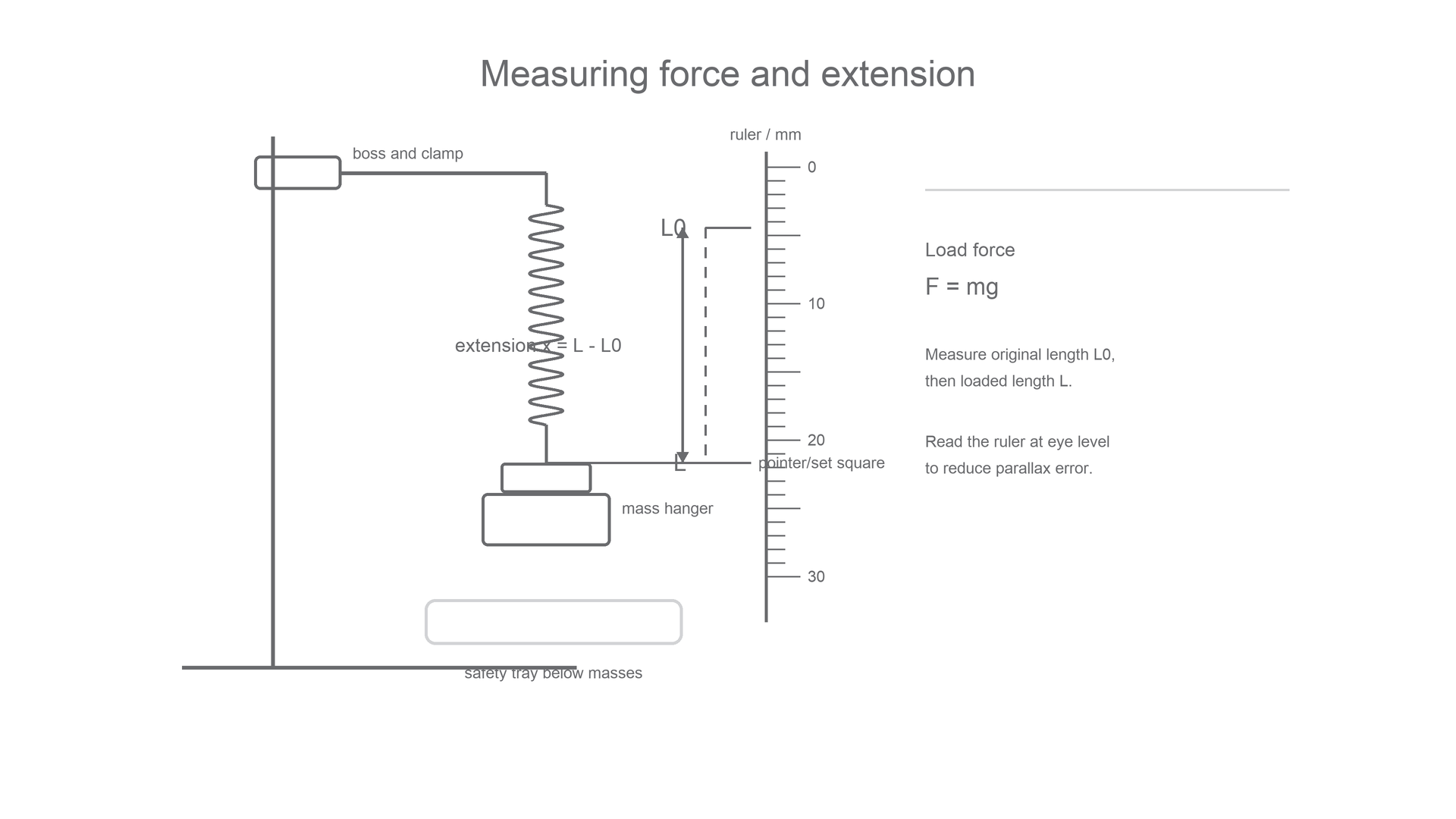
One suitable method is:
- Clamp the spring or test strip securely next to a vertical ruler.
- Measure the original length , or use a small preload as a reference if a rubber band or strip has slack.
- Add known masses one at a time, allowing the system to become stationary.
- Calculate the load force using , or read force directly from a calibrated force meter.
- Measure the new length each time and calculate .
- Record force in
Nand extension inm. - Plot
F / Nagainstx / m. - Use the gradient of the straight-line region to find , if the graph shows Hookean behaviour.
The independent variable is usually the load force. The dependent variable is the extension. Important control variables include using the same spring or strip, the same ruler and reference point, and avoiding changes in temperature or permanent damage caused by repeated stretching.
Uncertainty matters because extension is found from two length readings. If a ruler reading has uncertainty ±1 mm, then a difference of two readings may have uncertainty about ±2 mm. This is a small percentage of a 80 mm extension, but a large percentage of a 5 mm extension.
Practical improvements include:
- place the ruler close to the spring and read at eye level to reduce parallax
- use a pointer or set square attached to the lower end of the spring
- take several readings over a suitable force range, not just one load
- repeat readings and check for anomalies
- use a safety tray or soft landing area below hanging masses
- do not overload the spring, wire or strip
- for a wire, use a long wire if the extension would otherwise be too small to measure accurately
Worked example: practical data and graph choice
A student uses a mass hanger to load a spring. For a total mass of 0.250 kg, the force is:
The original length is 0.180 m and the loaded length is 0.211 m, so:
The table entry should be force 2.45 N and extension 0.031 m. The graph axes should be labelled F / N and x / m.
Interpreting different force-extension behaviours
Springs and wires often have an initial range where force is proportional to extension. Rubber bands and polythene strips often do not: their graphs may curve, have different loading and unloading behaviour, or have a changing gradient.
The key question for this lesson is not "what is all the later material physics?" It is:
Does the graph show , and if so over what range?
Use this decision route.
- Look for a straight-line section.
- Check whether that straight-line section passes through the origin.
- If it does, Hooke's law applies over that section.
- Calculate only from the straight-line section.
- If the graph curves, say that the gradient changes and the object does not have a constant force constant over that range.
Do not say "the force is bigger, so the spring constant is bigger" from one point alone. The force constant is about the ratio , or more securely the gradient of an F against x graph.
Worked example: deciding whether Hooke's law applies
A rubber strip gives these readings:
| Force / N | Extension / m |
|---|---|
| 1.0 | 0.018 |
| 2.0 | 0.046 |
| 3.0 | 0.090 |
If Hooke's law applied, doubling force from 1.0 N to 2.0 N would double the extension from 0.018 m to 0.036 m. The measured extension is 0.046 m, larger than double. The ratio is not constant:
The rubber strip does not obey Hooke's law over this range.