2.7-2.9 - Biological molecules and food tests
Food is made from large biological molecules, and those molecules are built from smaller units. In this lesson you will learn the element patterns and building blocks that Edexcel expects you to recall, then use qualitative food tests to identify glucose, starch, protein and fat in food samples.
Elements in food molecules
Carbohydrates, proteins and lipids are biological molecules. They are all carbon-based molecules, but they do not all contain exactly the same elements.
Biological molecule
A molecule made by, or found in, living organisms.
For Edexcel International GCSE, learn the element patterns like this:
| Biological molecule | Elements to identify |
|---|---|
| Carbohydrates, such as glucose, starch and glycogen | carbon, hydrogen and oxygen |
| Lipids, meaning fats and oils | carbon, hydrogen and oxygen |
| Proteins | carbon, hydrogen, oxygen and nitrogen |
The common exam trap is to remember that all three contain carbon, hydrogen and oxygen, then forget that protein also contains nitrogen. Do not add digestion functions here unless the question asks for them; this cluster is about chemical elements, structure and food tests.
Large molecules and basic units
Large biological molecules are made by joining many smaller basic units. Edexcel only requires the basic unit relationships below, not detailed displayed formulae or bond names.
[DIAGRAM: asset_name: Biological molecules and food tests - diagram 01; asset_slug: b05_biological_molecules_and_food_tests__diagram_01; recommended_method: deterministic_drawing; description: Monochrome concept map showing starch and glycogen as large carbohydrate molecules made from many simple sugars, protein as a large molecule made from amino acids, and lipid as a large molecule made from fatty acids plus glycerol.]
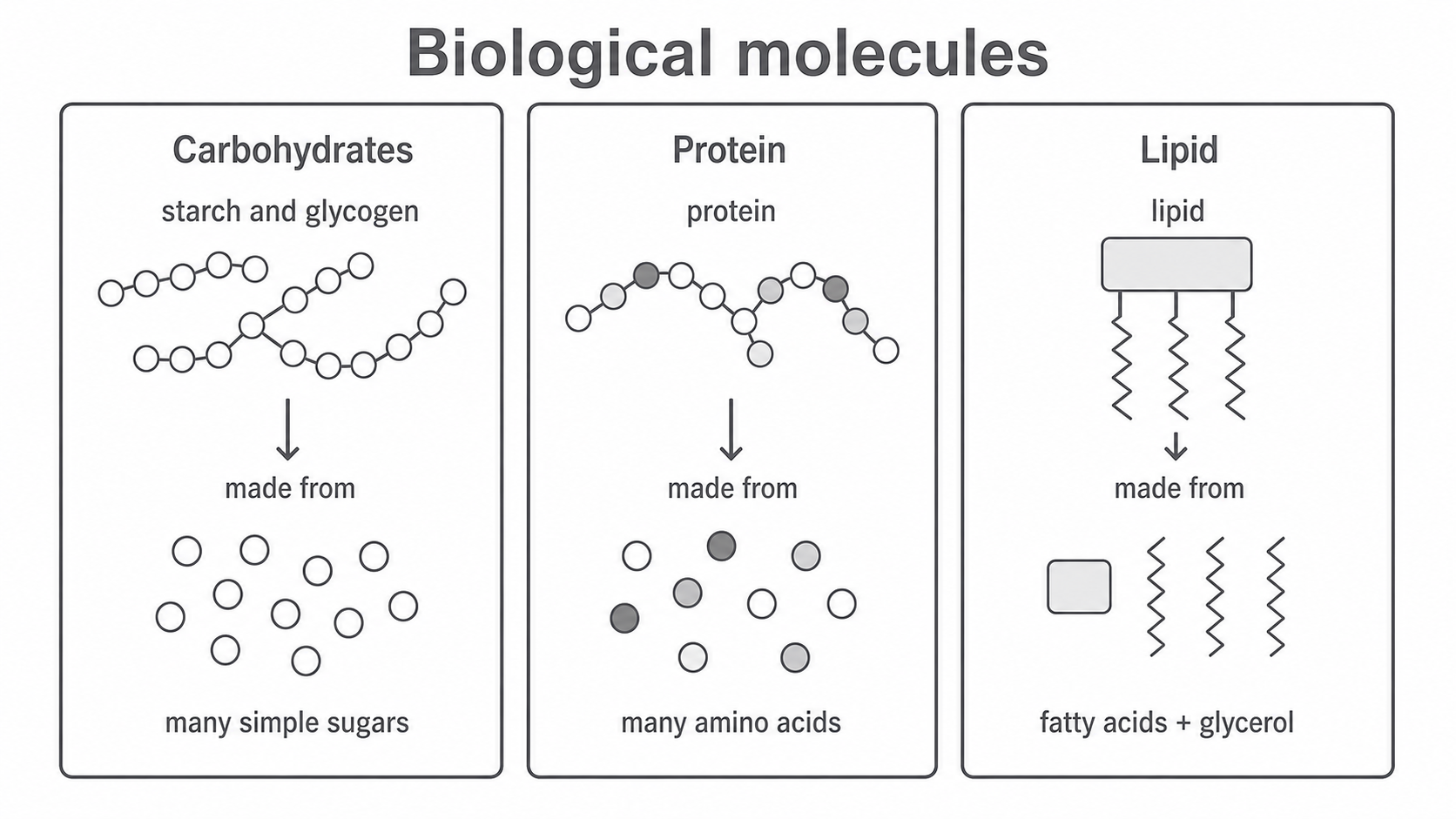
Starch and glycogen are carbohydrates. Both are large molecules made from simple sugars joined together. In many school examples that simple sugar is glucose, but the specification wording you must recall is simple sugars.
Proteins are large molecules made from amino acids. The amino acids can be arranged in different orders, so different proteins can have different shapes and properties, but this lesson only needs the idea that amino acids are the smaller units.
Lipids are large molecules made from fatty acids and glycerol. Fats and oils are both lipids, so in this lesson fat means the same food-test target as lipid.
Preparing food samples
Food tests work best when the food molecule can mix with the reagent. A solid food is usually crushed or ground first. For glucose, starch and protein tests, the crushed food is mixed with distilled water to make a food suspension or solution, then a small sample is transferred to a clean labelled test tube.
Use separate clean equipment for each food sample and each test. If starch from one sample contaminates another tube, iodine may give a false positive. A fair investigation keeps the sample size, reagent volume, heating time and water-bath temperature as similar as possible between samples.
Safety matters because the observations are made with chemical reagents. Wear eye protection. Heat Benedict's test in a water bath, not directly over a flame. Keep ethanol away from naked flames because it is highly flammable, and use small volumes of Biuret reagent because it contains alkaline solution.
Tests and positive results
Food tests are qualitative tests: they show whether a named substance is detected, not exactly how much is present. A positive result is the observation that shows the substance is present.
[DIAGRAM: asset_name: Biological molecules and food tests - diagram 02; asset_slug: b05_biological_molecules_and_food_tests__diagram_02; recommended_method: deterministic_drawing; description: Monochrome four-panel food-test workflow for glucose, starch, protein and fat, showing reagent or treatment, whether heating is needed, and the labelled positive observation in words.]
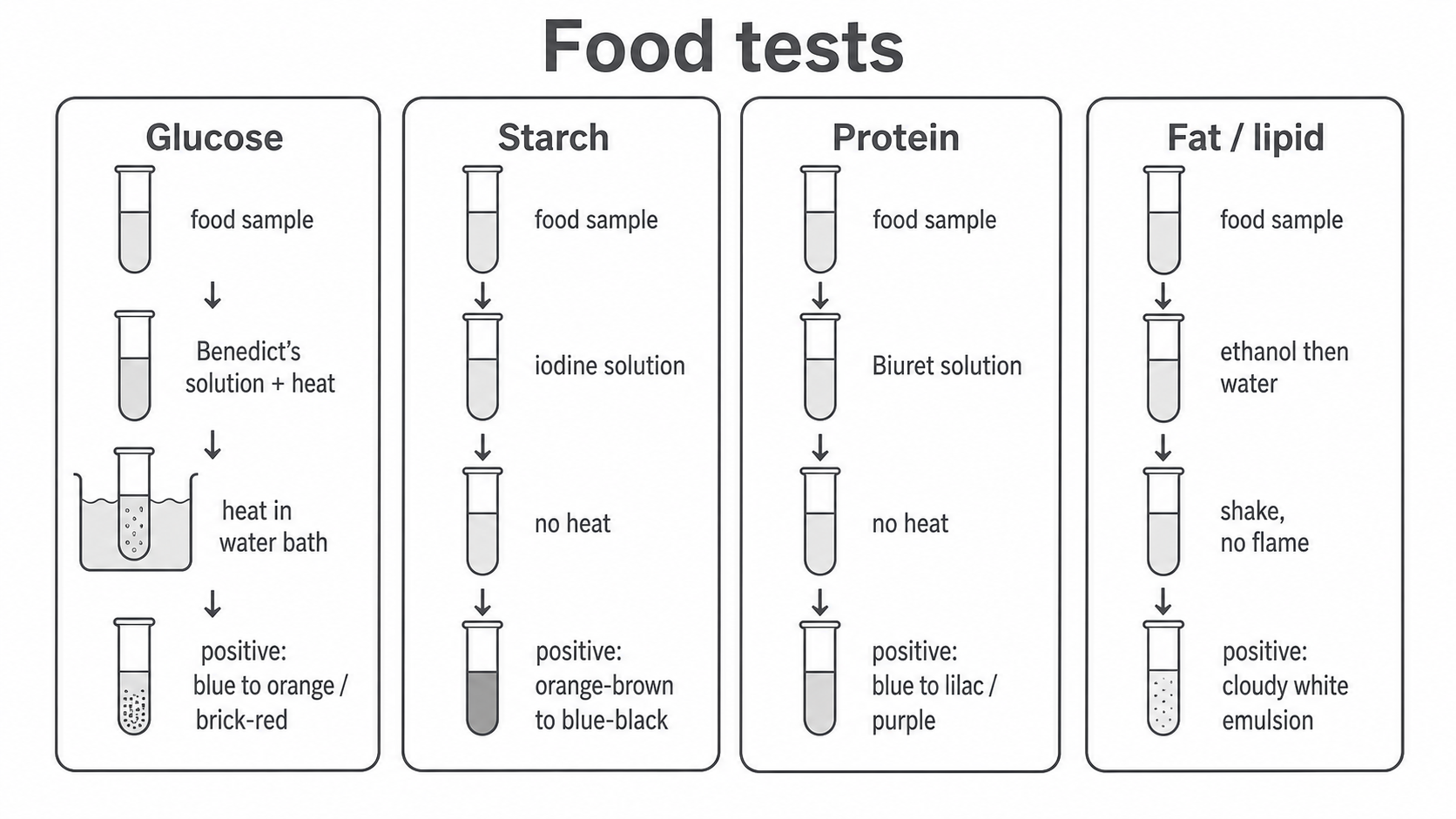
| Substance tested for | Reagent or treatment | Positive result |
|---|---|---|
| Glucose | Add Benedict's solution, then heat in a hot water bath | blue changes to green, yellow, orange or brick-red |
| Starch | Add iodine solution | orange-brown changes to blue-black |
| Protein | Add Biuret solution, or sodium hydroxide then copper sulfate solution | blue changes to lilac, violet or purple |
| Fat / lipid | Shake sample with ethanol, then add water | cloudy white emulsion forms |
The colour words are part of the answer. For glucose, Edexcel mark schemes often accept any positive Benedict's colour in the green to brick-red range, because stronger positive results move further towards brick-red. For fat, the standard practical method is the ethanol emulsion test; some official mark schemes also accept Sudan III, but you should be ready to describe the ethanol method unless the question names another reagent.
Interpreting results in exam answers
When an exam asks you to describe a food test, give both the method and the observation. "Use Benedict's solution" is not enough for a full glucose-test answer because the test also needs heating, and the result must be stated. "It changes colour" is too vague because the named colour change earns the observation mark.
A negative result means the food molecule was not detected by that test. It does not prove the food contains none at all in every possible sense; the concentration may be too low, the sample may not have mixed well, or the practical may have been contaminated. That is why fair method details, repeats and clean equipment support a more reliable conclusion.
Keep your conclusion inside the evidence. If a crushed nut gives a cloudy white emulsion after ethanol and water are added, you can conclude that fat is present. You should not use that result alone to claim the food is healthy, high in energy, or rich in protein; those are different questions.