1.2-1.4 - Classifying organisms and pathogens
Biologists classify organisms by looking for shared features, especially cell structure, nutrition, storage carbohydrates and examples of disease-causing forms. In this lesson, you will use the Edexcel groups plants, animals, fungi, protoctists, bacteria and viruses exactly as they are used in the specification. The main skill is to decide which features are enough to classify an organism, and which features are traps.
The classification route
The first useful question is whether the organism is cellular, and if it is cellular, whether its cells are eukaryotic or prokaryotic.
Eukaryotic organism
An organism whose cells have a nucleus. In this specification, plants, animals, fungi and protoctists are eukaryotic organisms.
Prokaryotic organism
An organism whose cells do not have a nucleus. Bacteria are prokaryotic organisms.
Viruses are treated separately. They are not living organisms and do not have a cellular structure. That means a virus is not a plant, animal, fungus, protoctist or bacterium.
[DIAGRAM: asset_name: classification_route_map; asset_slug: b02_classifying_organisms_and_pathogens__diagram_01; recommended_method: deterministic_drawing; description: A monochrome decision map separating cellular eukaryotic organisms, prokaryotic bacteria and non-cellular viruses, with the specification groups and key distinguishing features.]
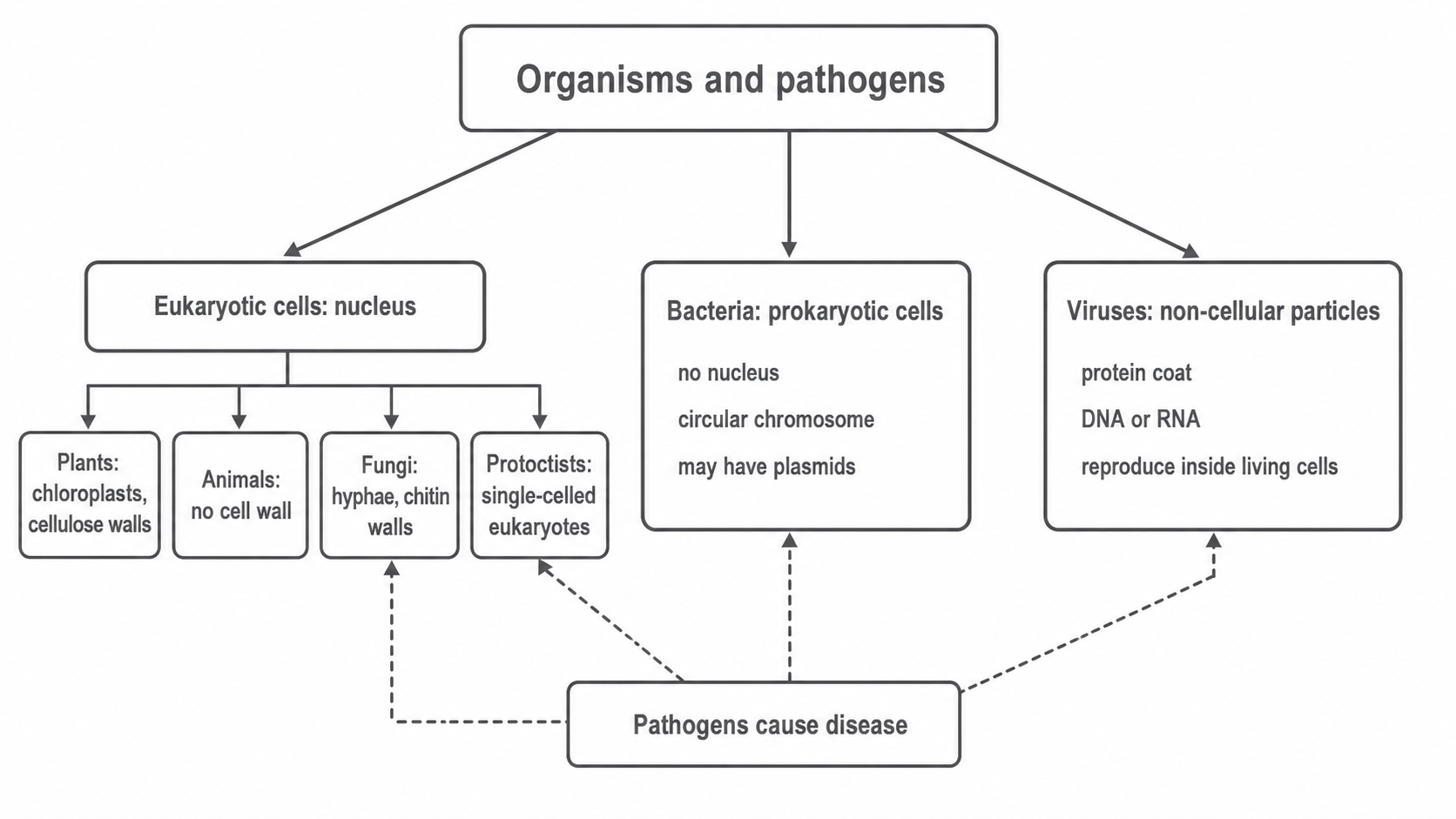
Use this route when you read a question stem:
| Evidence in the stem | Most useful classification move |
|---|---|
| Nucleus, chloroplasts, cellulose wall, photosynthesis | Think plant or plant-like protoctist, then check multicellular versus single-celled |
| Multicellular, no cell wall, nervous coordination, movement | Think animal |
| Hyphae, mycelium, chitin wall, extracellular digestion | Think fungus |
| Microscopic single-celled eukaryote | Think protoctist |
| No nucleus, circular chromosome, plasmids | Think bacterium |
| Protein coat, DNA or RNA, reproduces only inside living cells | Think virus |
Four eukaryotic groups
Plants, animals, fungi and protoctists are all eukaryotic, but the examination usually asks for the common features that separate the groups.
Plants are multicellular organisms. Their cells contain chloroplasts, so they can photosynthesise. Plant cells have cellulose cell walls and plants store carbohydrates as starch or sucrose. Edexcel examples include flowering plants such as maize, peas and beans.
Animals are also multicellular, but their cells do not contain chloroplasts and cannot photosynthesise. Animal cells have no cell walls. Animals usually have nervous coordination and are able to move from one place to another. They often store carbohydrate as glycogen. Humans, houseflies and mosquitoes are Edexcel examples.
Fungi do not photosynthesise. A typical fungus has a mycelium made from thread-like hyphae, and those hyphae contain many nuclei. Fungal cell walls are made of chitin. Fungi feed by secreting digestive enzymes onto food material outside the body, then absorbing the soluble organic products. This is saprotrophic nutrition. Mucor shows the typical hyphal structure, while yeast is a single-celled fungus. Fungi may store carbohydrate as glycogen.
Protoctists are microscopic single-celled eukaryotic organisms. Some have animal-like features, such as Amoeba in pond water. Others have plant-like features, such as Chlorella, because they contain chloroplasts. Plasmodium is a pathogenic protoctist that causes malaria.
The high-value comparison is not "plant good, animal moves, fungus odd". It is the precise pattern: cell wall material, chloroplasts, multicellular or single-celled organisation, feeding method and storage carbohydrate.
Bacteria as prokaryotes
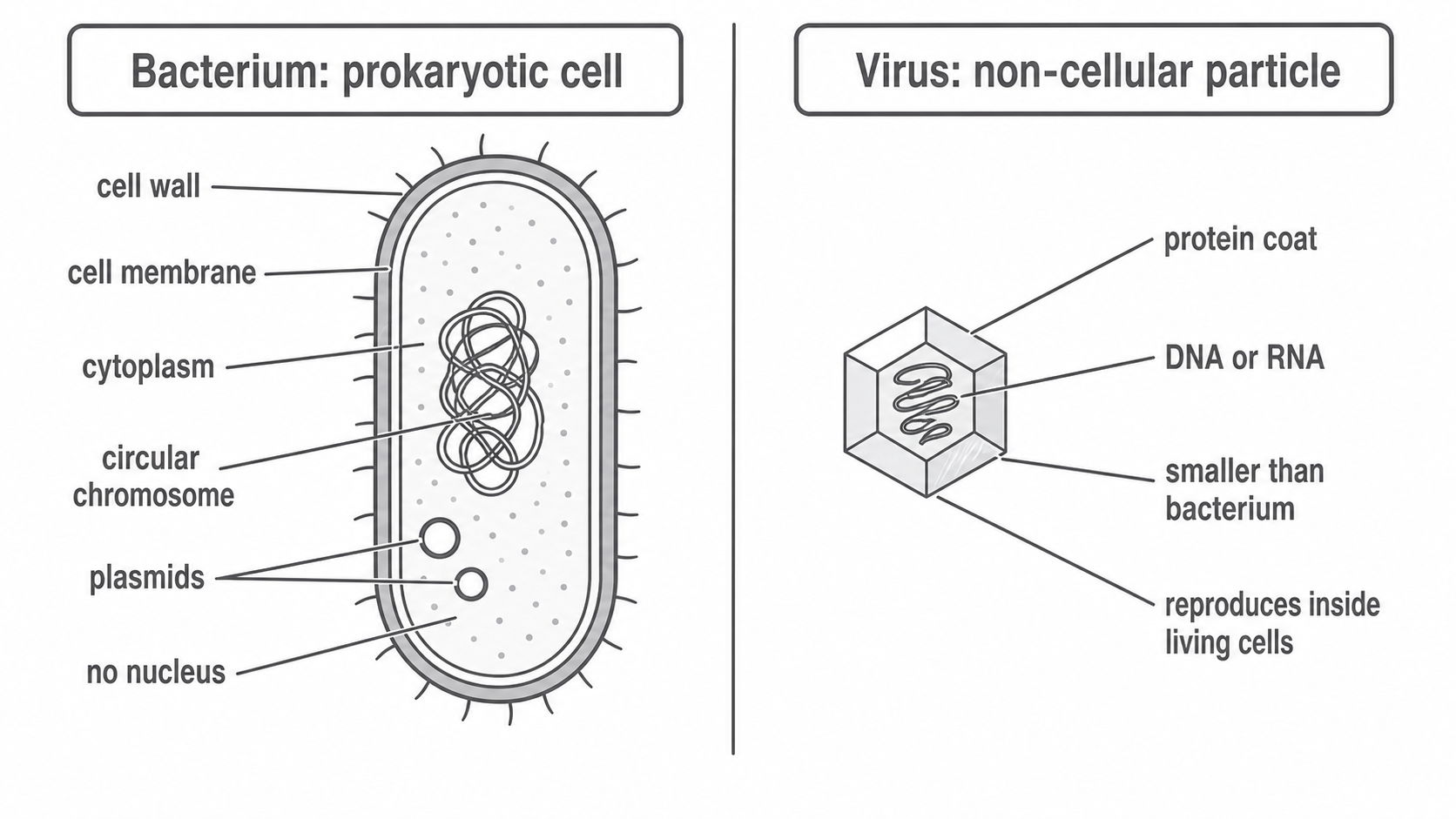
Bacteria are microscopic single-celled prokaryotic organisms. They have a cell wall, cell membrane and cytoplasm. They do not have a nucleus, but they do have a circular chromosome of DNA. Many also contain plasmids, which are small rings of DNA.
[DIAGRAM: asset_name: bacteria_and_virus_comparison; asset_slug: b02_classifying_organisms_and_pathogens__diagram_02; recommended_method: deterministic_drawing; description: A monochrome side-by-side diagram comparing a labelled bacterial cell with a labelled virus particle, showing the bacterium as cellular and the virus as non-cellular and smaller.]
Some bacteria can photosynthesise, but most feed off other living or dead organisms. This matters because you should not classify something as a plant just because it photosynthesises, and you should not classify something as a pathogen just because it is a bacterium.
Edexcel names two bacterial examples:
| Example | Shape or role |
|---|---|
| Lactobacillus bulgaricus | A rod-shaped bacterium used in yoghurt production from milk |
| Pneumococcus | A spherical bacterium that acts as the pathogen causing pneumonia |
Notice the contrast: one named bacterium is useful in food production, while another is pathogenic. A bacterium is classified by its prokaryotic cell structure, not by whether it helps or harms humans.
Pathogens and viruses
Pathogen
A pathogen is an organism or infectious agent that causes disease.
In this specification, pathogens may include fungi, bacteria, protoctists or viruses. The word pathogen is about causing disease, not about belonging to one classification group. A fungus can be a pathogen, but many fungi are not. A bacterium can be a pathogen, but many bacteria are harmless or useful.
Viruses are handled carefully because they are not living organisms. They are small particles, smaller than bacteria, and are parasitic. They can reproduce only inside living cells and can infect every type of living organism.
A virus has no cellular structure. It has a protein coat and contains one type of nucleic acid, either DNA or RNA. Viruses have a wide variety of shapes and sizes, so do not rely on shape alone to identify them.
Edexcel examples show viruses infecting different hosts:
| Virus | Disease or effect |
|---|---|
| Tobacco mosaic virus | Causes discolouring of tobacco leaves by preventing chloroplast formation |
| Influenza virus | Causes flu |
| HIV | Causes AIDS |
The safest exam wording is: viruses are not cells, cannot reproduce independently and only reproduce inside living cells.
Classification decisions in questions
Classification questions often give a mixture of correct clues and tempting distractions. Work from diagnostic features first.
If the organism is multicellular, photosynthetic and has cellulose cell walls, classify it as a plant. If it is multicellular, lacks chloroplasts and cell walls, and usually moves using nervous coordination, classify it as an animal. If it uses hyphae, a mycelium, chitin cell walls and extracellular digestion, classify it as a fungus.
If it is microscopic and single-celled but has eukaryotic features, classify it as a protoctist. If it is microscopic and single-celled with no nucleus, circular DNA and plasmids, classify it as a bacterium. If it is smaller than bacteria, has a protein coat, has DNA or RNA, and reproduces only inside living cells, classify it as a virus.
Common traps are worth making explicit:
- Not all bacteria are pathogens; Lactobacillus bulgaricus is useful in yoghurt production.
- Not all pathogens are bacteria; Plasmodium is a protoctist pathogen and viruses can also be pathogens.
- Not all single-celled organisms are bacteria; yeast is a single-celled fungus and Amoeba is a protoctist.
- Photosynthesis is not exclusive to plants in this specification; Chlorella is a plant-like protoctist and some bacteria can photosynthesise.
- Viruses contain genetic material, but they are not cells and are not classified as living organisms.
Classify from the feature pattern, not from one familiar word in the question.
Try that decision-making now with two descriptions where one clue could easily pull you toward the wrong group.