2.39 - Respiration practical
Respiring living organisms release carbon dioxide and heat. In this practical, you investigate those two products using living material such as germinating seeds, then compare the results with suitable controls. The exam focus is not just the observation: it is also whether the method is fair, reliable, safe, and supports the conclusion.
What the practical shows
The specification uses the word evolution in its older scientific sense: a gas or heat is given off. Here, the aim is to show that living, respiring material gives off carbon dioxide and heat.
Respiring organism
An organism, or living tissue from an organism, whose cells are carrying out respiration and releasing energy from food molecules.
Germinating seeds are commonly used because the embryo inside the seed is alive and actively growing. It respires using stored food in the seed, so the changes can be detected without needing a large animal or plant.
A good investigation compares:
- germinating seeds, which should be respiring
- boiled seeds, which have been killed and should not respire
- sometimes glass beads, which are non-living and can match the volume of the seeds
The controls matter because carbon dioxide in the air, room-temperature changes, microbes on seeds, or unequal seed masses could otherwise be mistaken for respiration by the seeds.
The practical is a comparison: the result from living, germinating seeds only supports respiration if suitable non-respiring controls do not show the same change.
Detecting carbon dioxide
Carbon dioxide can be detected with limewater or sodium hydrogen-carbonate indicator. Limewater is especially useful when the question asks whether carbon dioxide is present: it turns cloudy or milky when carbon dioxide is bubbled through it. Sodium hydrogen-carbonate indicator changes towards yellow when carbon dioxide concentration increases.
[DIAGRAM: asset_name: Respiration practical - diagram 01; asset_slug: b17_respiration_practical__diagram_01; recommended_method: deterministic_drawing; description: Monochrome labelled apparatus showing three sealed seed tubes connected by delivery tubes to limewater: germinating seeds, boiled seeds, and glass beads. Only the germinating-seed tube has bubbles entering cloudy limewater, with labels for damp cotton wool, rubber bung, delivery tube, and limewater.]
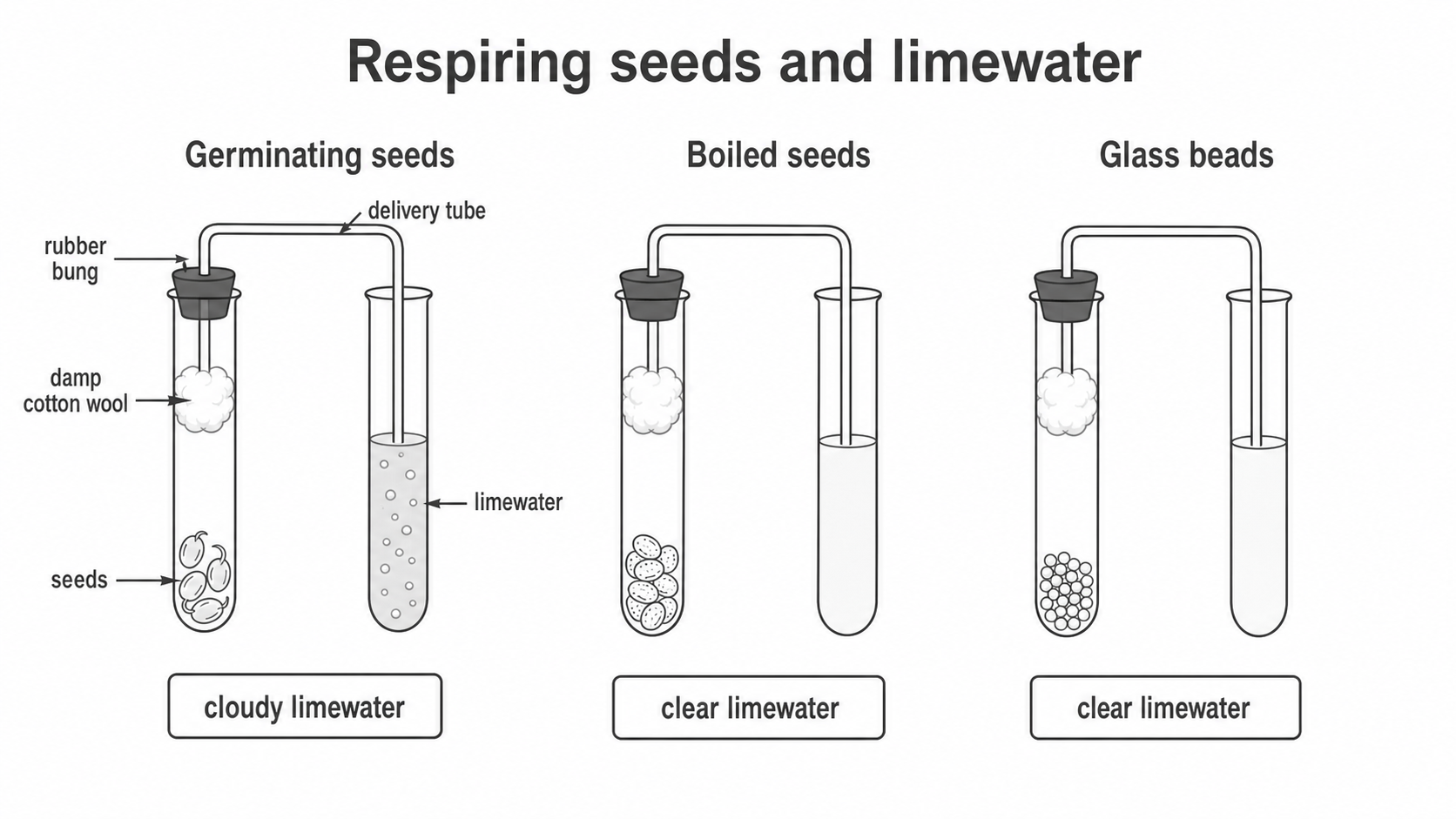
A typical method is:
- Put damp cotton wool and germinating seeds in one tube.
- Put the same number or mass of boiled seeds in a second tube.
- Put glass beads in a third tube if a non-living volume control is wanted.
- Seal each seed tube with a bung and delivery tube.
- Place the delivery tube end just below the surface of limewater in a separate tube.
- Leave the apparatus in the same warm conditions for the same time.
- Compare the limewater in each setup.
The expected result is that limewater connected to germinating seeds becomes cloudy. Limewater connected to boiled seeds or glass beads should remain clear. This supports the conclusion that living respiring seeds release carbon dioxide.
If sodium hydrogen-carbonate indicator is used instead, keep the starting colour the same in all tubes and avoid breathing directly over the indicator. Exhaled air contains carbon dioxide, so it could change the indicator before the experiment begins.
Detecting heat
Respiration releases energy. Some of that energy is transferred as heat, so an insulated flask can show a temperature rise from actively respiring seeds.
[DIAGRAM: asset_name: Respiration practical - diagram 02; asset_slug: b17_respiration_practical__diagram_02; recommended_method: deterministic_drawing; description: Monochrome labelled side-by-side vacuum flasks, one with germinating seeds and one with boiled seeds, each with cotton wool plug and thermometer bulb among seeds. Labels show initial temperature, final temperature, temperature rise only in germinating seeds, and same time/same starting temperature.]
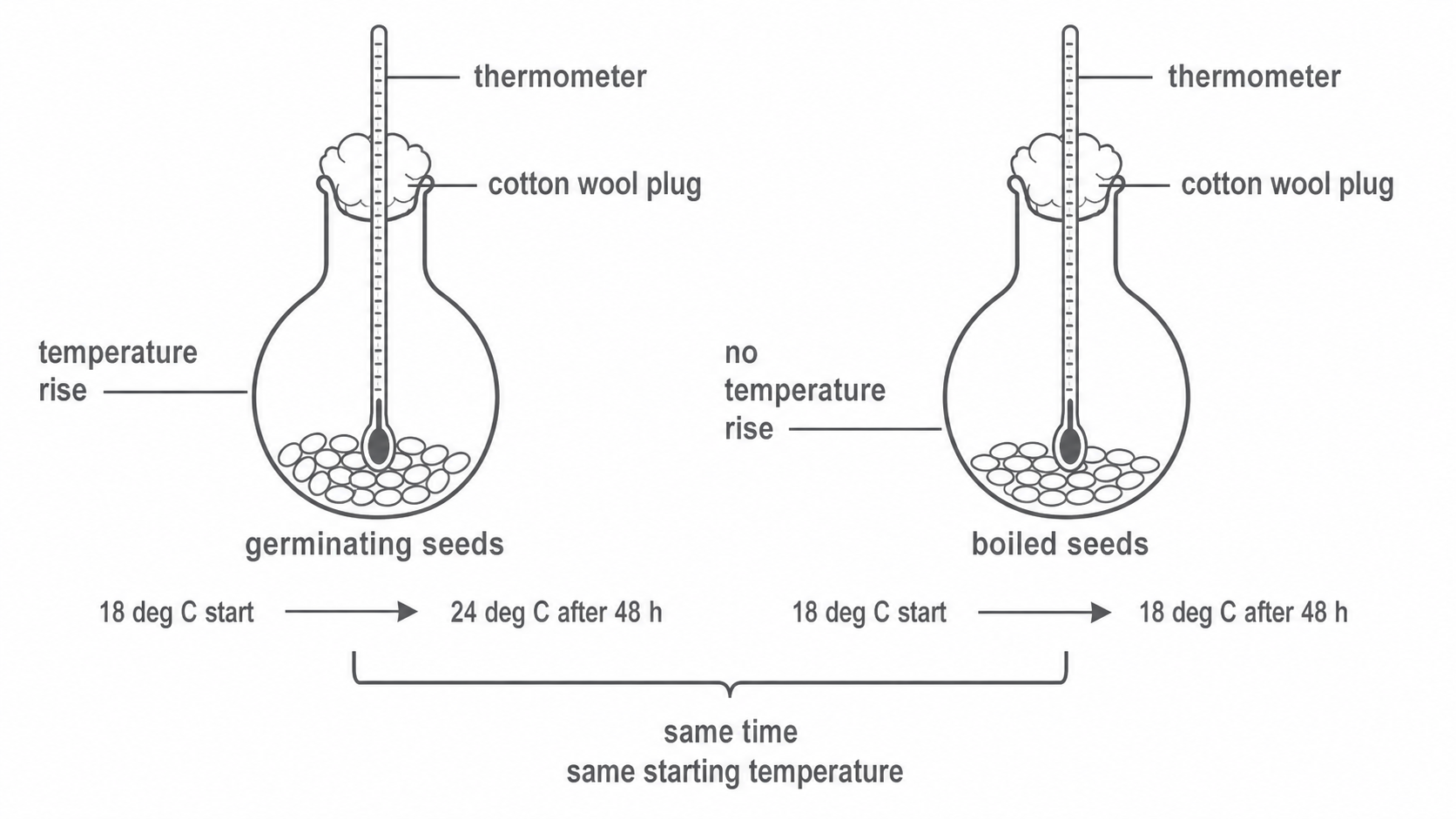
A typical method is:
- Disinfect the seeds and the inside of the flasks, then rinse if instructed by the teacher.
- Put germinating seeds into one vacuum flask.
- Put the same mass of boiled seeds of the same species into a second vacuum flask.
- Place a thermometer or temperature probe so the bulb or sensor is among the seeds.
- Plug the top with cotton wool to reduce heat loss while still allowing gas exchange.
- Record the starting temperature in both flasks.
- Leave both flasks for the same time, often 48 hours, in the same surroundings.
- Record the final temperature in both flasks and calculate the temperature change.
Temperature change
The germinating-seed flask should show a larger temperature rise than the boiled-seed flask. The biological explanation is that living seeds are respiring and releasing heat, while boiled seeds have been killed and their enzymes are denatured, so they do not respire.
Disinfecting is important because microorganisms on the seeds could also respire. If microbes grow on the boiled seeds, they could release heat and make the control look as if the dead seeds were respiring.
Variables, controls and safety
For the carbon dioxide investigation, the dependent variable is the indicator change. For the heat investigation, the dependent variable is the temperature change. In both cases, the independent variable is usually the type of material in the apparatus: germinating seeds, boiled seeds, or glass beads.
Important control variables include:
- species of seed
- number or mass of seeds
- stage of germination
- volume and concentration of limewater or indicator
- starting temperature
- time left before readings are taken
- surrounding temperature
- size and insulation of the flask
- whether apparatus is sealed in the same way
Reliability improves when repeats are carried out and a mean is calculated. If one result is very different from the others, treat it as a possible anomaly and check whether the apparatus leaked, the seed mass was different, the thermometer was misplaced, or the room temperature changed.
Validity improves when the method really tests respiration rather than another cause. The boiled-seed control checks whether living material is needed. Disinfecting reduces the effect of microbial respiration. Equal seed mass and equal time make the comparison fair.
Safety and ethical points are practical, not decorative. Wear eye protection if using indicators, disinfectant, or limewater. Wash hands after handling seeds or living organisms. If small animals are used instead of seeds, they must be handled carefully, kept away from harmful chemicals, and returned to suitable conditions as soon as possible.
Conclusions and evaluation
A strong conclusion links the observation to the control and then to respiration:
- Limewater changed with germinating seeds but not with boiled seeds, so living respiring seeds released carbon dioxide.
- The germinating-seed flask became warmer than the boiled-seed flask, so living respiring seeds released heat.
Do not overclaim. A cloudy limewater result shows carbon dioxide was released; it does not by itself measure the rate of respiration unless the method includes timed measurements or a quantitative carbon dioxide sensor. A temperature rise shows heat release; it does not prove that every joule of energy from respiration became measurable heat in the flask.
To make the carbon dioxide investigation more quantitative, you could record the time taken for limewater to become cloudy, use the same volume of limewater each time, or use a carbon dioxide sensor. To make the heat investigation more precise, you could use digital temperature probes, data logging, repeats, equal seed masses, and a well-insulated flask.
Exam answers often lose marks by saying only "the seeds produce energy". The practical evidence is more specific: respiring seeds release carbon dioxide and heat. Another common error is forgetting the control. Without a boiled-seed or non-living comparison, it is much harder to show that the observed change was due to respiration by living seeds.