2.33B - Food energy practical
Food contains chemical energy. In this practical, you estimate how much energy a food sample releases by burning it and measuring how much it warms a known mass of water. The method is simple, so the result is an estimate rather than the true food-label value, but it is excellent for learning fair testing, calculation and evaluation.
What the practical measures
The food sample is used as a fuel. When it burns, some of its stored chemical energy is transferred by heating to the water above it. If the same mass of water is used each time, a larger rise in water temperature suggests that more energy has been transferred from the food.
Energy content
Energy content is the energy released from a known mass of food, usually compared as energy per gram of food.
The practical does not measure every joule stored in the food. Some energy heats the air, the glass, the needle and the surroundings instead of the water. This is why the result is normally much lower than a value printed on food packaging.
To compare foods fairly, you need two ideas:
- total energy transferred to the water
- energy transferred per gram of food burned
The second one matters because a larger sample can release more total energy simply because there is more of it.
Method and variables
A typical setup uses a boiling tube clamped above a burning food sample held on a mounted needle. The tube contains a measured volume of water and the water temperature is measured before and after the food burns.
[DIAGRAM: asset_name: Food energy practical - diagram 01; asset_slug: b14_food_energy_practical__diagram_01; recommended_method: deterministic_drawing; description: Monochrome apparatus diagram showing a clamped boiling tube with measured water and thermometer, a burning food sample on a mounted needle below it, upward heat transfer arrows, and labels for the measurements used in the calculation.]
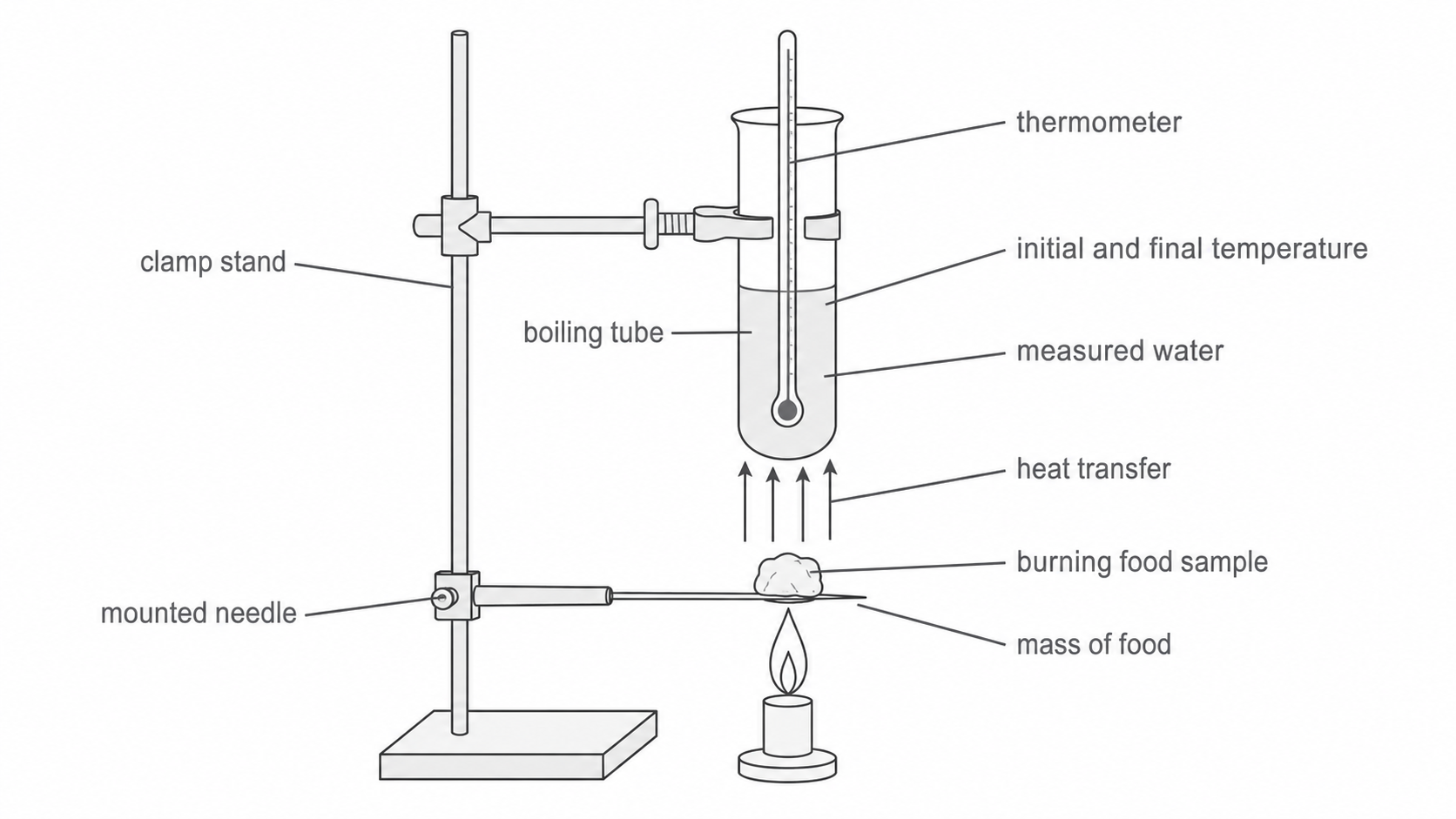
One clear method is:
- Measure a fixed volume of water, such as 20 cm3 or 25 cm3, into a boiling tube.
- Record the initial temperature of the water.
- Measure the mass of the food sample.
- Carefully light the food sample using a Bunsen burner, then place it under the boiling tube.
- Keep the burning food in the same position under the tube. If it goes out before it is fully burned, relight it.
- Stir the water gently with the thermometer and record the highest final temperature reached.
- Calculate the temperature rise and repeat for other food samples.
The independent variable is usually the type of food sample. The dependent variable is the temperature rise, or the calculated energy per gram. Control variables include the volume of water, the distance between the burning food and the tube, the apparatus arrangement, the starting temperature where possible, and the rule for relighting the sample.
Safety is part of the method, not an afterthought. Wear eye protection, tie long hair back, take care with the Bunsen flame and hot glass, keep the mounted needle away from hands, and avoid foods that could trigger allergies. Nuts are usually avoided because nut allergies can be severe.
Calculating energy content
The calculation uses the temperature rise of the water. For school-level food calorimetry, 1 cm3 of water is taken to have a mass of about 1 g.
Energy transferred to water
In this formula, E is the energy transferred to the water in joules, m is the mass of water in grams, c is the specific heat capacity of water, and Delta T is the temperature rise in degrees C. For water, use:
After finding the energy transferred to the water, divide by the mass of food burned:
Worked example: a student burns 1.5 g of crisp. It heats 25 cm3 of water from 20.0 degrees C to 32.0 degrees C.
Temperature rise:
Mass of water:
Energy transferred to water:
Energy per gram:
That is also:
Show your working clearly in this practical. It helps you earn method marks even if one number is copied incorrectly.
Recording and comparing results
A good results table makes the calculation easy to check. Put units in the column headings, not repeated in every data cell.
| Food sample | Mass of food burned / g | Volume of water / cm3 | Initial water temperature / degrees C | Final water temperature / degrees C | Temperature rise / degrees C | Energy per gram / J g-1 |
|---|---|---|---|---|---|---|
| Crisp A | 1.5 | 25 | 20.0 | 32.0 | 12.0 | 840 |
| Crisp B | 1.4 | 25 | 20.0 | 28.4 | 8.4 | 630 |
Temperature rise alone can be useful for a quick comparison only if the mass of food burned and volume of water are the same. Energy per gram is a fairer comparison because it corrects for different food masses.
Repeats improve reliability. If three repeats are done for each food, calculate a mean energy per gram, but consider whether any result is anomalous before using it. A result may be anomalous if the food fell off the needle, went out repeatedly, or was much larger or smaller than the other repeats.
When presenting data, a bar chart is suitable for comparing different food samples because the independent variable is categoric. The bars should show calculated energy per gram, not just the final water temperature.
Evaluating the method
The main weakness is heat loss. In a simple boiling-tube setup, a lot of energy from the burning food escapes to the air instead of heating the water. Some energy also heats the glass tube, the thermometer and the mounted needle.
Another weakness is incomplete combustion. If the food leaves black residue or will not burn fully, not all of its chemical energy has been released. The calculated energy per gram will then be too low.
Accuracy can also be affected by practical details:
- the distance between the flame and the water changes
- the boiling tube angle changes
- the food sample falls off the needle
- water is not stirred before reading the final temperature
- the thermometer is read at eye level in one repeat but not another
- the balance or measuring cylinder is not precise enough for small samples
Useful improvements are linked to those weaknesses. A draught shield or simple calorimeter can reduce heat loss. Keeping the distance between food and tube constant improves fairness. Stirring before reading the highest water temperature improves the temperature measurement. Repeating and calculating a mean improves reliability. Using a larger mass of water can make the temperature change easier to handle without boiling, but it may also make the rise smaller, so the apparatus choice must be justified carefully.
The best evaluation answers name a problem, explain its effect on the calculated result, and give a matching improvement.
This practical estimates energy content by measuring how much a known mass of burning food heats a known mass of water, then converting the temperature rise into energy per gram.
Use that idea when you evaluate the method: every limitation either changes how much energy reaches the water or changes how accurately the mass and temperature rise are measured.