2.5B-2.6B - Cell differentiation and stem cells
Multicellular organisms are not just large collections of identical cells. During development, cells become specialised so different parts of the organism can do different jobs. Stem cells matter because they can divide and produce cells that may replace damaged or diseased cells, but using them in medicine involves scientific, medical and ethical trade-offs.
Differentiation in development
A new organism begins with cells that are not yet specialised for one particular job. These cells divide by mitosis to make more cells. As development continues, some cells differentiate: they become specialised cells with structures and functions suited to particular roles.
Cell differentiation
Cell differentiation is the process in which an unspecialised cell becomes a specialised cell with a particular function.
Differentiation is important because a growing organism needs different cell types. Muscle cells contract, nerve cells carry electrical impulses, and blood cells transport substances. These cells are not interchangeable: each is specialised for a job that helps tissues and organs work.
[DIAGRAM: asset_name: Cell differentiation and stem cells - diagram 01; asset_slug: b04_cell_differentiation_and_stem_cells__diagram_01; recommended_method: deterministic_drawing; description: Monochrome process diagram showing an unspecialised early embryo cell dividing by mitosis and differentiating into several specialised cell types, including muscle cell, nerve cell and blood cell, then contributing to tissues and organs.]
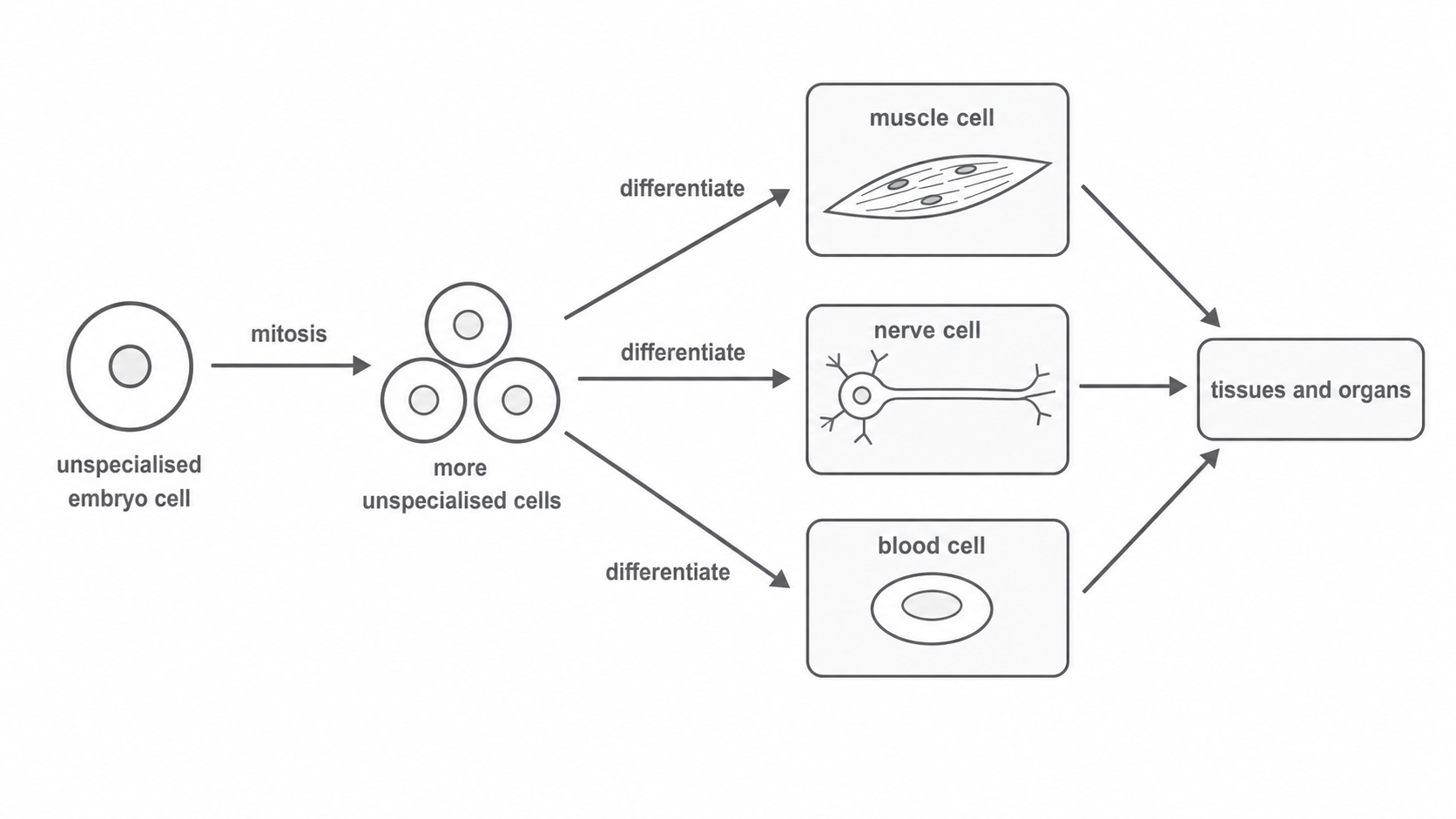
The key exam link is: differentiation produces specialised cells, and specialised cells allow tissues and organs to develop. Without differentiation, the embryo would produce many similar cells but not the range of cells needed for a functioning body.
Specialised cells and function
A specialised cell has features that help it carry out its function efficiently. For example, a muscle cell contains structures that help it contract, while a nerve cell has a long shape that helps it carry impulses over a distance.
Specialisation is useful because different body functions need different cell features. A cell adapted for contraction is not the best design for carrying impulses. A cell adapted for carrying oxygen is not the best design for absorbing water from soil. Differentiation lets one organism build many cell types from earlier unspecialised cells.
This is why an answer about differentiation should not stop at "cells become different". The important biological point is that the differences matter: specialised cells have specific functions, and groups of specialised cells form tissues and organs.
Once many body cells are fully specialised, they cannot usually change into a completely different cell type. That is one reason stem cells are medically interesting: they are less specialised and can still produce other cells.
What stem cells are
Stem cells are unspecialised cells. They can divide by mitosis, and some of the cells produced can differentiate into specialised cell types.
Stem cell
A stem cell is an unspecialised cell that can divide and can produce specialised cells by differentiation.
The two source ideas that matter most here are embryonic stem cells and adult stem cells.
Embryonic stem cells come from an early embryo. They can produce many different cell types, so they are very flexible. This makes them useful in research and potentially useful in treatments, but their use raises ethical issues because embryos are involved.
Adult stem cells are found in some tissues and organs, such as bone marrow. They help maintain and repair tissues, but they usually produce a more limited range of specialised cells than embryonic stem cells. Bone marrow stem cells, for example, can produce different blood cells.
Do not confuse a stem cell with an ordinary specialised cell. A specialised muscle cell or nerve cell already has a specific function, so it is not normally able to divide repeatedly and form many other cell types.
Stem cells in medicine
Using stem cells in medicine is based on a simple idea: if cells are damaged, diseased or missing, stem cells may be used to produce replacement specialised cells. The process has to be controlled carefully so the right cells are produced and transplanted safely.
The established example for this level is blood-forming stem cells from bone marrow or blood. These can be used in stem cell transplants because they can produce different blood cells:
- red blood cells, which transport oxygen
- white blood cells, which help defend against pathogens
- platelets, which help blood clot
[DIAGRAM: asset_name: Cell differentiation and stem cells - diagram 02; asset_slug: b04_cell_differentiation_and_stem_cells__diagram_02; recommended_method: deterministic_drawing; description: Monochrome flow diagram comparing stem cells from the patient, a donor or an embryo, controlled growth and differentiation, transplant to replace damaged cells, and side labels for key benefits and risks.]
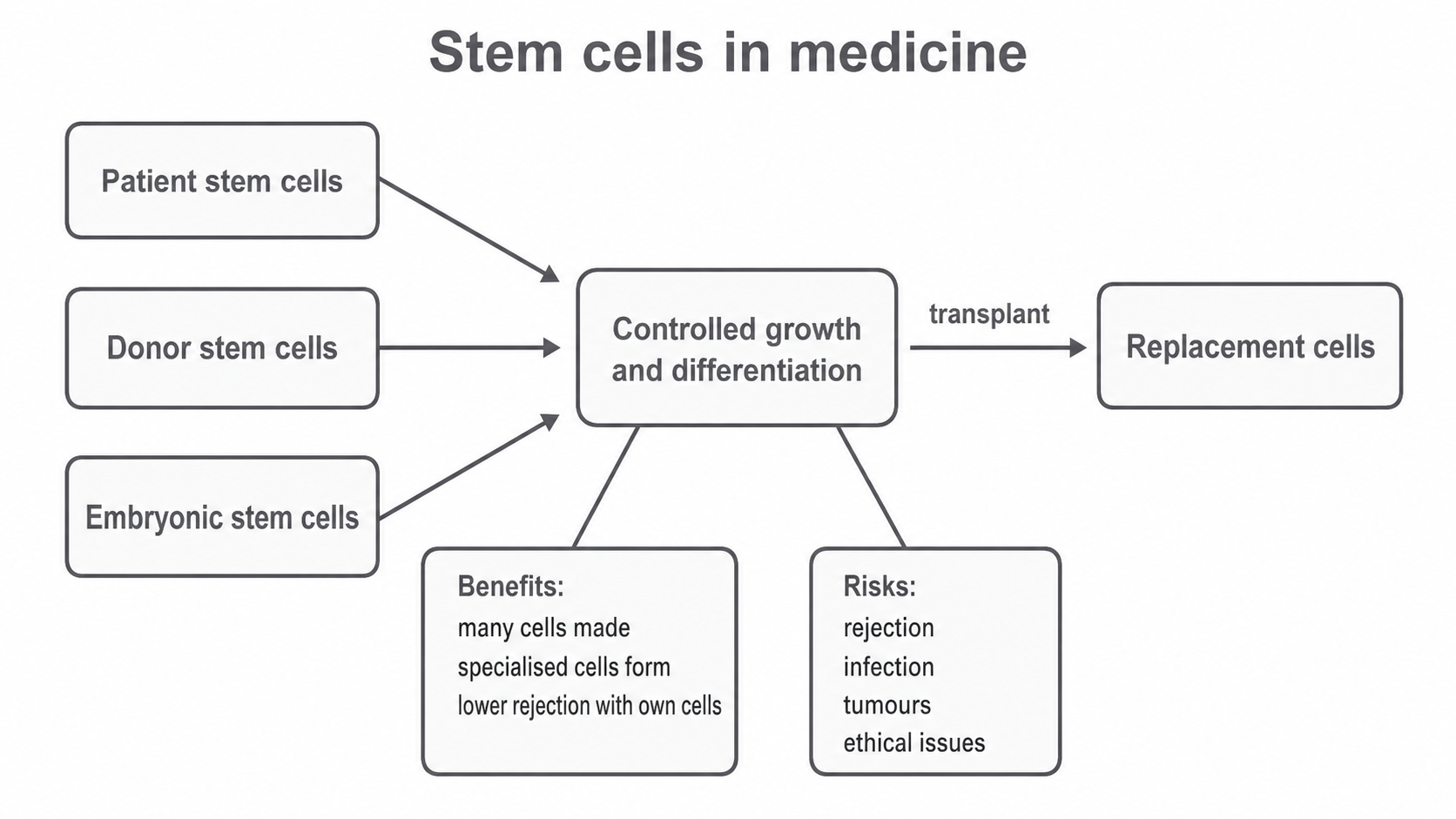
Stem cells may come from the patient or from a donor. Using the patient's own stem cells is called an autologous transplant. This can reduce rejection because the cells have the same genes and antigens as the patient. Donor stem cells can be useful when the patient's own cells are diseased or cannot be collected, but the donor and patient need to be closely matched.
Many possible stem-cell uses are still being researched. In exam answers, avoid saying that stem cells automatically cure any disease. A better answer explains that stem cells can divide and differentiate, so they may replace particular damaged or diseased cells if the treatment is controlled and safe.
Weighing benefits and risks
The specification asks for advantages and disadvantages of using stem cells in medicine. The strongest answers compare the benefit with the source of the cells and the possible risk.
Advantages include:
- stem cells can divide, so they can produce many replacement cells
- stem cells can differentiate, so they may replace damaged specialised cells
- stem cells may treat diseases where cells are missing, damaged or destroyed
- using a patient's own stem cells lowers the chance of immune rejection
- embryonic stem cells can produce many cell types, so they have wider potential uses
Disadvantages include:
- embryonic stem-cell use raises ethical objections because embryos are involved
- donor stem cells may be rejected by the patient's immune system
- donor cells can cause graft versus host disease, where donor immune cells attack the patient's tissues
- transplants can involve infection risk and a long recovery
- cells may grow or differentiate in an uncontrolled way, including tumour formation
- adult stem cells may only form a limited range of specialised cells
- some claimed stem-cell treatments are unproven, so benefit and safety must be tested
Good Edexcel-style evaluation is not just a list. Link each point to the biology. For example, "own stem cells are better" is weak by itself. A stronger answer says that own stem cells have the same antigens as the patient, so they are less likely to be attacked by the immune system.