2.34-2.37 - Aerobic respiration and ATP
Respiration is the chemical process that transfers energy from glucose into ATP in living organisms. ATP is the small molecule cells can use directly when they need energy for work such as movement, active transport, and building larger molecules. In this lesson, the main focus is aerobic respiration, its equation, and how it differs from anaerobic respiration.
Respiration makes ATP
Respiration is not the same as breathing. Breathing is one way animals get oxygen into the body and remove carbon dioxide; respiration is a chemical process inside cells. All living organisms respire because all living cells need a usable supply of energy.
During respiration, glucose is broken down by enzyme-controlled reactions. The energy transferred from glucose is used to make ATP. ATP is useful because it can move energy around the cell in small, manageable amounts, instead of releasing all the energy from glucose at once.
Respiration
Respiration is the chemical process in living cells that transfers energy from glucose to make ATP.
In animals, plants, and fungi, most aerobic respiration happens in mitochondria. Bacteria do not have mitochondria, but they can still respire because respiration is a cell process, not a process that only happens in one type of organelle.
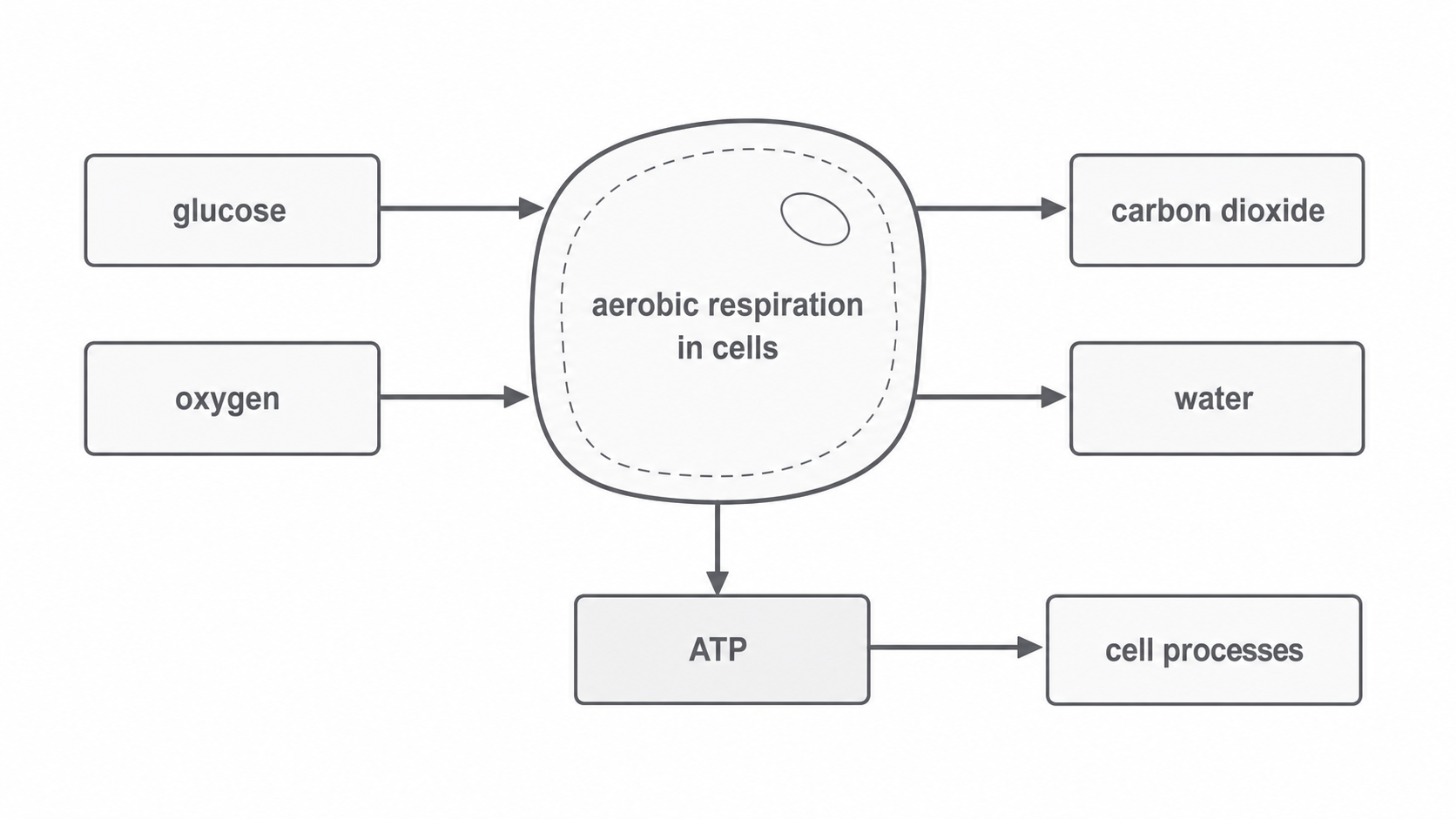
[DIAGRAM: asset_name: Aerobic respiration and ATP - diagram 01; asset_slug: b15_aerobic_respiration_and_atp__diagram_01; recommended_method: deterministic_drawing; description: Monochrome flow map showing glucose and oxygen entering aerobic respiration in a cell, carbon dioxide and water leaving, and ATP supplying cell processes.]
ATP powers cells
ATP stands for adenosine triphosphate. You do not need to draw its chemical structure here, but the name helps explain the idea: ATP has three phosphate groups. When ATP is broken down to ADP and phosphate, energy is made available for cell processes.
ATP
ATP is a molecule that provides energy for cells.
Cells use ATP for processes that require energy, including:
- muscle contraction
- active transport across cell membranes
- synthesis of large molecules from smaller molecules
- cell division and growth
A useful exam phrase is: respiration transfers energy from glucose to ATP, and ATP then provides energy for cell processes. Avoid writing that cells "make energy"; energy is transferred, not created.
Aerobic respiration equations
Aerobic respiration is respiration that uses oxygen. In aerobic respiration, glucose is completely broken down, so the products are carbon dioxide and water. The energy transferred is used to make ATP; it is not written as a chemical substance in the balanced symbol equation.
Word equation for aerobic respiration
glucose + oxygen -> carbon dioxide + water
You may also see the word equation written with "energy transferred" or "ATP produced" after the products. That reminds you why the reaction matters, but the substances you must name are glucose, oxygen, carbon dioxide, and water.
Balanced symbol equation for aerobic respiration
The numbers in the balanced equation matter. One glucose molecule reacts with six oxygen molecules. This produces six carbon dioxide molecules and six water molecules. The atoms are conserved: six carbon atoms on both sides, twelve hydrogen atoms on both sides, and eighteen oxygen atoms on both sides.
Aerobic and anaerobic compared
Anaerobic respiration is respiration without oxygen. It still produces ATP, but it transfers much less energy to ATP from each glucose molecule than aerobic respiration does. This is because the glucose is not completely broken down.
The key difference is oxygen use: aerobic respiration requires oxygen; anaerobic respiration does not. The next difference follows from that: aerobic respiration completely breaks down glucose to carbon dioxide and water, while anaerobic respiration leaves some energy in its end products.
[DIAGRAM: asset_name: Aerobic respiration and ATP - diagram 02; asset_slug: b15_aerobic_respiration_and_atp__diagram_02; recommended_method: deterministic_drawing; description: Monochrome comparison grid contrasting oxygen use, glucose breakdown, ATP yield, and products for aerobic and anaerobic respiration.]
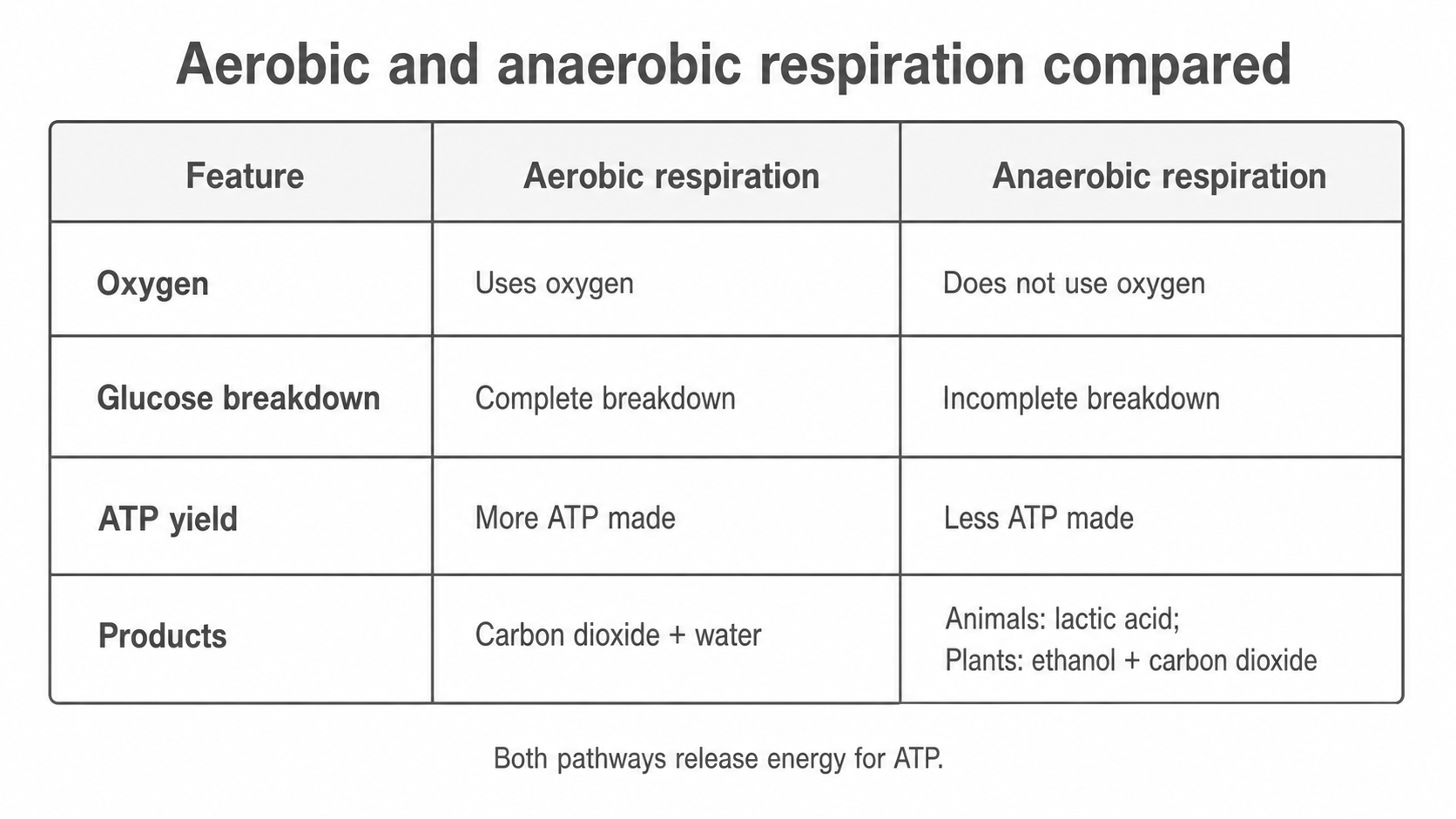
For this lesson, you should be able to describe the differences. The detailed anaerobic word equations are taught in the next respiration cluster, but it is useful to know the product pattern: animals produce lactic acid, while plants and yeast produce ethanol and carbon dioxide.
Exam precision
Pearson questions on this cluster often reward short, exact statements. If a question asks for ATP, name ATP rather than only saying "energy". If a question asks for the balanced symbol equation, include the correct formulae and the balancing numbers.
Common mistakes are easy to avoid:
- Do not say respiration means breathing.
- Do not say oxygen is produced in aerobic respiration; oxygen is a reactant.
- Do not say glucose is made in aerobic respiration; glucose is broken down.
- Do not put carbon dioxide and water on the left-hand side of the aerobic respiration equation.
- Do not claim anaerobic respiration makes no ATP; it makes less ATP.
When explaining ATP, link the ideas in order: glucose is broken down in respiration, energy is transferred to ATP, and ATP provides energy for cell processes. That chain is usually clearer than trying to describe every biochemical step.
Aerobic respiration uses glucose and oxygen to produce carbon dioxide and water, transferring energy to ATP so cells can carry out their work.