2.29-2.32 - Digestive enzymes, bile and absorption
Food is useful to the body only after large, insoluble molecules have been digested into small, soluble molecules. Digestive enzymes do the chemical breakdown, bile makes lipid digestion more efficient, and the small intestine absorbs the soluble products into transport systems. This lesson follows the journey from food molecules in the gut to absorbed nutrients leaving a villus.
Enzymes turn large food molecules into soluble products
Digestion is the breakdown of food molecules. Mechanical digestion breaks food into smaller pieces, but chemical digestion uses enzymes to break large molecules into smaller molecules.
Digestive enzymes are proteins that catalyse breakdown reactions in the alimentary canal. They are needed because many food molecules are too large and insoluble to pass through the wall of the small intestine. After digestion, the products are small enough to be absorbed.
Digestive enzyme
A biological catalyst that breaks large food molecules into smaller soluble molecules in the digestive system.
The important exam pattern is substrate -> enzyme -> product:
[DIAGRAM: asset_name: digestive_enzyme_products; asset_slug: b13_digestive_enzymes_bile_and_absorption__diagram_01; recommended_method: deterministic_drawing; description: Monochrome flow summary showing starch digested by amylase then maltase to glucose, proteins digested by proteases to amino acids, and lipids digested by lipases to fatty acids and glycerol.]
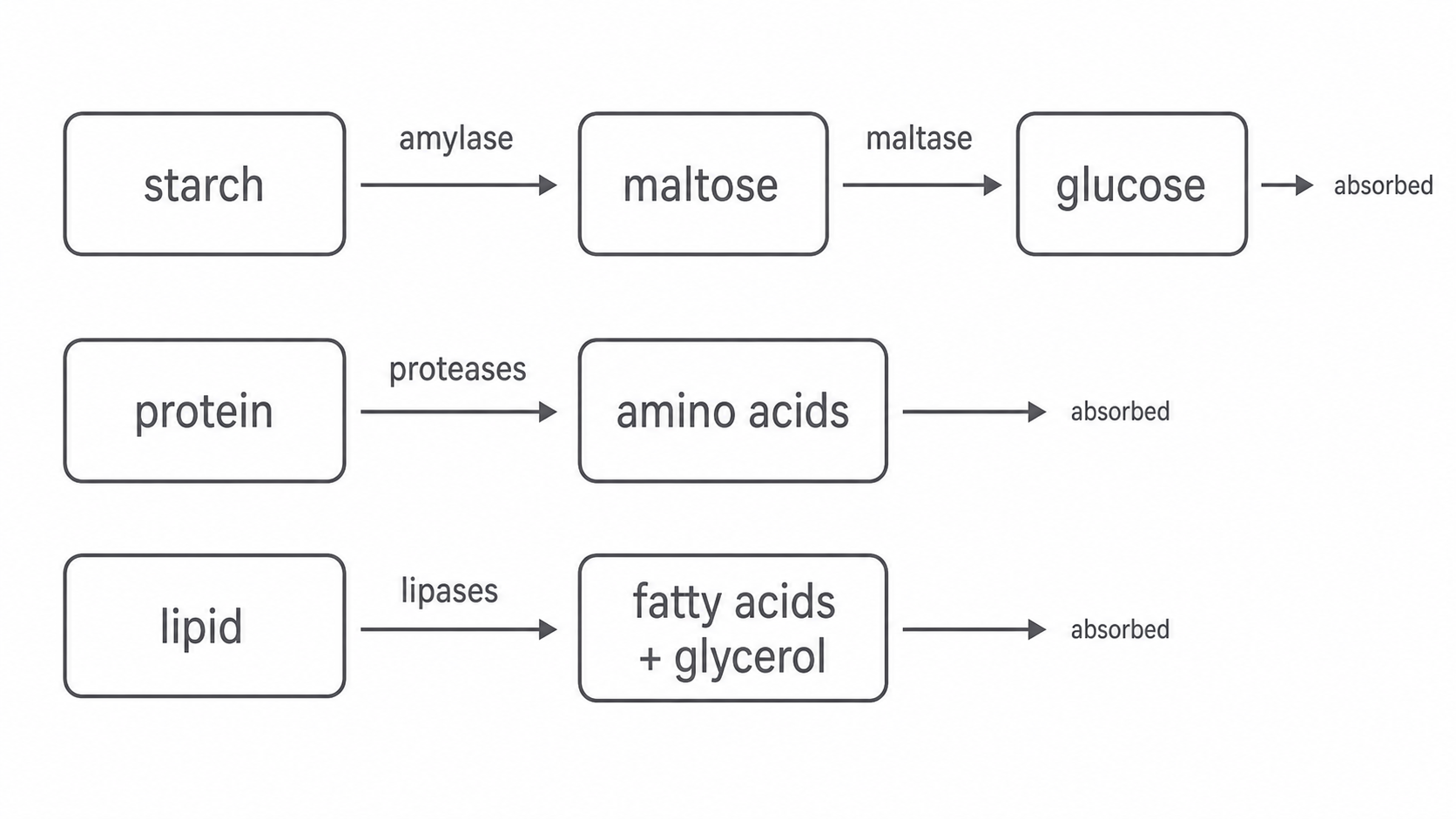
Notice the wording: enzymes do not "melt" food or "use up" food. They catalyse the breakdown of specific large molecules into named small products.
Carbohydrates and proteins have named products
Starch is a large carbohydrate made from many glucose units. The Edexcel sequence is:
- amylase digests starch into maltose
- maltase digests maltose into glucose
Glucose is a small soluble sugar, so it can be absorbed through the wall of the small intestine after digestion. A common mistake is to stop at "amylase digests starch into sugar". That is partly true but not precise enough when the question asks for the named enzyme sequence: amylase starts the process and maltase finishes it by producing glucose.
Proteins are digested by proteases. The final products are amino acids. The key exam link is that proteins are too large for direct absorption, but amino acids are small soluble molecules that can pass into the blood.
For this specification: starch -> glucose by amylase and maltase; protein -> amino acids by proteases.
Lipids need lipase and bile
Lipids are fats and oils. Lipases digest lipids into fatty acids and glycerol. These are the named products you should use in an exam answer.
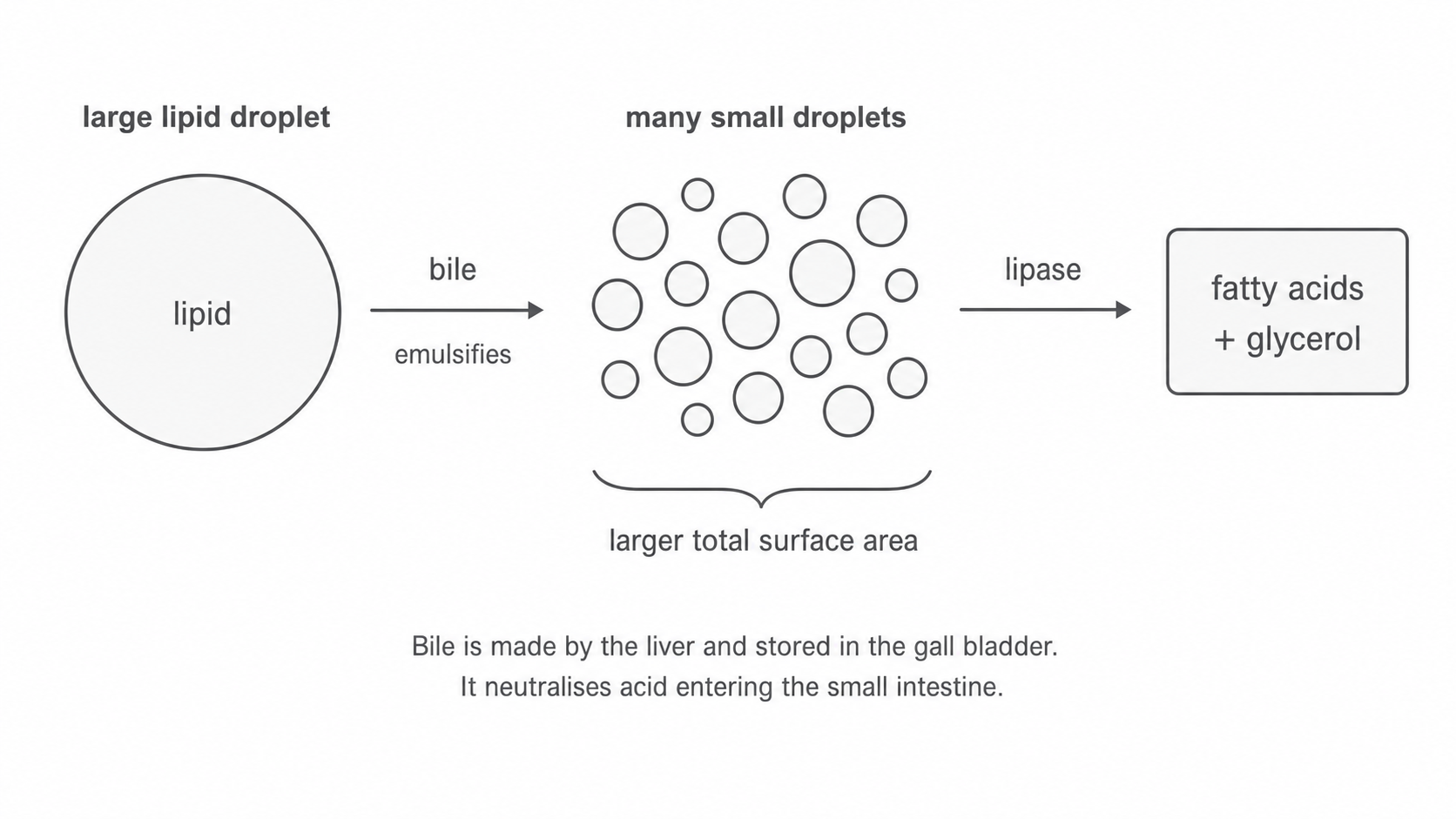
Bile is involved in lipid digestion, but bile is not an enzyme. Bile is produced by the liver and stored in the gall bladder. When food containing lipid enters the small intestine, bile is released into the first part of the small intestine.
Bile has two roles in this specification:
- it neutralises stomach acid entering the small intestine
- it emulsifies lipids
Neutralising stomach acid makes the contents of the small intestine less acidic. This matters because digestive enzymes in the small intestine work best away from the strongly acidic conditions of the stomach.
Emulsification means breaking large lipid droplets into many smaller droplets. The amount of lipid has not changed, but the surface area has increased. More lipid surface is exposed to lipase at the same time, so lipid digestion is faster.
[DIAGRAM: asset_name: bile_emulsification; asset_slug: b13_digestive_enzymes_bile_and_absorption__diagram_02; recommended_method: deterministic_drawing; description: Monochrome process diagram showing one large lipid droplet changed by bile into many smaller droplets, increasing total surface area for lipase, with lipase acting to form fatty acids and glycerol.]
Absorption moves digested food into transport systems
Absorption is the movement of digested food molecules from the small intestine into the body's transport systems. It happens after digestion has produced small soluble molecules.
Glucose and amino acids pass into blood capillaries in the wall of the small intestine. They are then carried away in the blood to cells and organs. Fatty acids and glycerol are absorbed through villi too; many lipid digestion products enter a lymph vessel called a lacteal before eventually reaching the blood.
This is why the small intestine is not just a tube for food to pass through. Its lining is specialised as an exchange surface. It must provide a large area for contact with digested food, a short distance for movement into the body, and transport vessels that carry absorbed products away.
When answering "how is the small intestine adapted for absorption?", link each structure to the job it does. Naming a structure alone usually earns less credit than naming the structure and explaining how it increases absorption.
A villus is built for rapid absorption
The inner surface of the small intestine has many tiny finger-like projections called villi. One projection is a villus. Villi greatly increase the surface area in contact with digested food.
[DIAGRAM: asset_name: villus_structure; asset_slug: b13_digestive_enzymes_bile_and_absorption__diagram_03; recommended_method: deterministic_drawing; description: Labelled monochrome villus diagram with lumen, thin epithelium, microvilli/surface area, blood capillary network, lacteal, arrows for glucose and amino acids to blood, and fatty acids and glycerol to lacteal.]
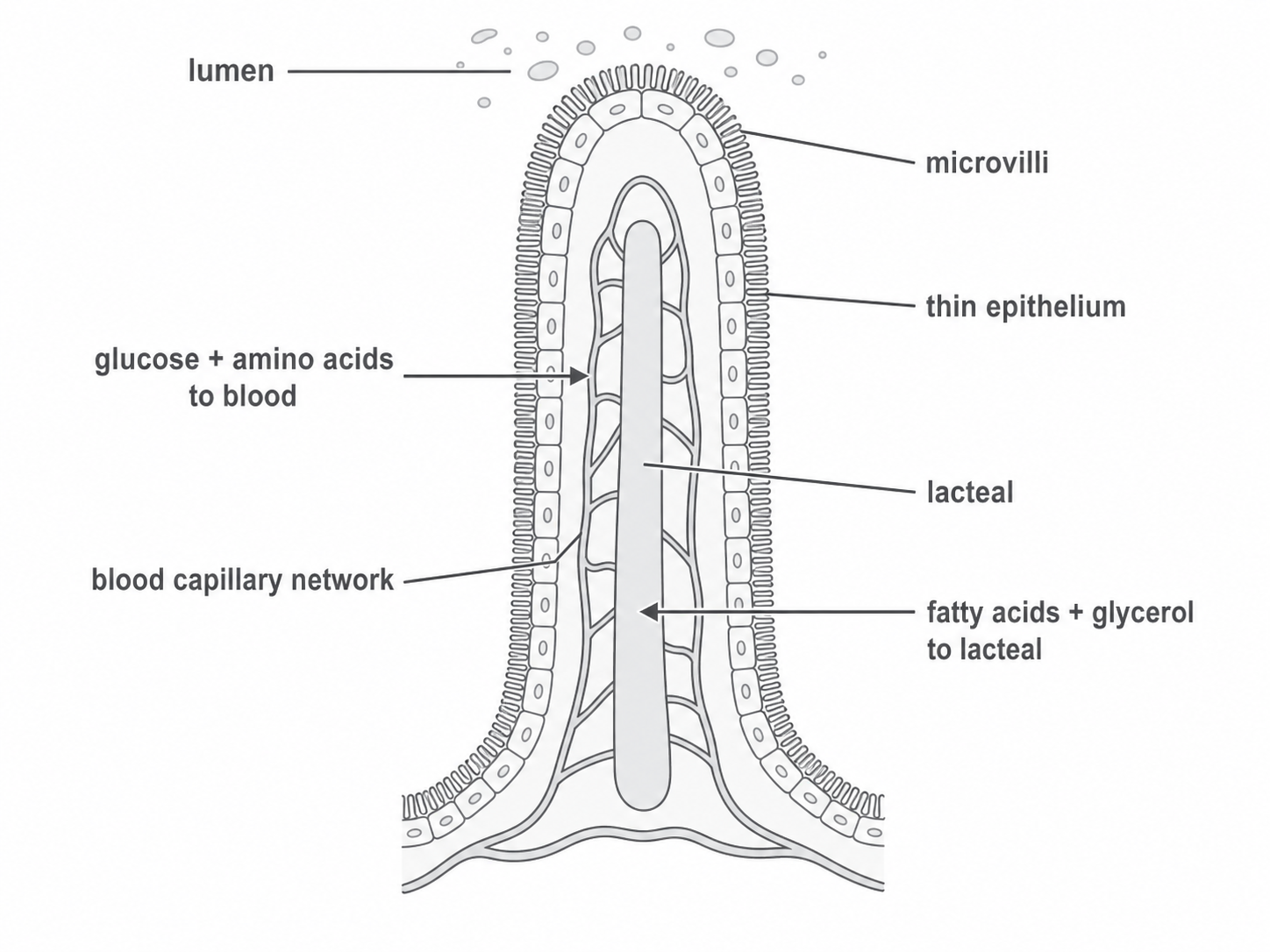
Each feature helps absorption in a specific way:
| Villus feature | How it helps absorption |
|---|---|
| Many villi on the small intestine lining | Provides a large surface area for absorption |
| Microvilli on epithelial cells | Further increases surface area |
| Epithelium is thin | Gives a short diffusion distance |
| Blood capillary network | Carries glucose and amino acids away, maintaining a concentration gradient |
| Lacteal | Carries absorbed lipid digestion products away in lymph |
The phrase "including the structure of a villus" means you should be able to describe more than "small intestine has villi". A strong answer names the villus parts and links them to rapid movement of products of digestion.