2.21-2.23 - Leaf adaptations, minerals and photosynthesis practical
Leaves are not just flat green surfaces: their layers, air spaces and transport tissues make photosynthesis efficient. Plants also need mineral ions to build the molecules that let them grow. This lesson finishes with the practical logic for showing oxygen production, starch production, and the requirements for photosynthesis.
Leaf structure for photosynthesis
A leaf is adapted for photosynthesis because it helps the plant collect light, take in carbon dioxide, supply water, and move products away. In exam answers, do not just name a structure. Link the structure to how it helps photosynthesis.
[DIAGRAM: asset_name: Leaf adaptations, minerals and photosynthesis practical - diagram 01; asset_slug: b10_leaf_adaptations_minerals_and_photosynthesis_practical__diagram_01; recommended_method: deterministic_drawing; description: Monochrome labelled cross-section of a leaf showing waxy cuticle, upper epidermis, palisade mesophyll with chloroplasts, spongy mesophyll with air spaces, lower epidermis, stomata with guard cells, vascular bundle, xylem and phloem. Arrows show light entering, carbon dioxide diffusing in, oxygen diffusing out, water and mineral ions arriving in xylem, and sugars moving away in phloem.]
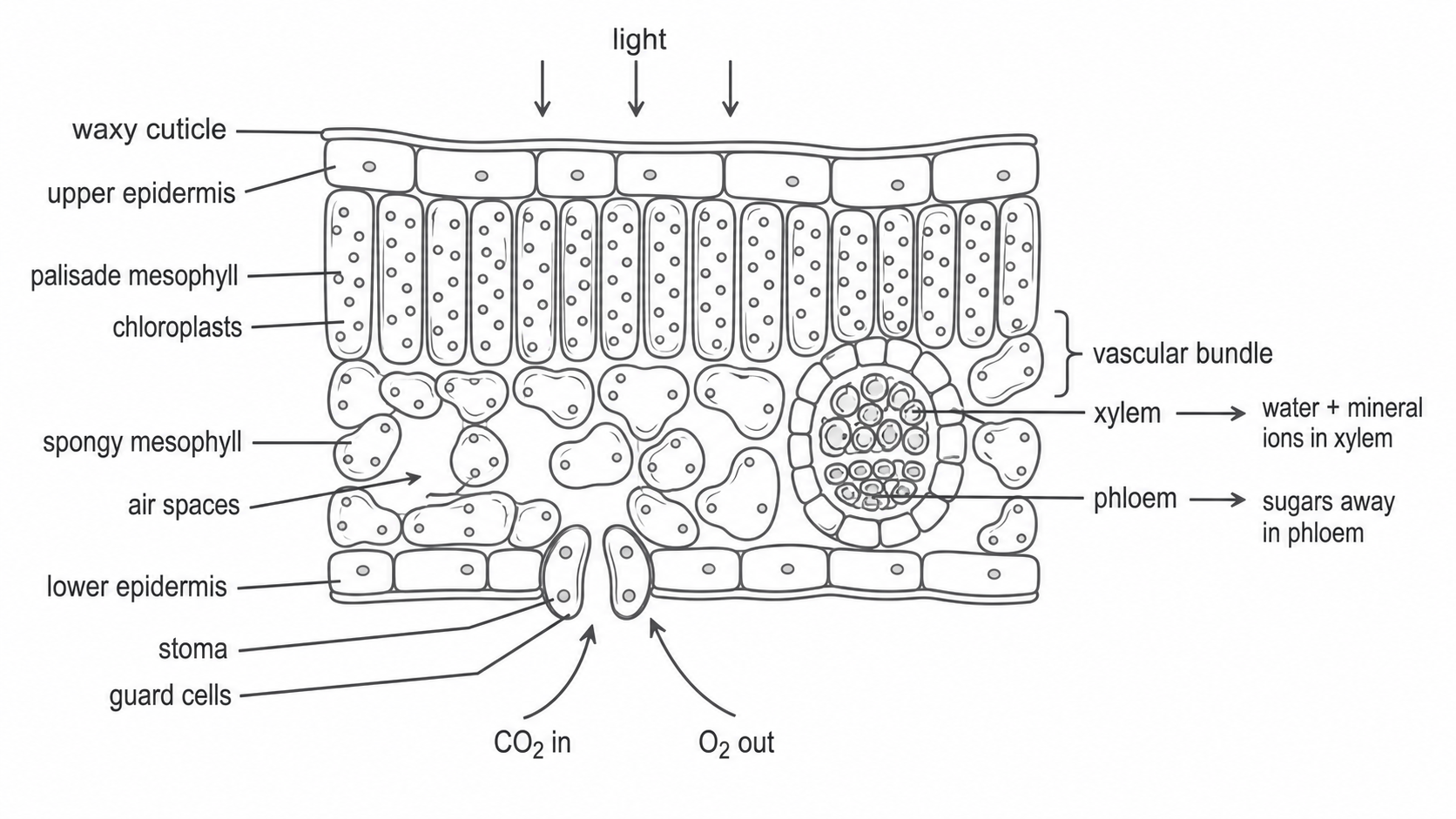
| Leaf feature | How it is adapted for photosynthesis |
|---|---|
| Broad, flat leaf | Gives a large surface area to absorb light. |
| Thin leaf | Gives a short diffusion distance for carbon dioxide to reach photosynthesising cells. |
| Transparent upper epidermis and thin cuticle | Let light pass through to the palisade mesophyll. |
| Palisade mesophyll near the upper surface | Contains many chloroplasts, so it absorbs lots of light energy. |
| Spongy mesophyll with air spaces | Allows carbon dioxide to diffuse through the leaf to photosynthesising cells. |
| Stomata, controlled by guard cells | Let carbon dioxide diffuse into the leaf and oxygen diffuse out. |
| Xylem in the vascular bundle | Brings water and mineral ions to the leaf. |
| Phloem in the vascular bundle | Carries sugars made by photosynthesis away from the leaf. |
Adaptation
An adaptation is a feature that helps an organism carry out a function or survive in its environment.
A strong explanation uses a chain: "palisade cells contain many chloroplasts, so more light energy can be absorbed, so the rate of photosynthesis can be higher when light is available." A weak answer stops at "it has chloroplasts" and leaves the function unstated.
Mineral ions and growth
Plants require mineral ions for growth. The two mineral ions required in this lesson are magnesium ions and nitrate ions.
Mineral ion
A mineral ion is a dissolved ion that a plant takes up and uses to make substances needed for healthy growth.
Magnesium ions are needed to make chlorophyll. Chlorophyll is the green pigment in chloroplasts that absorbs light energy for photosynthesis. If a plant cannot make enough chlorophyll, less light energy is absorbed, so the plant makes less glucose.
Nitrate ions are needed to make amino acids. Amino acids are used to make proteins, and proteins are needed for growth, repair and making new cells. If a plant lacks nitrate ions, it cannot make enough amino acids and proteins, so growth is reduced.
Keep the wording precise:
- magnesium ions -> chlorophyll -> light absorption for photosynthesis
- nitrate ions -> amino acids -> proteins -> growth
The common mistake is to say that nitrate ions are "energy" or that magnesium ions are "food". Mineral ions are not food. They are raw materials for building plant molecules.
Showing oxygen from a water plant
One way to investigate photosynthesis is to use a water plant. As the plant photosynthesises, oxygen is released and can be seen as bubbles. The bubbles are useful because they give visible evidence that oxygen is being produced.
[DIAGRAM: asset_name: Leaf adaptations, minerals and photosynthesis practical - diagram 02; asset_slug: b10_leaf_adaptations_minerals_and_photosynthesis_practical__diagram_02; recommended_method: deterministic_drawing; description: Monochrome apparatus diagram for showing oxygen evolution from a water plant, with a beaker of water, pondweed under an inverted funnel, an inverted test tube collecting gas, bubbles rising, a lamp, and labels for measuring bubbles per minute or gas volume over a fixed time while controlling temperature, plant length or species, carbon dioxide concentration and time.]
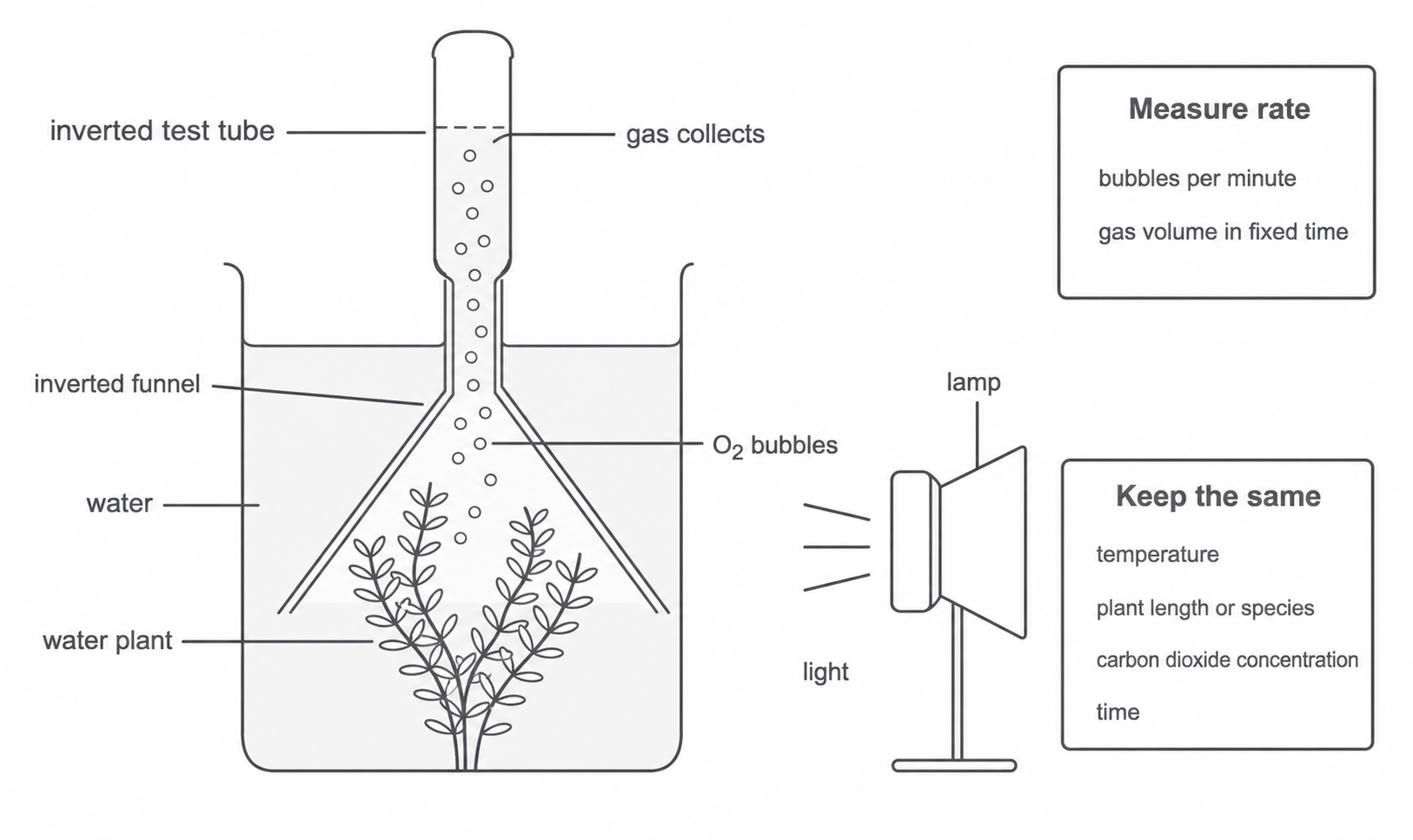
A standard method is:
- Place a piece of pondweed or another suitable water plant in water.
- Put an inverted funnel over the plant and a water-filled test tube over the funnel stem.
- Shine a lamp on the plant.
- Leave the plant to adjust for a short time before taking measurements.
- Measure oxygen production by counting bubbles per minute or measuring gas volume collected in a fixed time.
- Repeat and calculate a mean if comparing conditions.
If enough gas is collected, oxygen can be tested using a glowing splint. Oxygen relights a glowing splint. In many school practicals, however, the more useful measurement is the rate of bubbling or the volume of gas produced per unit time.
When the question asks about a fair test, identify variables:
- independent variable: the factor deliberately changed, such as light intensity or carbon dioxide concentration
- dependent variable: oxygen produced per minute, bubble count per minute or gas volume in a fixed time
- control variables: same species and length of plant, same temperature, same carbon dioxide concentration if it is not the variable, same time interval, same lamp or same distance if not being changed
Testing a leaf for starch
Photosynthesis makes glucose, but a leaf is usually tested for starch instead of glucose. This is because some glucose made in photosynthesis is converted into starch for storage. Starch gives a clear iodine test, so starch in a leaf is evidence that photosynthesis has taken place.
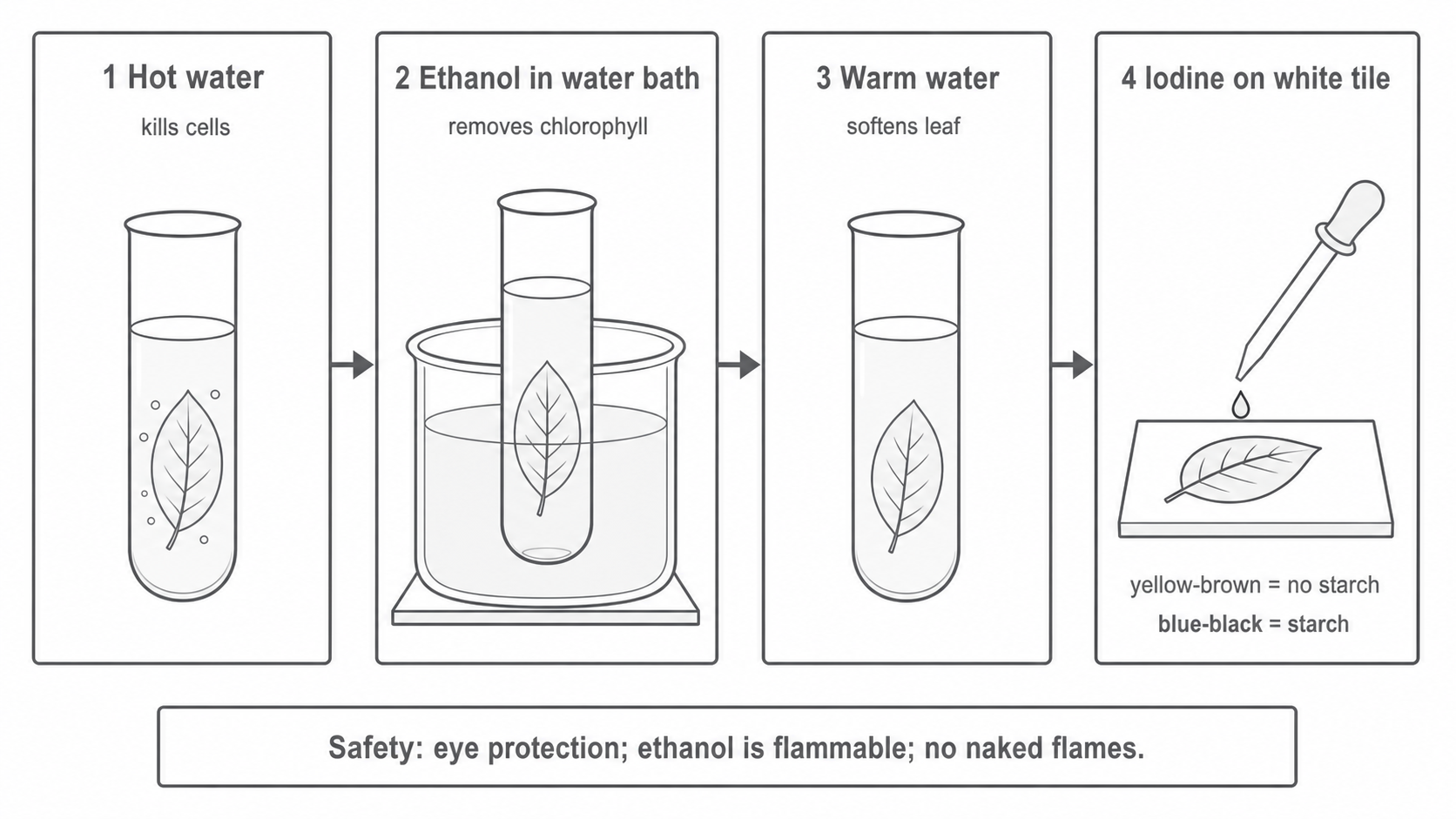
[DIAGRAM: asset_name: Leaf adaptations, minerals and photosynthesis practical - diagram 03; asset_slug: b10_leaf_adaptations_minerals_and_photosynthesis_practical__diagram_03; recommended_method: deterministic_drawing; description: Monochrome four-step starch test sequence showing a leaf in hot water, a leaf in hot ethanol heated by a water bath with no flame, the leaf softened in warm water, and iodine added to the leaf on a white tile. Labels state that blue-black indicates starch and yellow-brown indicates no starch, with ethanol flammability and eye protection noted.]
Before testing a plant for a photosynthesis requirement, it is usually destarched. The plant is kept in darkness long enough for stored starch to be used up. Then, if starch appears after the plant is placed in light, the starch must have been made during the investigation.
The starch test has a clear sequence:
- Put the leaf in hot water to kill the cells and stop reactions.
- Put the leaf in hot ethanol in a water bath to remove chlorophyll. Use a water bath because ethanol is flammable.
- Rinse or soften the leaf in warm water because ethanol makes it brittle.
- Spread the leaf on a white tile and add iodine solution.
- A blue-black colour shows starch is present; yellow-brown shows starch is absent.
Safety matters here. Wear eye protection, handle hot liquids carefully, and keep ethanol away from naked flames.
Using starch to prove requirements
The starch test can show that light, carbon dioxide and chlorophyll are required for photosynthesis. The logic is always the same: remove one requirement, keep the others available, then test whether starch is made.
[DIAGRAM: asset_name: Leaf adaptations, minerals and photosynthesis practical - diagram 04; asset_slug: b10_leaf_adaptations_minerals_and_photosynthesis_practical__diagram_04; recommended_method: deterministic_drawing; description: Monochrome three-panel comparison of starch-test outcomes for photosynthesis requirements. Panel 1 shows a destarched leaf partly covered with opaque foil: exposed area makes starch, covered area does not. Panel 2 shows a leaf enclosed with a carbon dioxide absorber compared with a control: no carbon dioxide gives no starch, control gives starch. Panel 3 shows a variegated leaf: chlorophyll-containing regions make starch, regions without chlorophyll do not.]
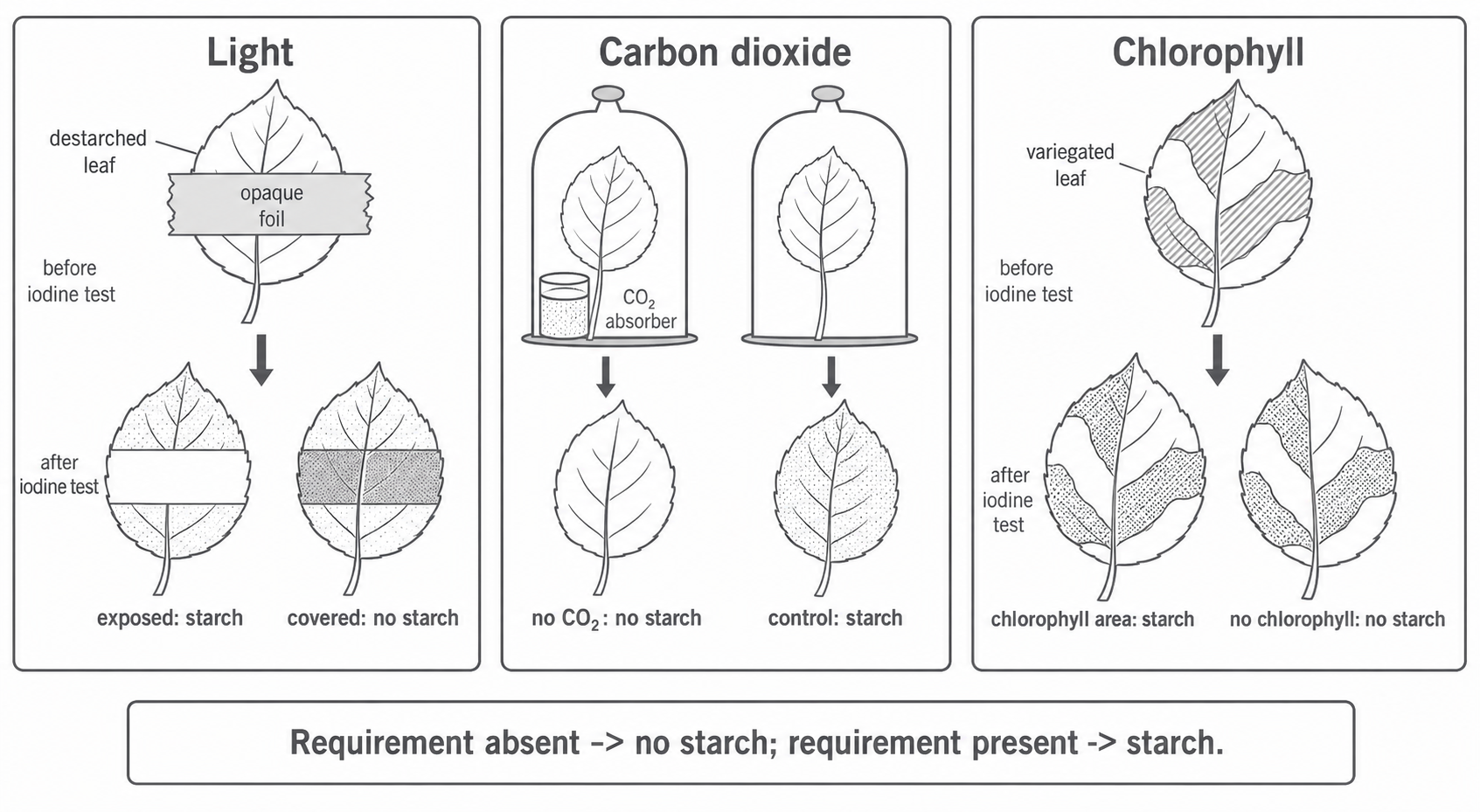
To test light, cover part of a destarched leaf with opaque foil or black paper. Place the plant in light. When the leaf is tested with iodine, the exposed area should contain starch, while the covered area should not. This shows light is required.
To test carbon dioxide, place part of a destarched plant in a sealed container with a carbon dioxide absorber, such as soda lime or potassium hydroxide if used by the centre. A control leaf is kept in similar conditions with carbon dioxide available. Follow teacher or technician safety instructions for the absorber and do not touch it directly. After time in light, the leaf without carbon dioxide should not contain starch, while the control should. This shows carbon dioxide is required.
To test chlorophyll, use a variegated leaf. A variegated leaf has regions with chlorophyll and regions without chlorophyll. After time in light, only the regions with chlorophyll should contain starch. This shows chlorophyll is required.
For all three investigations, the conclusion must match the evidence:
| Requirement tested | No-starch result means | Starch result means |
|---|---|---|
| Light | The covered area could not photosynthesise because light was blocked. | The exposed area received light and made starch. |
| Carbon dioxide | The leaf without carbon dioxide could not photosynthesise. | The control leaf had carbon dioxide and made starch. |
| Chlorophyll | The region without chlorophyll could not photosynthesise. | The region with chlorophyll made starch. |