2.15-2.17 - Diffusion, osmosis and active transport
Cells are surrounded by membranes, so useful substances must be able to enter and waste substances must be able to leave. Some movement happens passively down a gradient, while some needs energy from the cell. This lesson compares diffusion, osmosis and active transport, then uses those ideas to plan and interpret diffusion and osmosis practicals.
Three transport processes
A cell membrane is partially permeable: it lets some particles cross more easily than others. Movement into and out of cells depends on the particle, the gradient, and whether the cell must spend energy to move it.
Diffusion is the net movement of particles from a region where they are at a higher concentration to a region where they are at a lower concentration. It is passive, so it does not require energy from respiration. Oxygen and carbon dioxide can move by diffusion across cell membranes because they are small molecules and can pass through the membrane.
Osmosis is the net movement of water molecules through a partially permeable membrane from a dilute solution, where there is a higher concentration of water molecules, to a more concentrated solution, where there is a lower concentration of water molecules. The membrane matters: without a partially permeable membrane, it is just diffusion and mixing.
Active transport is the movement of particles across a membrane against their concentration gradient, from lower concentration to higher concentration. It requires energy released by respiration and uses carrier proteins in the cell membrane. For example, a root hair cell can take up mineral ions from soil even when the ion concentration is lower in the soil than inside the cell.
[DIAGRAM: asset_name: transport_process_comparison; asset_slug: b08_diffusion_osmosis_and_active_transport__diagram_01; recommended_method: deterministic_drawing; description: Three-panel monochrome comparison showing diffusion down a concentration gradient, osmosis of water through a partially permeable membrane, and active transport against a concentration gradient using energy and a carrier protein.]
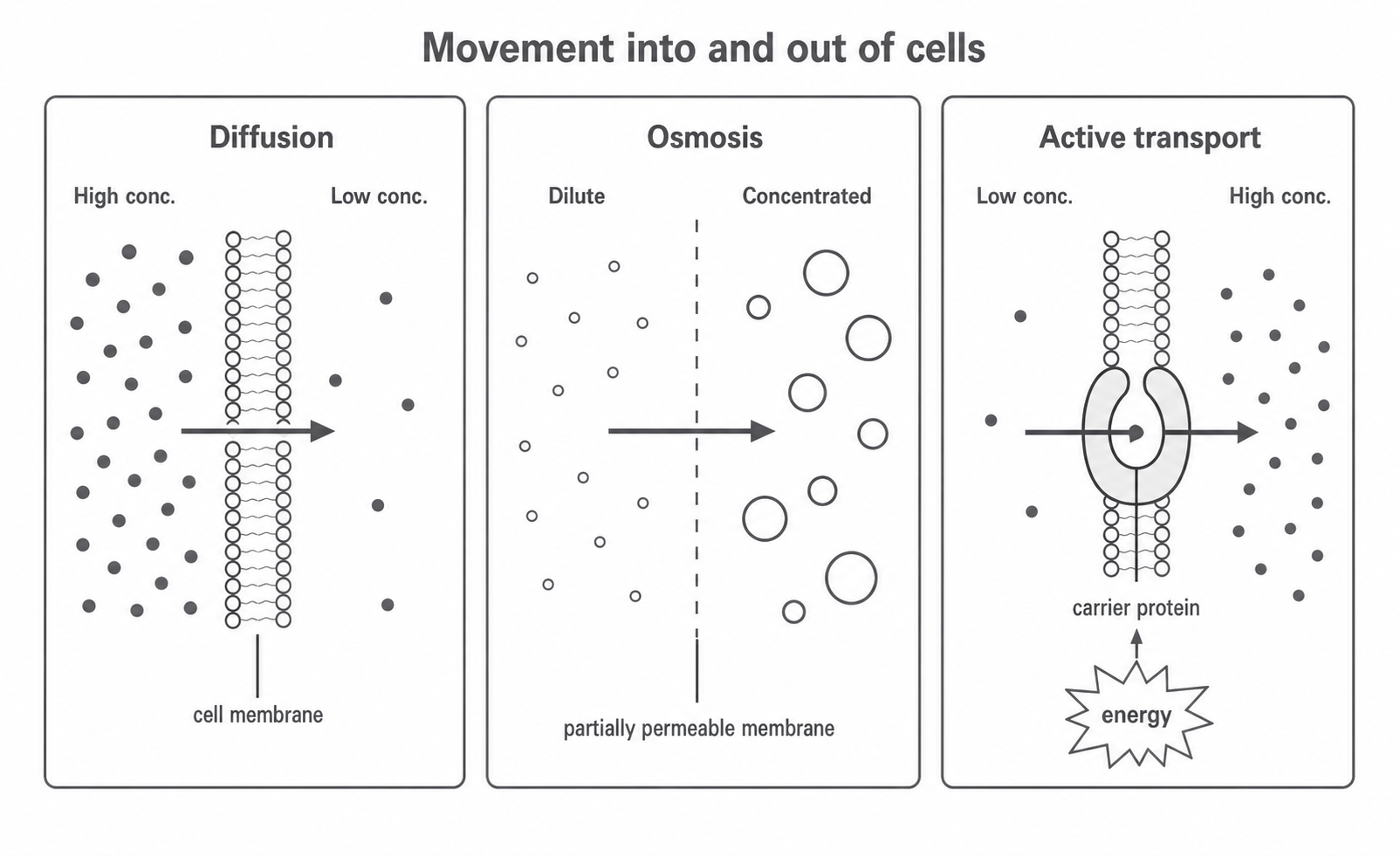
The exam habit is to name the process and give the direction of movement. For diffusion, say which particle moves and that it moves from high concentration to low concentration. For osmosis, say water moves through a partially permeable membrane. For active transport, say movement is against the concentration gradient and needs energy.
Factors affecting rate of movement
The rate of movement into or out of cells depends on how often particles reach the exchange surface and how far they must travel. Edexcel names four rate factors for this topic: surface area to volume ratio, distance, temperature and concentration gradient.
A larger surface area to volume ratio makes exchange faster for each unit of cell volume. More membrane surface is available for particles to cross, while there is less cytoplasm volume to supply. This is why small cells exchange substances more easily than large cells of the same shape.
A shorter distance makes diffusion or osmosis faster. If particles only have to cross a thin membrane or a short layer of tissue, they reach the other side sooner. In a thick block, particles may enter the outside quickly but take much longer to reach the centre.
A higher temperature usually increases the rate because particles have more kinetic energy and move faster. In living tissue, very high temperatures can damage membranes and proteins, so a practical should keep temperature controlled rather than assume hotter is always better.
A steeper concentration gradient increases the rate of net movement. If there is a big difference between the concentrations on the two sides of a membrane, many more particles move in one direction than the other. As the difference becomes smaller, the rate of net movement slows.
[DIAGRAM: asset_name: rate_factor_summary; asset_slug: b08_diffusion_osmosis_and_active_transport__diagram_02; recommended_method: deterministic_drawing; description: Monochrome summary of the four required rate factors: high surface area to volume ratio, short diffusion distance, higher temperature particle motion, and steep concentration gradient.]
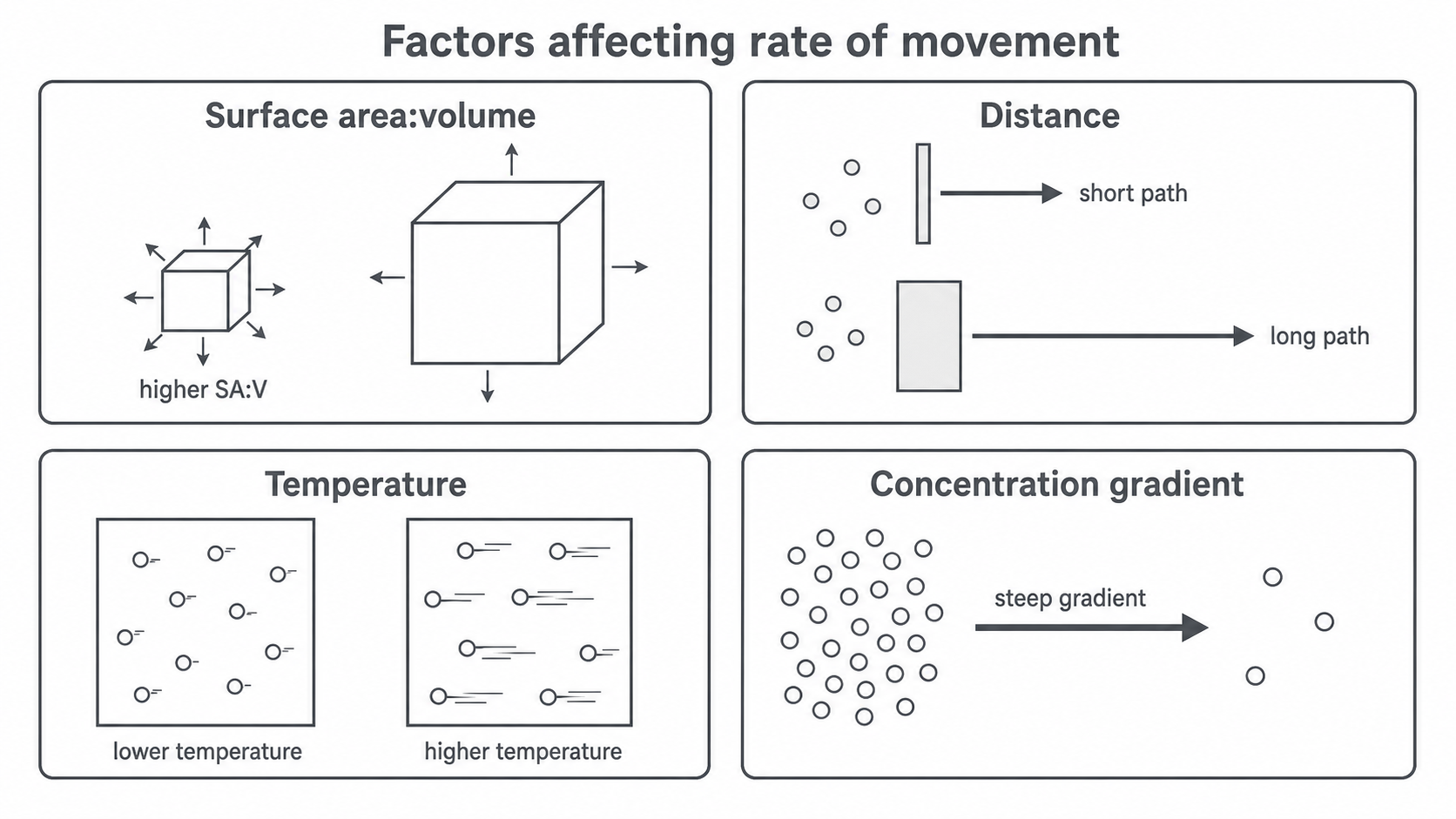
For a cube, surface area is , volume is , and the surface area to volume ratio is surface area divided by volume. A 1 cm cube has surface area , volume , and a ratio of 6:1. A 2 cm cube has surface area , volume , and a ratio of 3:1. The larger cube has more total surface area, but less surface area for each unit of volume.
Predicting osmosis
Osmosis questions often look like concentration questions, but the moving substance is water. Water moves from the side with the higher concentration of water molecules to the side with the lower concentration of water molecules, through a partially permeable membrane.
If a plant cell is placed in a dilute solution, water enters by osmosis. The vacuole and cytoplasm press against the cell wall, so the cell becomes turgid. If the plant cell is placed in a concentrated solution, water leaves by osmosis. The vacuole and cytoplasm shrink away from the cell wall, so the cell becomes flaccid and may become plasmolysed.
Animal cells do not have a cell wall. If too much water enters an animal cell by osmosis, the cell may burst. If water leaves, the cell shrinks. The same rule still applies: water moves down its own gradient, from higher water concentration to lower water concentration.
In potato osmosis practicals, potato tissue is usually treated as living plant tissue. In a dilute solution, potato cells gain water and the tissue gains mass. In a concentrated sucrose or salt solution, potato cells lose water and the tissue loses mass. At the concentration where there is no net change in mass, the external solution is close to isotonic with the potato cell contents.
Active transport in cells
Diffusion and osmosis can only give net movement down a gradient. A cell sometimes needs a substance even when there is already more of that substance inside the cell than outside. Active transport solves this by using energy to move particles against the gradient.
Carrier proteins are specific. A carrier protein that moves nitrate ions will not necessarily move glucose or sodium ions. This specificity helps cells control which substances enter or leave.
Active transport depends on energy released by respiration. If a cell cannot release enough energy, active transport slows or stops, even if the concentration gradient still exists. This is a common exam link: energy from respiration is not used to make diffusion happen, but it is needed for active transport.
Useful examples include mineral ions entering root hair cells and glucose moving into cells lining the small intestine. You do not need the full details of roots or digestion in this cluster, but the examples show why active transport matters: cells can absorb substances they need even when diffusion would move them the other way.
Investigating diffusion and osmosis
The specification practical is to investigate diffusion and osmosis using living and non-living systems. You should be able to describe a method, identify variables, process results, and explain the pattern using gradients.
[DIAGRAM: asset_name: practical_setups; asset_slug: b08_diffusion_osmosis_and_active_transport__diagram_03; recommended_method: deterministic_drawing; description: Monochrome practical diagram showing agar cube diffusion, Visking tubing osmosis as a non-living membrane model, and potato cylinder osmosis as living plant tissue.]
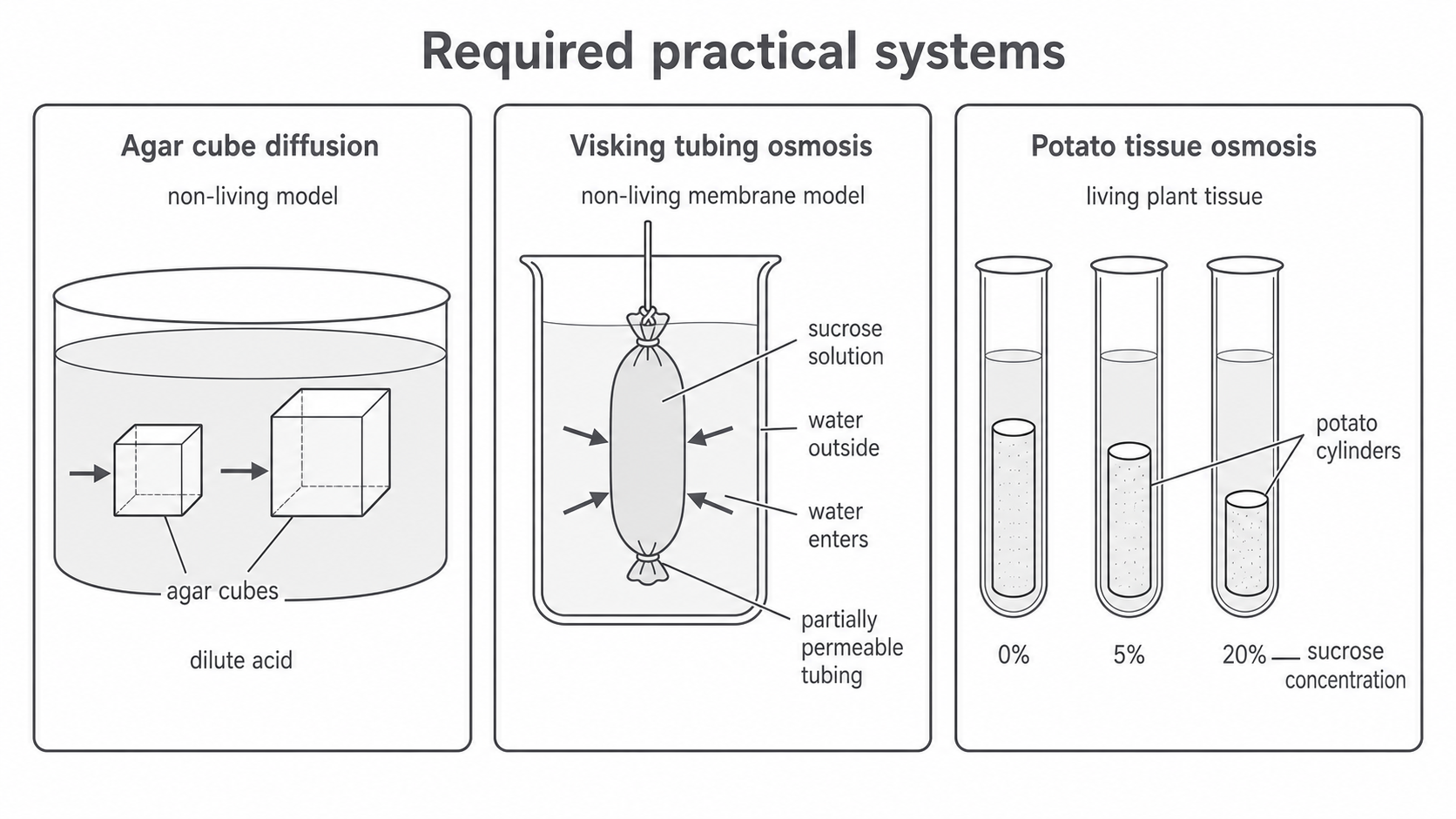
For a non-living diffusion model, agar cubes can be made with alkali and an indicator, then placed in dilute acid. Acid diffuses in from the outside and changes the indicator. Smaller cubes, or cubes with a higher surface area to volume ratio, are penetrated more quickly because the diffusion distance to the centre is shorter.
For a non-living osmosis model, Visking tubing can act as a partially permeable membrane. If the tubing contains concentrated sucrose solution and is placed in water, water enters the tubing by osmosis. The mass of the tubing or the liquid level in a capillary tube can be measured over time.
For a living osmosis investigation, use potato cylinders or chips. Put equal-sized pieces into different concentrations of sucrose or salt solution for the same time. Measure the mass before and after, blotting the potato dry in the same way each time.
Percentage change in mass
The independent variable could be solution concentration. The dependent variable could be change in mass, percentage change in mass, change in length, or rate of change. Important control variables include the size and surface area of the potato pieces, volume of solution, time in solution, temperature, potato variety, and drying method before weighing. Repeats and a mean improve reliability, while a graph of percentage change against concentration helps estimate the isotonic point.
Safety and validity matter. Use care with scalpels or cork borers, wear eye protection if dilute acid is used with agar, and do not eat laboratory food materials. A valid comparison changes one independent variable while keeping the other conditions the same.