1.1 - Characteristics of living organisms
Biology studies living organisms, so the first question is how to recognise that something is alive. Pearson Edexcel does not ask for one magic test. It asks you to understand the shared life processes that living organisms carry out: nutrition, respiration, excretion, response, movement, control of internal conditions, reproduction, and growth and development.
The shared life processes
An organism is a living thing. Living organisms can be very different from one another: a human, a bean plant, a mushroom, and a single-celled organism do not look or behave in the same way. What links them is that they share the same broad characteristics of life.
Organism
An organism is an individual living thing.
The Edexcel list can be remembered as MRS C GREN:
| Letter | Characteristic | What it means in this lesson |
|---|---|---|
| M | Movement | The whole organism or part of it changes position. |
| R | Respiration | Chemical reactions in cells release energy from food molecules. |
| S | Sensitivity/response | The organism detects and responds to its surroundings. |
| C | Control | The organism controls its internal conditions. |
| G | Growth and development | The organism increases in size and changes as it matures. |
| R | Reproduction | New organisms of the same kind are produced. |
| E | Excretion | Waste products are removed. |
| N | Nutrition | Materials are obtained for energy, growth, repair, and development. |
[DIAGRAM: asset_name: Characteristics of living organisms - diagram 01; asset_slug: b01_characteristics_of_living_organisms__diagram_01; recommended_method: deterministic_drawing; description: A monochrome hub-and-spoke overview with "Living organisms" in the centre and eight labelled life-process boxes around it: nutrition, respiration, excretion, response to surroundings, movement, control internal conditions, reproduction, and growth and development.]
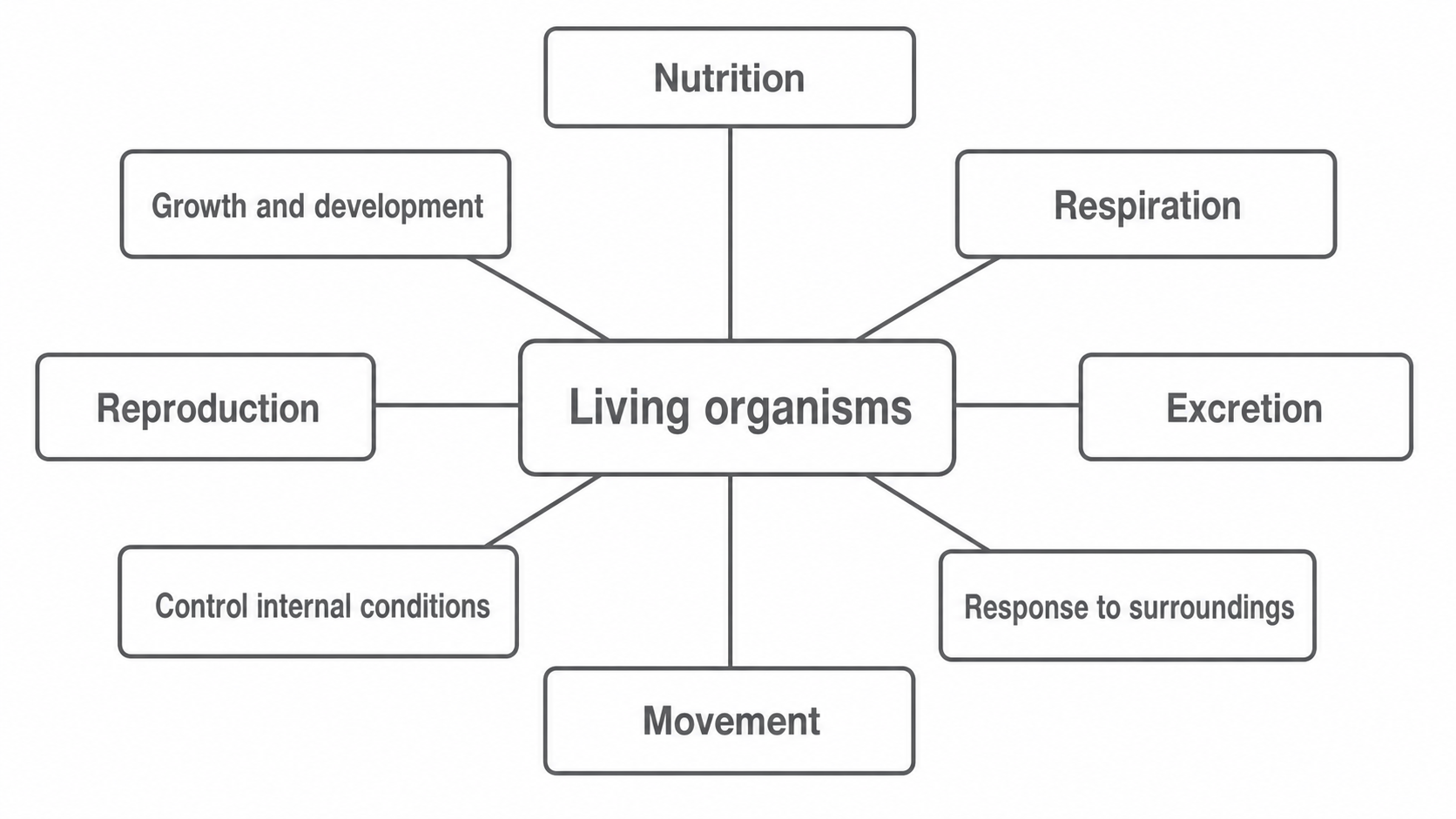
The list matters because non-living things can show one or two life-like features. A car moves and uses fuel, but it does not grow, reproduce, excrete metabolic waste, or control internal cell conditions. In an exam answer, use the whole set of shared characteristics rather than relying on one visible feature.
Nutrition and respiration
Living organisms need a supply of useful materials. Nutrition means obtaining materials that can be used for energy, growth, repair, and development. Animals usually take in ready-made food by feeding on other organisms or their products. Plants make sugars using light and also take in water and mineral ions from their surroundings. You do not need the detailed food-test, diet, or photosynthesis content here; the key B01 idea is simply that all living organisms require nutrition.
Nutrition
Nutrition is obtaining materials needed for energy, growth, repair, and development.
Respiration is often confused with breathing. In biology, respiration means chemical reactions in cells that release energy from food molecules. Breathing can supply oxygen for respiration in many animals, but breathing itself is not respiration. Plants, animals, fungi, and single-celled organisms all respire because their cells need energy for life processes such as movement, growth, active transport, and making new substances.
Respiration
Respiration is the release of energy from food molecules by chemical reactions in cells.
Nutrition and respiration are linked. Nutrition supplies the food molecules; respiration releases energy from them. That released energy is then used by the organism to carry out the other characteristics of life, such as movement, growth, repair, and making new substances.
Excretion and internal control
Cells constantly carry out chemical reactions. Some of these reactions produce waste substances. Excretion is the removal of waste products from the organism. If wastes build up, they can interfere with cell reactions or become harmful.
Excretion
Excretion is the removal of waste products from an organism.
Carbon dioxide is a waste product of respiration. In many animals, nitrogen-containing wastes are removed from the body, and excess water and salts may also be removed. You do not need the detailed organs of excretion yet; for this lesson, focus on the general idea that living organisms remove waste made by their life processes.
Control of internal conditions means keeping the conditions inside the organism suitable for cell reactions. This is also called homeostasis. The conditions are not held at one perfectly fixed value; they are controlled within a suitable range. Examples include controlling temperature, water content, or the concentration of substances around cells.
Homeostasis
Homeostasis is the control of internal conditions within suitable limits.
Excretion and internal control often work together. Removing excess water, salts, or carbon dioxide helps keep internal conditions suitable for cells.
Response and movement
Living organisms detect changes in their surroundings and respond to them. A change that can be detected is called a stimulus. A response is the action or change that follows. The response may help the organism get resources, avoid harm, or keep internal conditions suitable.
Stimulus
A stimulus is a change in the surroundings that an organism can detect.
Animals often show rapid responses: a human moves a hand away from a hot object, or an insect moves towards food. Plants respond too, even though many plant responses are slower. A shoot may grow towards light, and roots may grow in response to gravity and water. Single-celled organisms may move towards useful chemicals or away from harmful conditions.
Movement does not always mean travelling from place to place. It can be movement of the whole organism, movement of a body part, or movement inside the organism. A root growing through soil, a flower opening, or muscles moving a limb are all examples of biological movement.
The exam trap is to assume that an organism must move like an animal. Edexcel's characteristic is broader: living organisms move, but the movement can be slow, local, or only in part of the organism.
Reproduction, growth and development
Reproduction is the production of new organisms. This keeps a kind of organism going over generations. Some organisms reproduce with two parents, and some can reproduce from one parent, but the detailed mechanisms come later in the course. For this lesson, the important point is that reproduction is one of the shared characteristics of living organisms.
Reproduction
Reproduction is the production of new organisms of the same kind.
Do not use one individual that cannot reproduce as proof that it is not alive. For example, a worker bee or an infertile animal is still alive because it carries out the other life processes. The characteristic belongs to living organisms as a group and to the life cycle of a species, not necessarily to every individual at every moment.
Growth is an increase in size or mass. It usually involves cells getting bigger and/or an increase in the number of cells. Development means the organism changes as it matures. A seedling becoming a mature plant and a child developing into an adult both show growth and development.
Living organisms are recognised by a pattern of shared life processes: they obtain materials, release energy, remove waste, respond and move, control internal conditions, reproduce, and grow and develop.