2.10-2.12 - Enzyme action and temperature
Enzymes make metabolic reactions happen fast enough for living organisms to survive. This lesson shows how enzymes act as biological catalysts, why their active sites matter, how temperature changes enzyme activity, and how to investigate that effect in a practical.
Enzymes as biological catalysts
A catalyst is a substance that increases the rate of a chemical reaction without being used up. Enzymes are biological catalysts: they are made by living cells and they catalyse metabolic reactions, meaning the chemical reactions that happen in cells and organisms.
Enzyme
An enzyme is a biological catalyst that speeds up a metabolic reaction without being used up in the reaction.
In this lesson, "metabolic" simply means the reaction is part of the chemistry of life.
Metabolic reaction
A metabolic reaction is a chemical reaction that happens in a living organism.
Each enzyme has an active site. A substrate molecule binds to the active site, forming an enzyme-substrate complex. The reaction happens more easily, products are released, and the enzyme can catalyse the reaction again.
[DIAGRAM: asset_name: Enzyme action and temperature - diagram 01; asset_slug: b06_enzyme_action_and_temperature__diagram_01; recommended_method: deterministic_drawing; description: Monochrome sequence showing substrate fitting into an enzyme active site, an enzyme-substrate complex, product release, and the unchanged enzyme ready to be reused.]
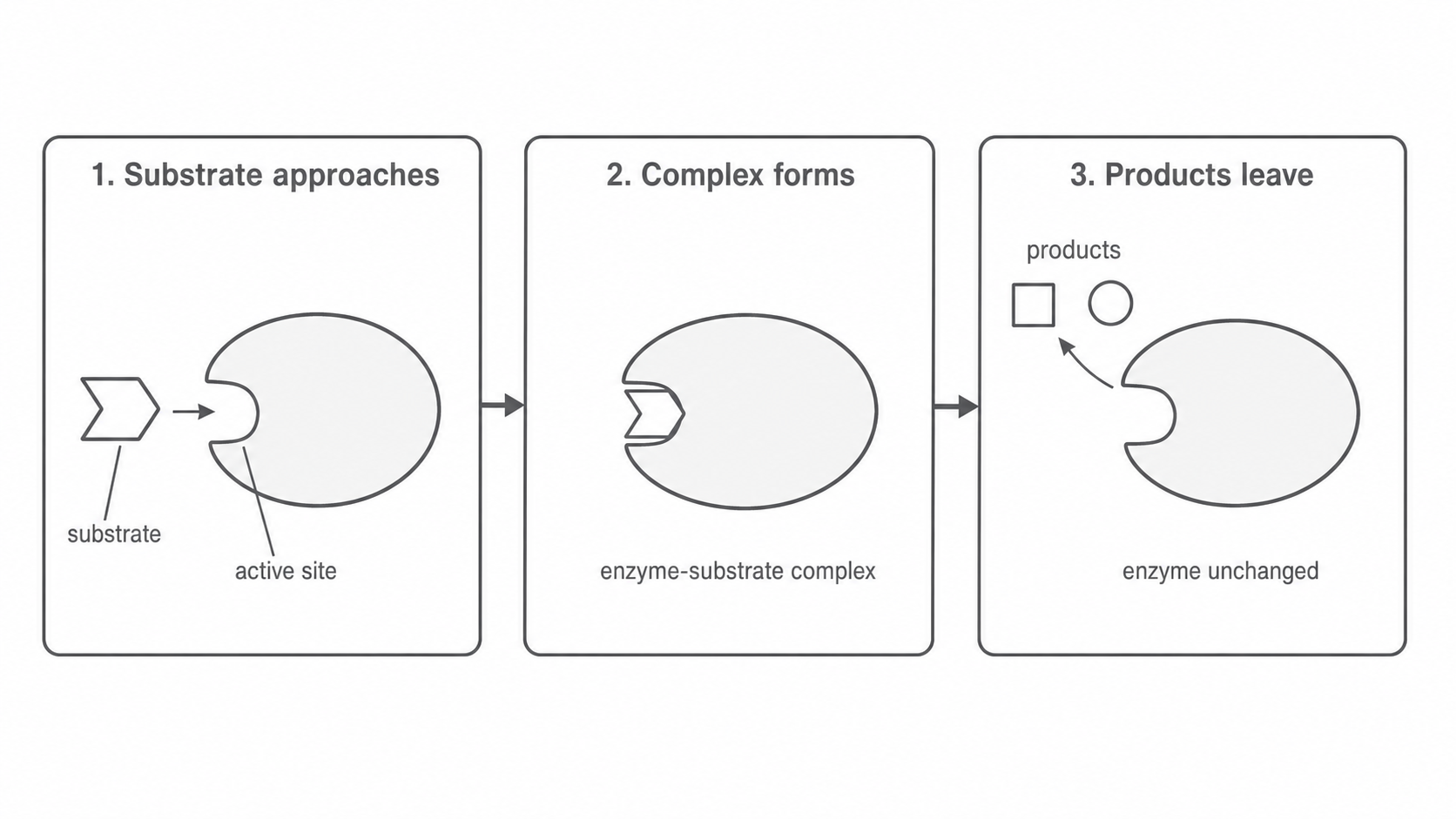
Enzymes are specific. The active site has a shape that is complementary to its substrate, so a different substrate will not usually fit. This is why a cell needs many different enzymes for different metabolic reactions.
Temperature and enzyme activity
Temperature affects enzyme activity because it changes both movement of molecules and the shape of the enzyme. The overall pattern is a rise to an optimum temperature, followed by a steep fall if the enzyme is heated too much.
[DIAGRAM: asset_name: Enzyme action and temperature - diagram 02; asset_slug: b06_enzyme_action_and_temperature__diagram_02; recommended_method: matplotlib; description: Monochrome line graph of relative enzyme activity against temperature, rising gradually at low temperatures, reaching an optimum, then falling steeply as the active site changes shape and the enzyme denatures.]
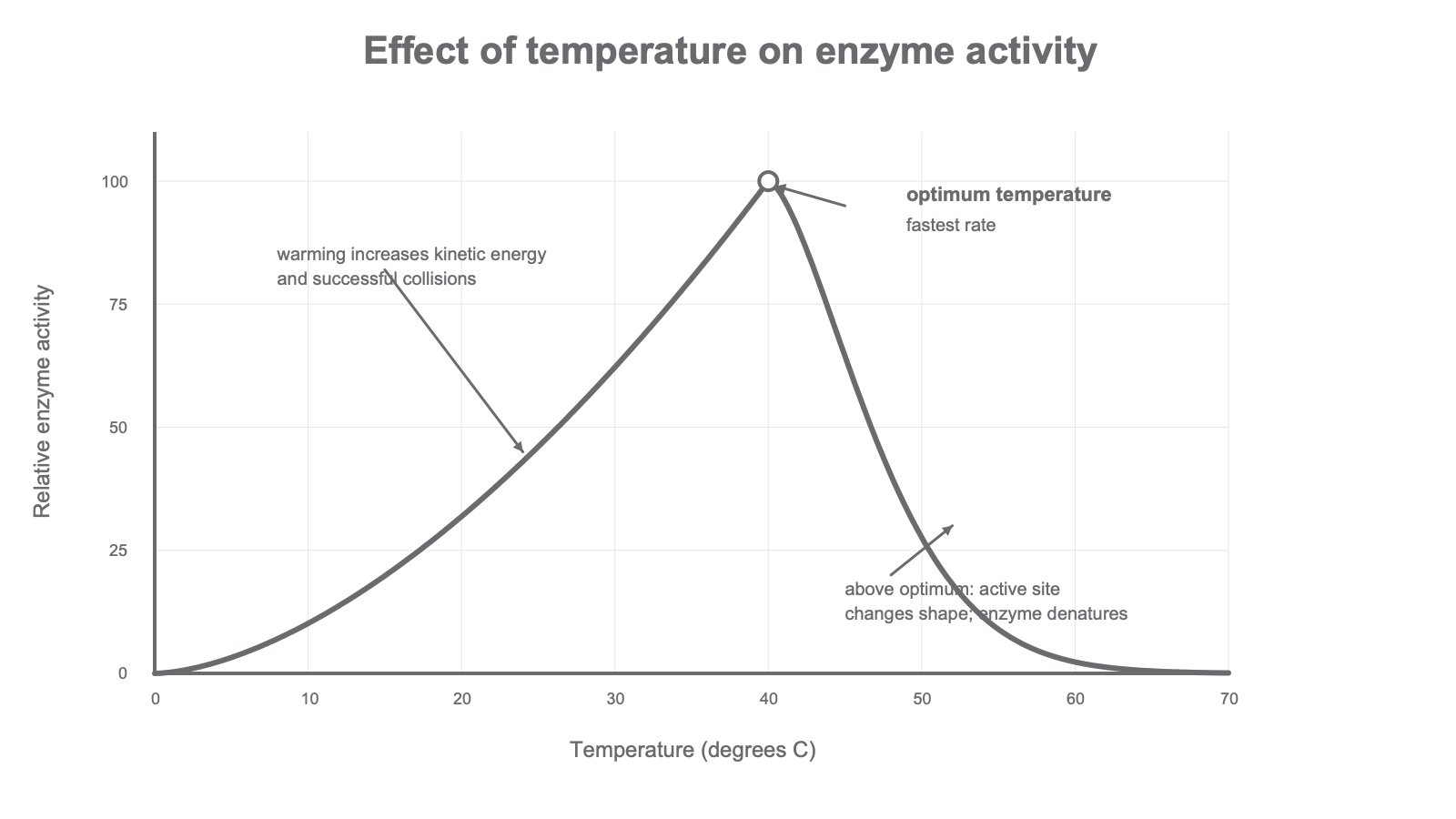
At low temperatures, enzyme and substrate molecules have less kinetic energy. They move more slowly, collide less often, and form fewer enzyme-substrate complexes each second. The reaction is slow, but the enzyme has not denatured; if warmed carefully, it can work faster again.
As temperature increases towards the optimum, molecules have more kinetic energy. There are more frequent successful collisions between enzyme active sites and substrate molecules, so more enzyme-substrate complexes form per second and the rate increases.
Optimum temperature
The optimum temperature is the temperature at which an enzyme-catalysed reaction has its fastest rate.
Above the optimum temperature, heat changes the shape of the enzyme, including the active site. The substrate no longer fits the active site properly, so fewer enzyme-substrate complexes form. At high enough temperatures, the enzyme is denatured and the rate falls sharply.
Active site shape and denaturation
The active site is the part of the enzyme that binds the substrate. Its shape is important because a substrate must fit before the enzyme can catalyse the reaction.
[DIAGRAM: asset_name: Enzyme action and temperature - diagram 03; asset_slug: b06_enzyme_action_and_temperature__diagram_03; recommended_method: deterministic_drawing; description: Monochrome comparison of a normal enzyme with a complementary active site and a denatured enzyme with a changed active site that no longer fits the substrate.]
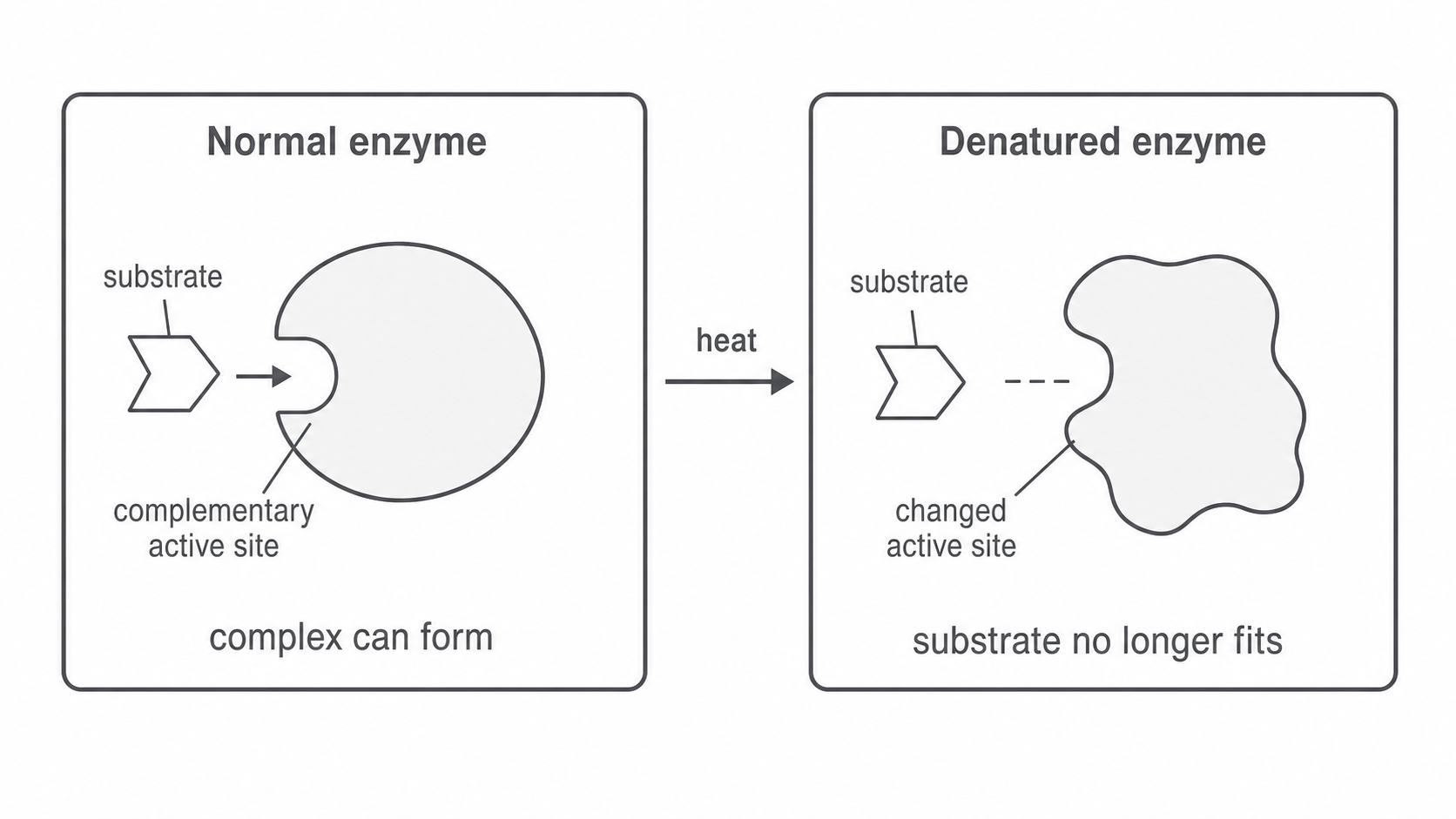
At this level, it is useful to think of an enzyme as a protein molecule whose shape allows it to work. If that shape changes, the active site changes too.
Denaturation means the enzyme's shape has changed so that it no longer works properly. For this specification point, the key result of heating too much is that the active site changes shape. The substrate may still collide with the enzyme, but the collision is no longer successful because the active site is no longer complementary.
Low temperature and high temperature are not the same problem. Low temperature usually slows enzymes because molecules move more slowly. High temperature can denature enzymes because the enzyme's shape changes.
Investigating temperature in the lab
The specification requires you to understand a practical that investigates how temperature affects enzyme activity. One common method uses amylase to break down starch. The reaction is followed by testing samples with iodine solution: blue-black means starch is still present, while orange-brown means the starch has been digested.
A fair method is:
- Add iodine solution to wells on a spotting tile.
- Put starch solution and amylase solution in separate tubes in a water bath at the chosen temperature, so both reach that temperature.
- Mix measured volumes of starch and amylase, then start a stopwatch immediately.
- At regular intervals, place a drop of the reaction mixture onto iodine on the spotting tile.
- Record the time when iodine no longer turns blue-black.
- Repeat at several temperatures and repeat each temperature to calculate a mean.
The independent variable is temperature. The dependent variable is the time taken for starch to be digested, or a calculated rate from that time. Control variables include the volumes and concentrations of amylase and starch, pH, total reaction volume, sampling interval, and the time allowed for solutions to reach the water-bath temperature.
Rate from time
If time is measured in seconds, the rate unit can be written as s^-1. Some practical questions multiply by 1000 so the numbers are easier to compare, but the biological interpretation is the same: a shorter time means a faster rate.
Wear eye protection when using iodine solution and take care with hot water baths and glassware. Safety language should be specific: iodine can irritate or stain, hot water can scald, and breakable glassware should be handled carefully.
Practical data and exam reasoning
Pearson-style enzyme questions often ask you to connect a result to the underlying biology. A strong answer usually has two layers: first describe the data, then explain the pattern using kinetic energy, successful collisions, enzyme-substrate complexes, active site shape and denaturation.
For example, if starch digestion takes 180 s at 20 degrees C, 50 s at 40 degrees C and 240 s at 60 degrees C, the enzyme is fastest at 40 degrees C because that is the shortest time and therefore the highest rate. The 60 degrees C result is slower because heating above the optimum has changed the active site shape, so fewer enzyme-substrate complexes form.
When you process practical data, keep the direction of the measurement clear:
- If the graph shows rate, the optimum is the highest point.
- If the graph shows time taken, the optimum is the lowest point.
- An anomalous result is a value that does not fit the pattern of the other repeats.
- Repeats and a mean improve reliability, especially if anomalous results are identified.
- A water bath improves validity because temperature is the independent variable and must be controlled.
Common mistakes are saying that cold temperature denatures the enzyme, saying that the enzyme is "killed", or explaining only "more heat gives more energy" after the graph has already passed the optimum. The exam idea is more precise: before the optimum, higher temperature increases successful collisions; after the optimum, denaturation changes the active site.