2.1-2.4 - Organisation and cell structures
Living organisms are built in levels: tiny structures inside cells help cells work, and cells can work together in larger structures. This lesson focuses on the Edexcel plant and animal cell structures you need to recognise, describe and compare. The key exam skill is to link each named structure to its job without mixing up structures that sound similar.
Levels of organisation
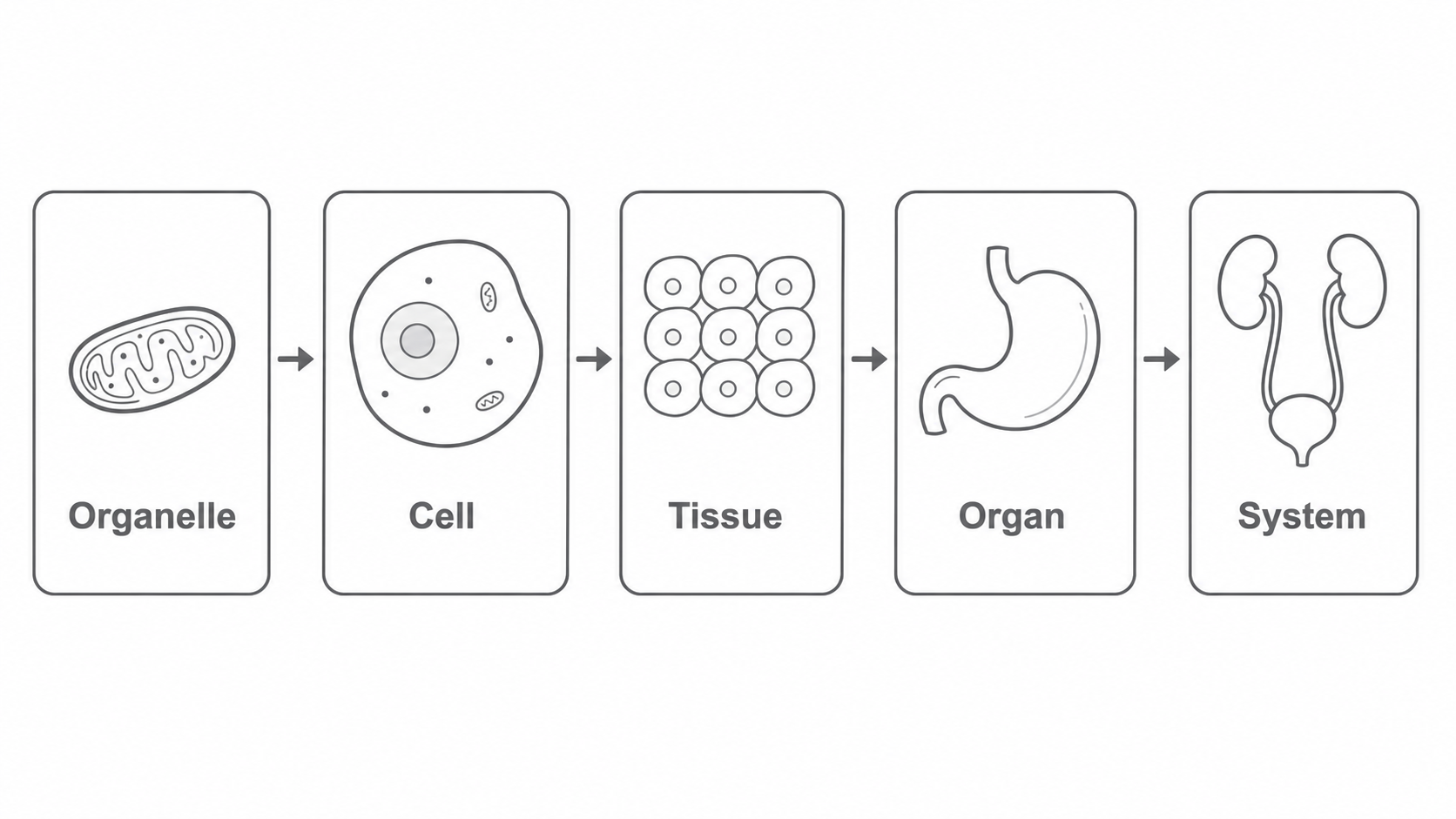
Biologists describe multicellular organisms using levels of organisation. Each level is made from the level before it, so the order matters.
Organelle
A small structure inside a cell that carries out a particular function.
An organelle is smaller than a cell. For example, a mitochondrion is an organelle inside a cell. Cells then group together in a multicellular organism:
- organelles are structures inside cells
- similar cells working together form a tissue
- different tissues working together form an organ
- organs working together form a system
A clear example is: mitochondria in a muscle cell, muscle cells in muscle tissue, muscle tissue as part of the stomach, and the stomach as part of the digestive system. The exam point is not to memorise only one example; it is to know the sequence and what each level means.
[DIAGRAM: asset_name: Organisation and cell structures - diagram 01; asset_slug: b03_organisation_and_cell_structures__diagram_01; recommended_method: deterministic_drawing; description: Monochrome hierarchy showing organelle, cell, tissue, organ and system in increasing scale with arrows and short labels.]
The basic cell plan
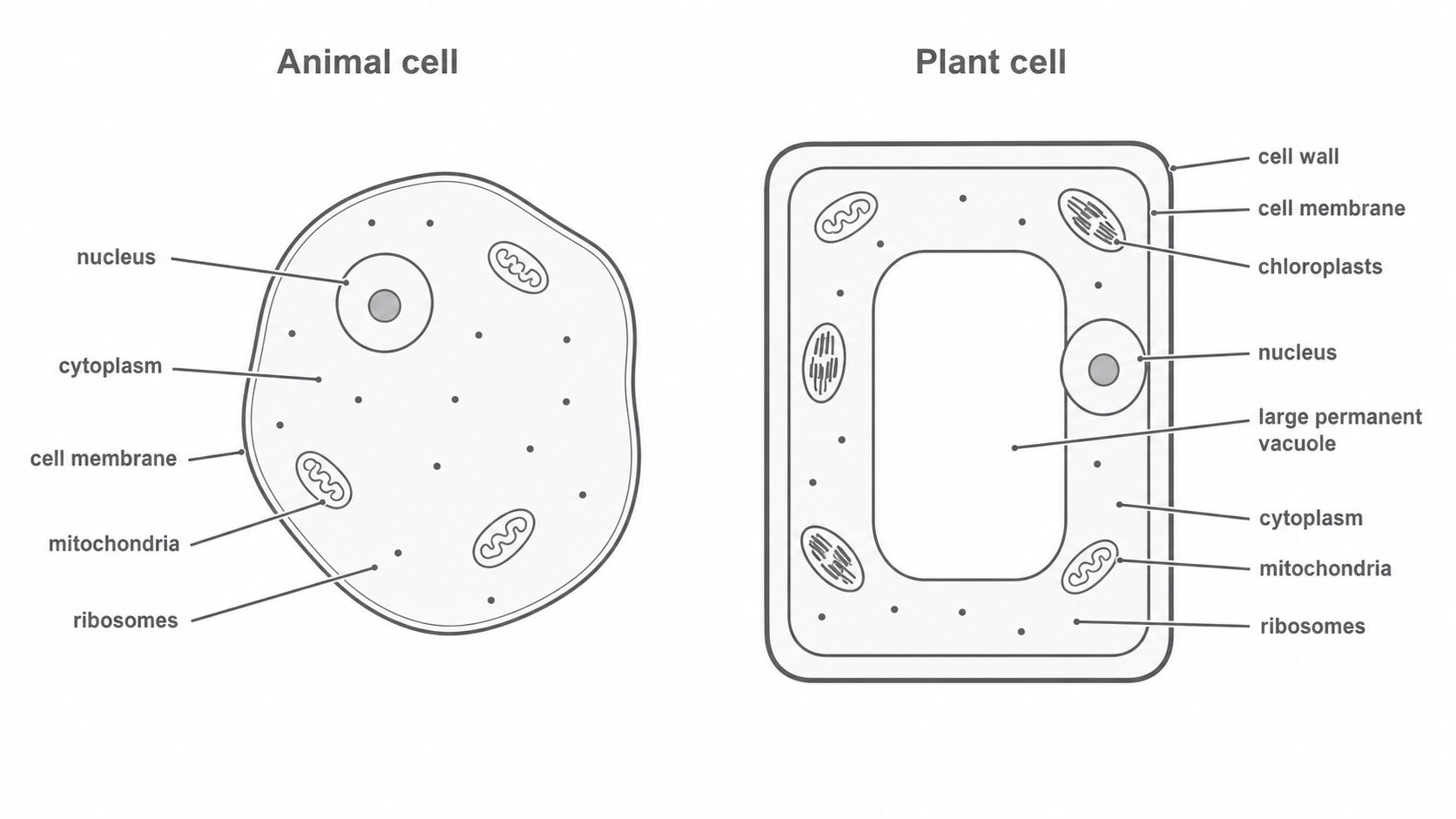
Typical plant and animal cells share three important structures: a nucleus, cytoplasm and a cell membrane.
The nucleus contains genetic material and controls the activities of the cell. It is often drawn as a large rounded structure, but in an exam answer its function matters more than its size.
The cytoplasm is the jelly-like material where many chemical reactions happen. Organelles are found in the cytoplasm, so do not describe cytoplasm as an empty space.
The cell membrane is the thin boundary around the cell. It controls the movement of substances into and out of the cell. This is different from a cell wall: a cell membrane is found in both plant and animal cells, but a cell wall is not found in animal cells.
Nucleus controls cell activities, cytoplasm is where many reactions happen, and the cell membrane controls movement into and out of the cell.
Use those three functions as separate marks in exam answers. If you swap the function of the nucleus and cell membrane, the biology changes completely.
Energy and protein structures
Mitochondria are the site of aerobic respiration. They are where energy is released for cell processes. Plant cells and animal cells both need mitochondria because both types of cell need energy.
Ribosomes are the site of protein synthesis. They are very small, so diagrams often show them as dots in the cytoplasm. In written answers, the important phrase is "protein synthesis" or "making proteins".
Chloroplasts are found in plant cells that photosynthesise. They absorb light energy for photosynthesis. In a monochrome diagram they may be labelled as chloroplasts even though real chloroplasts contain green chlorophyll.
A common mistake is to write that chloroplasts release energy. Chloroplasts are linked with photosynthesis; mitochondria are linked with aerobic respiration and releasing energy for cell processes.
Plant support and storage
Plant cells have a cell wall outside the cell membrane. The cell wall supports and strengthens the cell. Because it is outside the cell membrane, it should not be described as the structure that controls movement into and out of the cell.
Plant cells often have a large permanent vacuole. The vacuole contains cell sap and helps keep the cell firm. Animal cells do not have a large permanent vacuole like this.
Chloroplasts, a cell wall and a large permanent vacuole are the three structural features students usually use to distinguish a plant cell from an animal cell in this topic. Remember that the shared structures still matter: a typical plant cell also has cytoplasm, a cell membrane, a nucleus, mitochondria and ribosomes.
[DIAGRAM: asset_name: Organisation and cell structures - diagram 02; asset_slug: b03_organisation_and_cell_structures__diagram_02; recommended_method: deterministic_drawing; description: Monochrome side-by-side typical animal and plant cells with the required Edexcel structures labelled: nucleus, cytoplasm, cell membrane, mitochondria, ribosomes, plus plant cell wall, chloroplasts and large permanent vacuole.]
Comparing plant and animal cells
When asked for similarities, name structures found in both typical plant and animal cells:
| Structure found in both | Function |
|---|---|
| Nucleus | Contains genetic material and controls cell activities |
| Cytoplasm | Site of many chemical reactions |
| Cell membrane | Controls movement into and out of the cell |
| Mitochondria | Site of aerobic respiration, releasing energy for cell processes |
| Ribosomes | Site of protein synthesis |
When asked for differences, compare structures directly rather than listing one cell only.
| Plant cells | Animal cells |
|---|---|
| Have a cell wall | Do not have a cell wall |
| Have chloroplasts in photosynthesising cells | Do not have chloroplasts |
| Usually have a large permanent vacuole | Do not have a large permanent vacuole |
Good comparison answers use paired statements. For example, "plant cells have a cell wall, whereas animal cells do not" is stronger than just writing "cell wall" because it makes the difference explicit.