H418/04 - Offers and invitations to treat
Before deciding whether someone accepted a bargain, identify whether there was an offer capable of acceptance. Learn how words, context and the form of a promise distinguish offers from invitations, and how an offer can end.
Commitment to contract
An offer shows willingness to contract on stated terms with the intention of being bound if the other person accepts.
The person making it is the offeror; the person to whom it is addressed is the offeree. Ask whether a reasonable recipient, considering the words and circumstances, would understand that acceptance is enough to conclude agreement. This objective approach examines communicated meaning, rather than an unexpressed private intention. The terms must be sufficiently definite to identify the proposed obligation.
In Gibson v Manchester City Council (1979), a council letter said it “may be prepared to sell” a house and invited a formal application. The House of Lords held that this was not an offer. The tentative words and further application step mattered. In Storer v Manchester City Council (1974), the council sent a document for signature and return with sufficiently settled terms; the Court of Appeal found a binding agreement. These outcomes illustrate how factual distinctions work within precedent. They do not mean every council letter has the same status.
Original comparison: “I will sell you this desk for £80; reply yes by Friday” is much stronger evidence of an offer than “I might sell my desk; what would you pay?” A quotation of a price may merely supply information: look for commitment to sell, not a number alone. Resolving this issue establishes agreement, not necessarily every other requirement of an enforceable contract.
Invitations and sales
An invitation to treat invites offers or negotiation rather than itself giving someone the power to conclude agreement by accepting.
Ordinary shop displays and ordinary advertisements of goods for sale are generally invitations to treat. In Pharmaceutical Society v Boots (1953), customers selected medicines from self-service shelves before reaching a pharmacist-supervised till. The Court of Appeal held that the display was an invitation: the customer offered to buy at the till and the shop could accept or refuse there. This let customers change their selection and let the pharmacist supervise the sale. Putting goods in a basket did not conclude the contract.
In Partridge v Crittenden (1968), an advertisement for birds was treated as an invitation, rather than an offer for sale under the criminal provision in issue. Ordinary advertisers cannot usually intend to supply unlimited quantities to everyone who replies. This is a general classification, not a rule that every advertisement is incapable of being an offer. Nor does contractual classification decide every consumer-protection question about misleading advertising.
At an ordinary auction, inviting bids invites offers. A bid is the bidder's offer. Section 57(2) of the Sale of Goods Act 1979 provides that the sale is complete when the auctioneer announces completion by the fall of the hammer or another customary manner; until then a bidder may retract the bid. This statutory wording identifies the acceptance point. An auction advertised without reserve can involve an additional undertaking concerning the highest genuine bid; do not transfer the ordinary-sale analysis mechanically to that different promise.
Original example: a jacket displays £30. A customer offers to buy it, but the shop refuses before accepting. The price label normally does not itself give the customer a concluded contract. A different express commitment, however, must be assessed on its actual wording.
Bilateral and unilateral offers
The form of a promise determines what the offeror asks the offeree to do to accept it.
A bilateral offer seeks a promise in return: “I promise to sell the bicycle for £100 if you promise to pay.” Agreement can arise before either party performs. A unilateral offer seeks an act, rather than a return promise: “I will pay £100 to anyone who returns my lost bicycle.” The offeree need not undertake to search; the requested performance accepts the offer. Other formation requirements still matter.
In Carlill v Carbolic Smoke Ball Co (1893), an advertisement promised £100 to people who contracted influenza after using the product as directed. Mrs Carlill used it accordingly and became ill. The company's stated bank deposit showed seriousness. The Court of Appeal treated the precise reward promise as an offer to those who performed the conditions, rather than mere advertising praise. Separate advance notice of acceptance was not required in that unilateral arrangement. The case does not turn every enthusiastic advertising slogan into a reward contract.
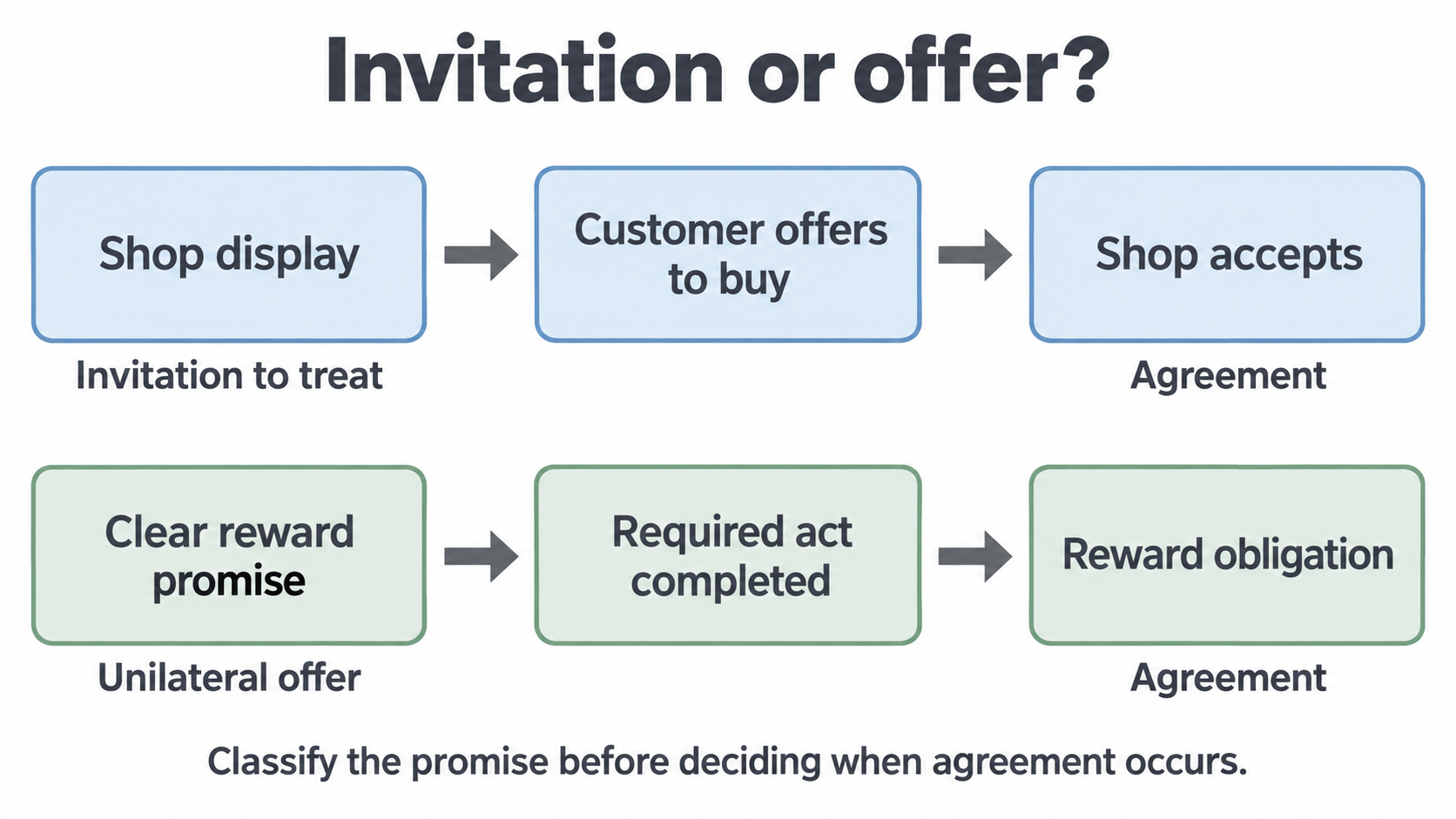
The top row requires a customer's offer and the shop's acceptance. The bottom row begins with a reward offer accepted by the required act.
An offer must be communicated to the offeree. A person cannot ordinarily accept a reward they do not know exists merely by coincidentally doing the stated act. Once aware of it, they must perform the required conditions; their main personal motive need not be earning the reward. An offer can be communicated to a named person, a class or the public. An offer addressed only to a named buyer cannot automatically be accepted by somebody else.
Counteroffers and enquiries
A response proposing a bargain on different terms is a counteroffer, whereas a genuine question may leave the original offer open.
A counteroffer rejects and replaces the original offer. In Hyde v Wrench (1840), Wrench offered his farm for £1,000. Hyde proposed £950, which Wrench rejected. Hyde then tried to accept the £1,000 offer. The court held that his counteroffer had ended the original offer; it could not be revived unilaterally. Wrench could choose to renew it, but Hyde's change of mind was not enough.
Continue this lesson.
You’re previewing NovaLearn without an account. Create a free account to read the rest.
Create free account