H418/01 - Criminal appeals
Learn how criminal decisions are challenged through a Crown Court rehearing, a case stated on law or jurisdiction, and appeals from trials on indictment. The correct route depends on the original court's role and the alleged error.
Appeals from magistrates to the Crown Court
A defendant convicted by magistrates normally has a statutory appeal to the Crown Court, but the matters that can be challenged depend on the plea.
A conviction appeal challenges the finding of guilt; a sentence appeal challenges the disposal imposed after conviction. Under Magistrates' Courts Act 1980 section 108, a defendant who pleaded not guilty may normally appeal conviction, sentence or both. A defendant who pleaded guilty normally appeals sentence, rather than using this route to retry guilt admitted by the plea. Exceptional questions about an invalid plea are not the ordinary section 108 route.
This appeal is a rehearing: the Crown Court can hear the relevant evidence again and make its own determination. It is heard by a judge sitting with magistrates, ordinarily two, without a jury. It differs from a normal Crown Court trial on indictment. The appeal does not ordinarily require prior permission; notice and applicable time limits must still be observed. The government appeal guidance describes the hearing and procedural requirements.
The court may dismiss the appeal, reverse or vary the decision. Its sentencing powers on this route are bounded by those available to the original magistrates' court; a sentence can be increased within those powers as well as reduced. An appeal should not be presented as a risk-free second attempt. Its purpose is correction of factual or sentencing error, with another chance to examine the relevant material.
Original worked comparison: A defendant who denied a summary charge argues that the witnesses wrongly identified them. A Crown Court conviction rehearing can address that factual dispute. A different defendant admitted the charge but argues that the fine is excessive: the ordinary appeal is about sentence. Neither gets a jury simply because the appeal is in the Crown Court.
Case stated on law or jurisdiction
A case stated asks the High Court to answer a legal or jurisdictional question arising from a lower court's decision rather than rehear the evidence generally.
The appeal is heard by the King's Bench Divisional Court, a formation of the High Court usually with two judges. OCR's older wording is Queen's Bench Divisional Court; King's Bench is its current name, not a new appeal route. Under Magistrates' Courts Act 1980 section 111, a party may apply for a case to be stated on the ground that the decision was wrong in law or exceeded jurisdiction. This includes the prosecution as well as a defendant where the statutory conditions apply. An ordinary application is within 21 days of the relevant decision.
The lower court states the material facts found and the legal question. The Divisional Court considers the law on those stated facts and may affirm, reverse or amend the decision, or send the matter back with its opinion. It is not the appropriate substitute for a full factual rehearing merely because someone prefers different witnesses.
Case stated can also challenge a Crown Court decision in its appeal jurisdiction. Senior Courts Act 1981 section 28 excludes decisions relating to trial on indictment from this general route. Therefore, “every Crown Court decision goes to the Court of Appeal” is wrong, as is “every Crown Court decision can be appealed by case stated”.
Original worked example: Magistrates acquit because they interpret a statutory phrase as requiring something the law arguably does not require. The prosecution can raise the legal meaning through case stated; it cannot use the defendant's section 108 conviction rehearing. If the defendant's complaint is only that a witness was believed, the factual Crown Court route is normally more appropriate. Choosing case stated from magistrates also ends the applicant's right to appeal that decision to the Crown Court under section 111(4); these are not two unrestricted parallel attempts.
Appeals from trials on indictment
A defendant challenging a Crown Court conviction or sentence arising from trial on indictment normally goes to the Court of Appeal, Criminal Division.
Leave, meaning permission to appeal, is generally required, or the trial judge may certify the case as fit for appeal where the statute permits. The defendant must identify proper grounds rather than simply ask a new jury to try again. The government guide describes applications; the ordinary application period is 28 days, with different starting points for conviction and sentence.
Under Criminal Appeal Act 1968 section 2, the Court of Appeal must allow a conviction appeal if it considers the conviction unsafe, and dismiss it otherwise. A serious misdirection on law, wrongly admitted evidence or important new evidence may support an unsafe-conviction argument. They are reasons to analyse, not automatic tickets to acquittal: the court assesses their significance to safety. If it allows the appeal it quashes the conviction; where statutory conditions justify it, a retrial may be ordered. Quashing therefore does not always mean proceedings are permanently over.
A sentence appeal may argue that the sentence was unlawful, wrong in principle or manifestly excessive. The court considers the legal powers and proper sentencing approach; disagreement with an available sentence does not establish error. The judges determine the appeal without a jury. Special prosecution appeal/reference powers exist, but the defendant's ordinary appeal route is not a general prosecution right to overturn every acquittal.
Original worked example: A judge tells a jury to convict without letting it determine guilt. In R v Wang [2005] UKHL 9, the House of Lords held that no circumstances authorise directing a jury to return a guilty verdict. The case involved possession of bladed articles; the critical legal point was who decides guilt, not a general exemption for possessing blades. Its published judgment illustrates why the legal significance of a direction matters. A defendant relying on a procedural error should link it to the challenged conviction rather than list it without explaining its effect.
Supreme Court appeals and finality
The UK Supreme Court can hear qualifying criminal appeals from the Court of Appeal Criminal Division and from the King's Bench Divisional Court.
The ordinary routes require the court below to certify a point of law of general public importance, and permission from that court or the Supreme Court. The point must be one that ought to be considered by the Supreme Court. Certification and permission are distinct conditions: having a certificate is not permission, and the Supreme Court cannot ordinarily bypass the missing certificate. The provisions are Criminal Appeal Act 1968 section 33 and Administration of Justice Act 1960 section 1. The defendant or prosecution may use the applicable route.
The case-stated route from the Divisional Court goes directly to the Supreme Court if these conditions are met, rather than through the Court of Appeal Criminal Division. A disputed witness in one case is not ordinarily a point of law of general public importance. A question about the meaning of a legal rule affecting many prosecutions is a stronger candidate. Wang reached the former final appeal court, the House of Lords, on a certified legal question about directing juries; the Supreme Court succeeded that judicial role in 2009.
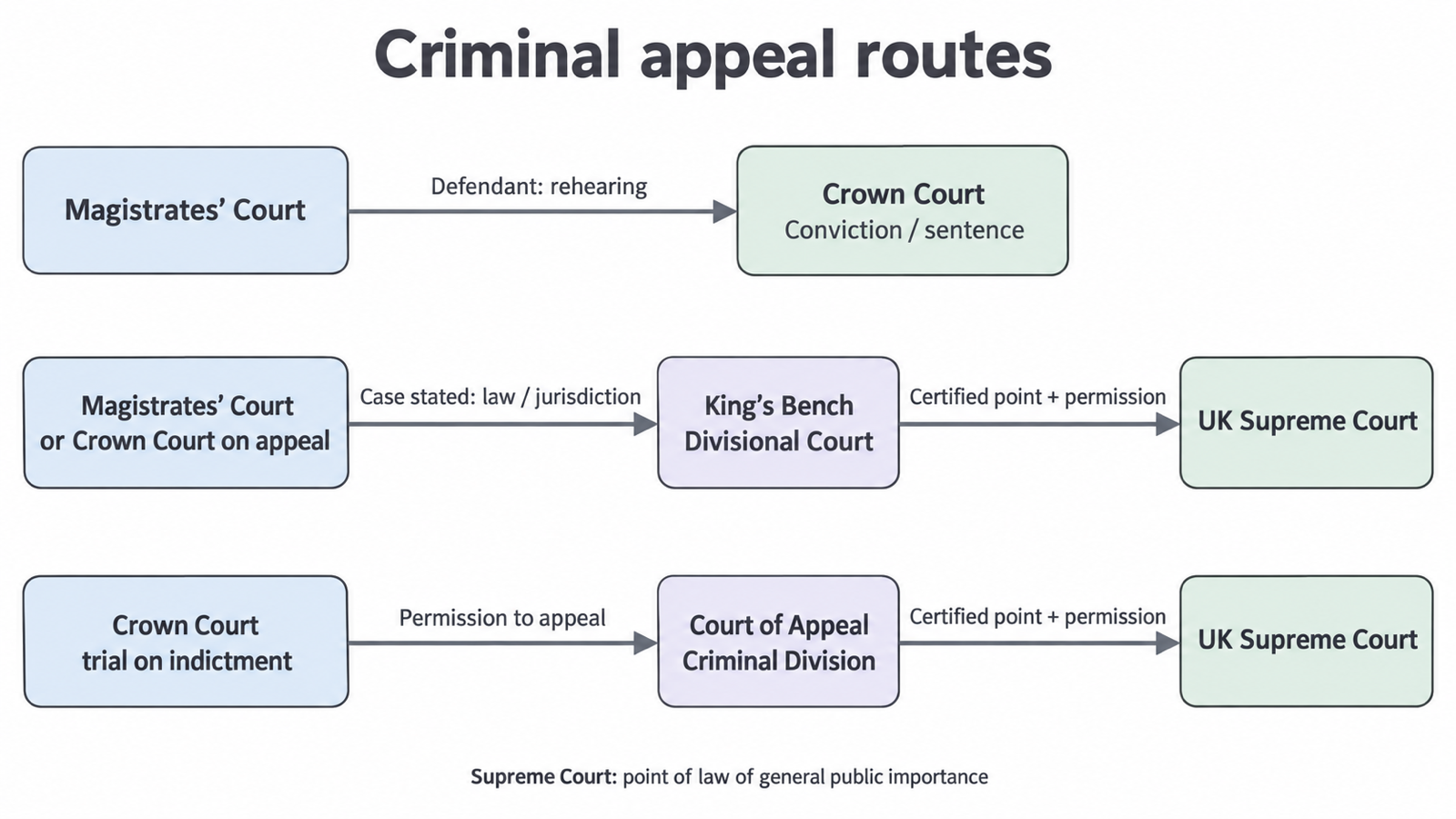
Read each row as a different procedural route, not one continuous ladder. The top Crown Court is acting on appeal; the bottom Crown Court has tried an indictment. The text explains plea restrictions, permission and the significance of each ground, which cannot all fit in a route diagram.
Appeals protect liberty by correcting error and clarify law through precedent. Filters also protect finality, finite court resources and witnesses from repeated proceedings. A restriction may leave an individual grievance without a further ordinary appeal, but opening every case indefinitely would undermine certainty. A defensible judgment asks whether the remaining issue is a significant legal question or a request to repeat a factual dispute. This connects institutional routes with fair trial safeguards and consistent law.
Quick recap
Use the Crown Court for the defendant's ordinary rehearing from magistrates, King's Bench for case stated on law or jurisdiction, and the Court of Appeal Criminal Division for qualifying challenges from trials on indictment. Supreme Court access ordinarily requires both certification and permission.