H418/01 - Unlawful act manslaughter
Learn how an unlawful and dangerous criminal act can lead to manslaughter without murder's intention, and why the base offence, objective danger, fault and causation must each be proved.
The involuntary route and base crime
Unlawful act manslaughter is a form of involuntary manslaughter built on a criminal act which is dangerous and causes death.
Involuntary manslaughter covers unlawful killings without the intention to kill or cause really serious harm required for murder. It does not mean every relevant bodily movement was involuntary. A defendant may deliberately commit a less serious offence and still lack murder's intention. Contrast voluntary manslaughter: murder's elements are present but a partial defence reduces liability.
For this route, identify the base offence: the crime on which the manslaughter is constructed. Its actus reus and relevant mens rea must be proved, and a valid defence to it can defeat the alleged unlawful act. A civil wrong alone is insufficient. Ordinary negligent performance of a lawful activity is not automatically an unlawful act for this purpose; gross negligence manslaughter has separate requirements.
R v Lamb (1967) illustrates the need to prove the base offence. The defendant pointed a revolver at his friend, mistakenly believing it would not fire; the friend did not fear an attack. The accidental shooting did not establish the assault relied on. A dangerous-looking incident and a death cannot replace proof of the base crime's legal requirements.
The route requires a positive act, not a pure failure to act. R v Lowe (1973) rejected unlawful act manslaughter based on child neglect by omission. That does not make fatal neglect lawful: a duty-based omission can instead raise gross negligence manslaughter or, with the required intention, murder.
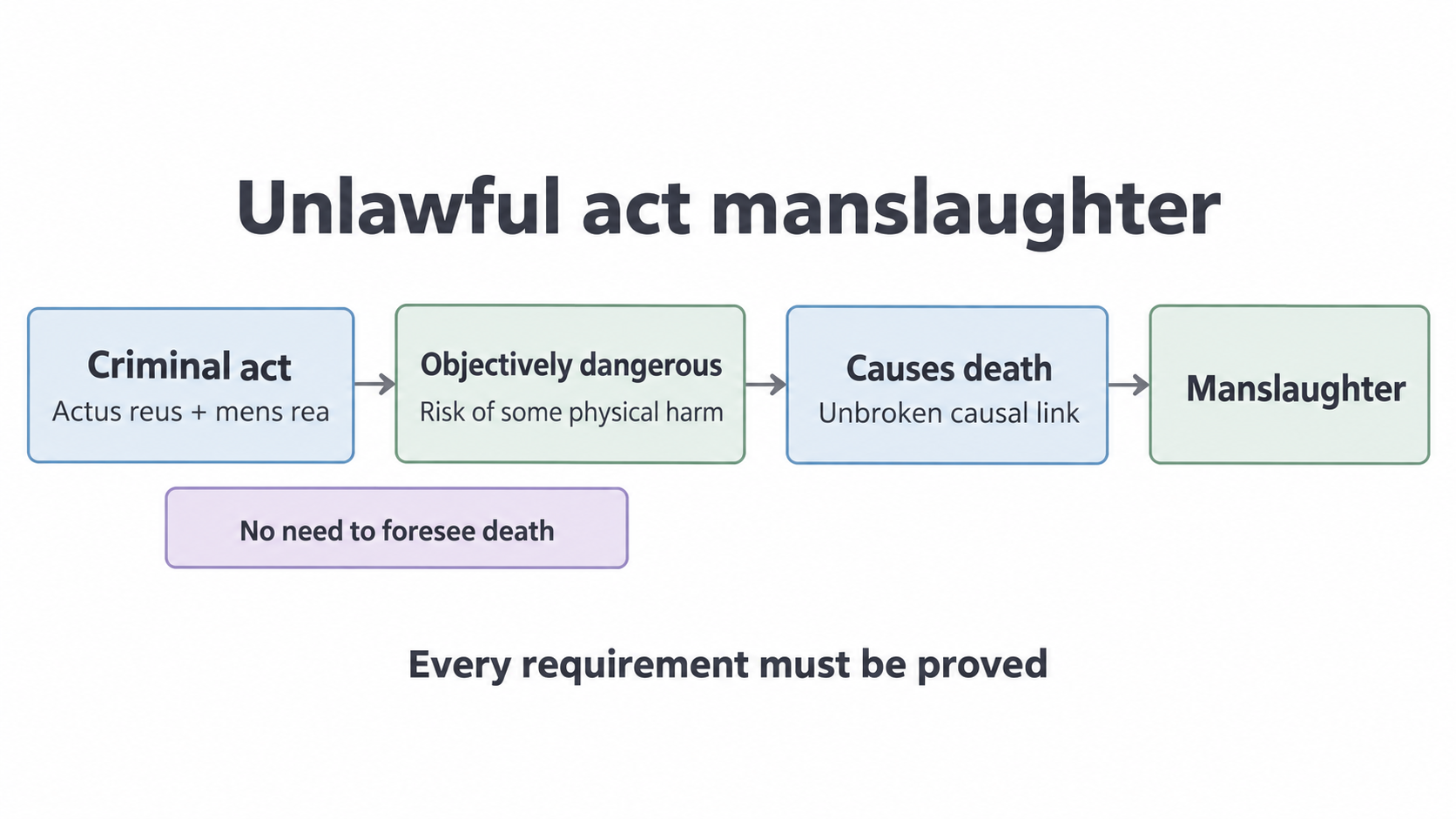
The diagram's arrows link cumulative requirements. Proving a crime does not automatically prove danger or causation. Its reminder about foresight concerns the death consequence; the prosecution still has to establish the mental element of the base crime.
Objective danger of physical harm
The criminal act must be dangerous in an objective sense, involving at least a risk of some physical harm to another person.
In R v Church (1965) the Court of Appeal established the central test: would all sober and reasonable people recognise that the act must expose another person to at least some risk of harm? The harm need not be serious, and death need not be foreseeable. Danger is assessed independently of the defendant's own failure to recognise it. It concerns the unlawful act in its circumstances, not whether the actual death later made the event look dangerous.
The required harm is physical. Mere distress or fright is not enough by itself, although a risk of physical harm through a fright-induced reaction can qualify where the relevant circumstances make that risk apparent. A criminal act causing only property damage may fail the danger requirement if no person is exposed to physical harm. Conversely, an act aimed at property can be dangerous to people.
R v Goodfellow (1986) involved arson at the defendant's home to seek rehousing; others died in the fire. The Court of Appeal confirmed that the unlawful act need not be aimed directly at the person who dies. Setting fire to an occupied building can expose people to physical harm even if the immediate aim concerns property.
Original comparison: Deliberately pushing a person beside a flight of stairs creates an obvious risk of at least some physical injury. Deliberately scratching an empty parked car may be criminal damage but, without additional facts, does not necessarily expose anyone to physical harm. Identify the physical risk instead of simply writing “the act was unlawful, so it was dangerous”.
What the reasonable observer knows
The sober and reasonable observer assesses danger using the relevant facts known during the unlawful act, rather than hidden facts revealed only afterwards.
In R v Dawson (1985) robbers frightened a petrol-station attendant who had an unknown heart condition and died. The Court of Appeal rejected an approach which gave the reasonable observer knowledge of the hidden condition. Fear alone did not necessarily establish the required risk of physical harm on the facts known at the scene. This concerns danger; it does not replace the separate rule that a defendant takes a victim as found when assessing a proved causal injury.
In R v Watson (1989) burglars encountered an elderly householder. The Court of Appeal explained that knowledge can develop during an offence: the observer can take account of the victim's apparent age and frailty once those facts become apparent to the defendants. The court nevertheless quashed the conviction following a problematic causation direction given without an opportunity for defence counsel to address it. Thus approval of the direction on danger did not make the conviction safe on every issue.
Original application: Before entering a house, two intruders know nothing about its occupant. During their continuing offence, they see a visibly frail older occupant struggling for breath while they threaten him. The observable facts can strengthen the argument that some physical harm would be recognised. A secret medical diagnosis discovered only after death cannot simply be added to the observer's knowledge. If ordinary physical danger is already clear, an undiscovered vulnerability may affect the outcome through causation, without needing to establish danger itself.
This is how a careful lawyer uses precedent: extract the proposition, identify the material factual difference and keep other offence elements separate. “Watson involved an older victim” is less useful than explaining when visible frailty becomes part of the objective danger assessment.
Causal death and free choice
The unlawful act must cause the death; a crime followed by a death is not enough.
Apply factual and legal causation. But for the act, would the person have died as and when they did? Did the act remain a sufficiently significant cause, rather than being displaced by an independent intervening act? It need not be aimed at the eventual victim, and the precise manner of death need not have been predicted. A victim's vulnerability normally does not erase an established causal injury.
R v Kennedy (No 2) (2007) concerned supplying a prepared syringe of heroin to an adult who freely and knowingly injected himself and died. The House of Lords held that the informed voluntary self-administration broke the causal chain for unlawful act manslaughter based on the supply. The criminality of supply did not prove that the supplier caused the death in the required legal sense.
The autonomy reasoning has limits. Directly administering the substance, coercing the recipient or supplying a person unable to make an informed voluntary decision raises different issues. Do not turn Kennedy into a rule that drug-related deaths can never lead to homicide liability. A supplier's later failure to seek help can also raise a separate duty-based gross negligence question, where its elements are proved.
Original comparison: A capable adult, fully informed about the substance, freely self-injects after receiving it. Kennedy presents a causation obstacle to this route. If the supplier secretly injects an unconscious person, the supplier performs the administration and cannot rely on the recipient's autonomous act. That changed fact affects both the identified base offence and causation.
Fault for the base offence
The prosecution must prove the base offence's mental element, but need not prove foresight of death or even the defendant's recognition of danger.
In DPP v Newbury and Jones (1976) the defendants deliberately pushed a paving stone from a railway bridge onto a train, killing a guard. The House of Lords confirmed that an intentional unlawful act which is objectively dangerous and causes death can establish manslaughter without foresight of harm. The necessary mens rea is that of the base offence, not an added intention to kill or a requirement that the defendant personally foresaw the death.
“Intentional act” and “intended harm” are different. For the ordinary crimes studied here, prove the required intention or recklessness relating to that crime. Battery, for example, requires intentional or reckless unlawful force, not an intention to cause really serious injury. A genuine accident that fails to establish the base offence's mental element cannot be rescued by the later death. Equally, someone who commits the crime cannot defeat objective dangerousness merely by saying, “I did not realise it might hurt anyone.”
Original application: Ben deliberately shoves Asha to move her aside beside a stairway, without intending serious injury. If this is unlawful battery, the physical risk is apparent to a sober reasonable observer, and the shove causes her fatal fall, unlawful act manslaughter is a strong conclusion. Murder would require additional proof of intention to kill or cause really serious harm. If Ben accidentally stumbles into Asha without intention or recklessness as to force, battery may not be proved and this route needs a different established base offence; death itself supplies none.
The route is sometimes called constructive manslaughter because liability for the death is built on a lesser crime. A criticism is that some-harm danger and base-offence fault can expose defendants to very serious homicide liability for an unforeseen death. A counterargument is that deliberately committing a crime dangerous to another person's physical safety justifies responsibility for its fatal consequences. The causal and objective-danger requirements constrain that responsibility. A reasoned judgment identifies both the difference in fault from murder and the safeguards; it does not describe the route as liability without any fault.
Quick recap
Prove a criminal act with its required fault, objective danger of some physical harm, and causal death. Keep hidden knowledge, autonomous intervention and lack of murder's intention distinct.