H418/03 - Taking a case to Strasbourg
The European Court of Human Rights can examine a state's Convention responsibility when effective domestic remedies have been used. Learn how a case reaches the Court, what makes it admissible, how the Court interprets rights, and the strengths and limits of this protection alongside English law.
The Court and an application
The European Court of Human Rights, or ECtHR, in Strasbourg is a Council of Europe court applying the European Convention on Human Rights.
It is separate from the European Union and its Court of Justice. The UK's departure from the EU did not remove its ECHR obligations or the Strasbourg route. The ECtHR is also not another ordinary appeal court for English judgments: it examines Convention violations attributable to a contracting state, not every alleged error of domestic law or disputed fact.
Under Article 34, a person, non-governmental organisation or group can apply claiming to be a victim of a state's violation. The applicant need not be a national of that state, but the complaint must concern its Convention responsibility towards someone within its jurisdiction. The respondent is the state. A complaint arising from a newspaper's conduct, for example, would have to identify a relevant failure of state protection or judicial treatment; Strasbourg does not simply try a private newspaper for damages as if it were an English tort court.
An individual normally starts by completing the Court's current application form. Rule 47 requires identifying information, a concise account of facts and alleged violations, an explanation of admissibility, signatures and copies of relevant decisions and documents. The form must let the Court understand the complaint without searching through an unexplained bundle. It is sent by post; the dispatch date of a compliant application normally establishes introduction. An incomplete letter or a fax does not ordinarily stop the time limit. A request to protect the applicant's identity from public disclosure differs from making an anonymous application which fails to identify the applicant to the Court.
The person can make the initial application without a lawyer. Representation is generally required later if the case is communicated to the government, subject to the Court's rules and exceptions. No filing fee is charged, but representation and preparation can have costs. A claimant should identify the Convention problem rather than submit a general account of dissatisfaction.
Domestic remedies and the deadline
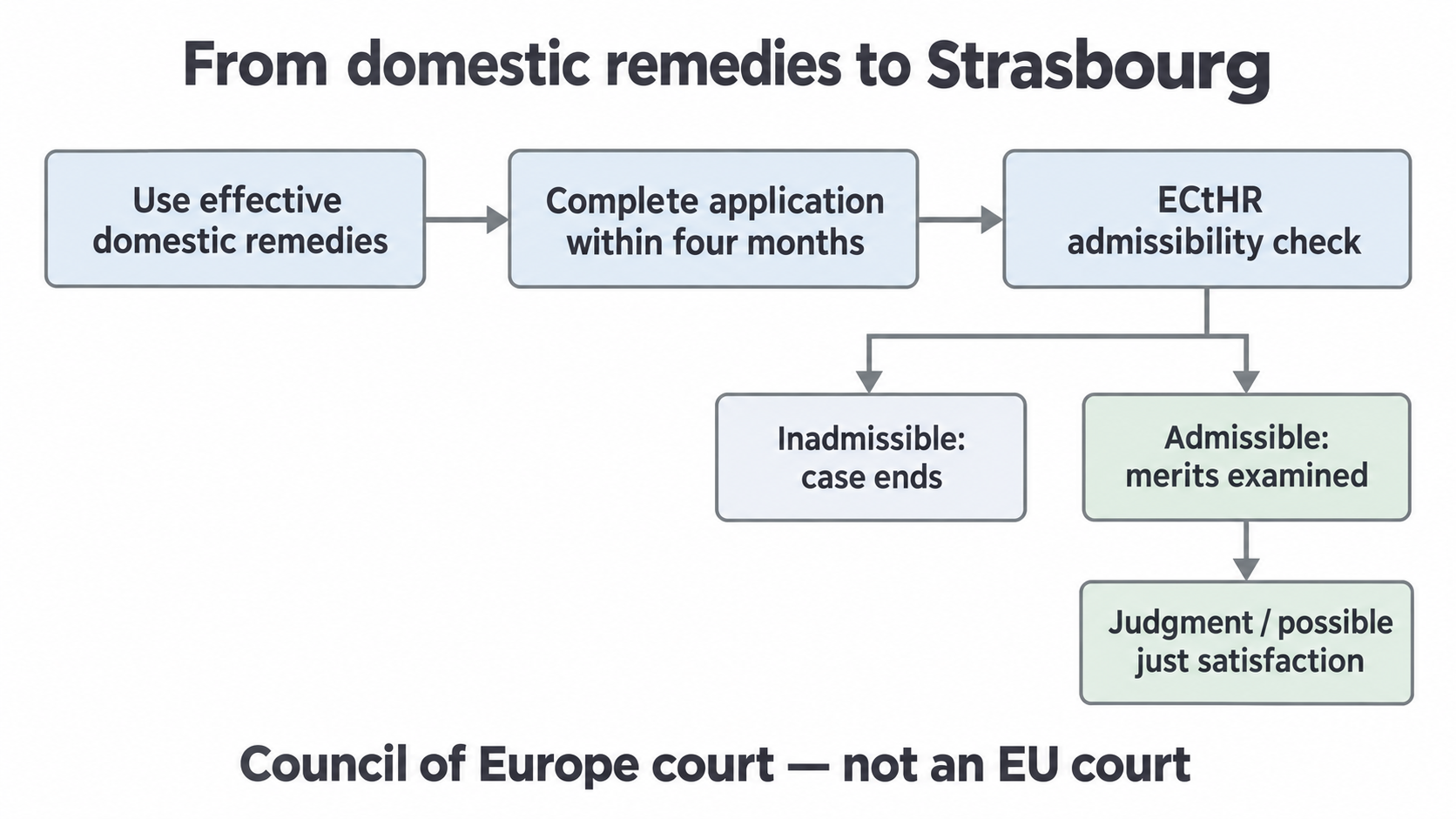
Article 35(1) normally requires exhaustion of effective domestic remedies and introduction within four months of the final domestic decision.
Exhaustion means using available remedies capable of providing redress for the particular complaint, following their procedural rules and raising its substance domestically. A person normally cannot skip an effective appeal because success seems unlikely or litigation is inconvenient. Equally, the rule does not require useless or unavailable remedies. The applicant must explain any claimed exception; lack of confidence in national judges alone is insufficient.
The four-month rule replaced the older six-month period from February 2022. Normally the period runs from the final decision in the effective domestic process, with the detailed calculation taking account of notification or knowledge where appropriate. If there is no effective remedy, the starting point can instead be the act or the applicant's knowledge of it. Pursuing a plainly ineffective extra procedure does not normally restart the clock. The limit is strict, so do not assume that sending an initial inquiry or requesting reopening creates extra time.
Original application: Leila challenges an alleged Article 8 breach in the proper domestic court, raises the substance of the complaint, and uses the effective appeals. Her final decision is notified on 10 January. She posts a complete application on 1 March. Those facts support exhaustion and timeliness, although the Court must still test other criteria. If she waits until July because she is preparing another complaint to a body unable to grant redress, the extra complaint will not ordinarily rescue the late application.
Contrast Ravi, who files in Strasbourg while an effective statutory appeal remains available and has not been used. His case risks rejection for non-exhaustion even if filed only a week after the original decision. Timeliness and exhaustion are separate tests: meeting one does not establish the other.
Other admission tests and progress
An admissible application must satisfy more than the exhaustion and time requirements.
The applicant must have victim status and a complaint within the Convention's scope and the state's responsibility. Article 35 excludes anonymous applications and substantially repeated matters already examined by the Court or submitted to another international investigation or settlement, unless relevant new information exists. The application must not be incompatible with the Convention, manifestly ill-founded or an abuse of the application right. “Manifestly ill-founded” includes a complaint lacking an arguable Convention basis; it is not simply a synonym for missing paperwork.
The applicant must normally have suffered a significant disadvantage, unless respect for human rights requires examination of the merits. This exception prevents a purely mechanical rule that every small loss must be ignored. There is no universal monetary threshold. Admissibility concerns whether the Court can examine the case; the merits concern whether a violation occurred. An admissible claimant can still lose on the merits.
A single judge can reject an evidently inadmissible case, with a final decision. Committees of three can deal with relevant cases, including well-established case law; Chambers of seven examine other cases. Admissibility and merits can be considered together. If a case is communicated, the government and applicant supply observations; many cases are decided on written material, without an oral hearing. A friendly settlement can resolve a case under Court supervision. The Grand Chamber has seventeen judges, but referral after a Chamber judgment is exceptional: a request within three months must be accepted by the relevant panel, rather than operating as an automatic appeal.
Under Article 41, the Court may award just satisfaction when a violation is found and domestic law gives only partial reparation. Compensation is not automatic. Under Article 46, a final judgment binds the respondent state in that case; the Council of Europe's Committee of Ministers supervises execution. Execution may require individual redress and wider changes, such as legislation or administrative practice. The ECtHR does not itself repeal an English Act, retry an applicant's prosecution or guarantee immediate compliance.
Continue this lesson.
You’re previewing NovaLearn without an account. Create a free account to read the rest.
Create free account