H418/03, H418/04 - The rule of law
Learn how the rule of law limits public power and helps people rely on legal rights. Compare different accounts of its core principles, then use court decisions and practical difficulties to judge how far it secures justice.
Government under law
The rule of law requires public power to operate within law rather than according to an official's personal preference.
The rule of law is a constitutional principle that people and public authorities should be governed by law, with legal limits, fair procedures and effective ways to challenge unlawful action. It is wider than the existence of written rules. A ruler could publish rules while exempting friends or punishing critics without a hearing. That would use law as an instrument of power while undermining the rule of law.
Its importance begins with security and predictability. People need to know what conduct is prohibited and whether agreements or property rights will be respected. Legal constraints also help prevent the state from using its superior resources arbitrarily. Arbitrary power is power exercised without sufficient legal constraint or justification. Lawful discretion is different: a rule may allow a decision-maker to choose between justified options within defined limits.
In Entick v Carrington (1765), state messengers entered Entick's home and seized papers under a secretary of state's warrant. The court held that the interference lacked a lawful basis and the officers were liable in trespass. The importance is that official status and a claimed public interest did not supply missing legal authority. It is not a rule that every search is unlawful: a search within a valid legal power is different.
Section 1 of the Constitutional Reform Act 2005 recognises the existing constitutional principle of the rule of law. It does not turn the principle into an exhaustive statutory list. The principle guides legal reasoning and institutional behaviour; a court still needs to identify the applicable legal rule and remedy in a particular challenge.
Dicey and core principles
Dicey's account explains the rule of law through constraints on punishment, equality before law and rights protected by courts.
In A. V. Dicey's nineteenth-century account, three connected ideas were central. First, a person should suffer punishment only for a breach of law established through ordinary legal procedures, rather than an official's arbitrary demand. Second, people of every rank, including officials, should answer to the ordinary law and courts. Third, English constitutional rights were substantially the result of judicial decisions protecting individuals, rather than solely promises in a constitutional document.
The third idea describes Dicey's view of the English constitution; it is not a claim that written rights are worthless or that modern rights have no statutory sources. His preference for ordinary courts also needs qualification today: specialist tribunals can provide lawful, fair decision-making rather than automatically violating equality.
Several practical requirements follow. Laws should be public, sufficiently clear and relatively stable. They should normally guide future conduct rather than create punishment for an act that was lawful when done. Courts should be independent of improper government or private pressure and impartial between the parties. People should receive a fair opportunity to meet allegations and contest evidence.
In an original example, a council publishes a licence rule, gives reasons for refusal and allows an independent challenge. That supports predictability and accountability. A mayor's secret instruction to refuse only political opponents' applications undermines those values, even if every applicant completes the same form. Equal forms do not establish equal treatment.
Equality does not require identical treatment regardless of relevant differences. A hearing adjustment enabling a disabled claimant to participate may support equality. The question is whether the difference has an objective justification, not whether everyone literally receives the same arrangement.
Bingham, rights and remedies
Bingham's account joins the quality of legal rules to effective protection of people and their rights.
Lord Bingham described eight principles: accessible and predictable law; rights and liability ordinarily decided by law rather than uncontrolled discretion; equal application unless objective differences justify distinction; public powers used fairly, in good faith and within their limits; protection of fundamental human rights; civil dispute resolution without prohibitive cost or excessive delay; fair adjudication; and compliance with international as well as domestic legal obligations. This is an influential account, not eight independently enacted offences.
A formal account emphasises how law is made and administered: clarity, prospectivity and fair procedure. A substantive account also asks whether its content protects fundamental rights. The distinction matters because clear rules can still discriminate. Bingham's approach challenges the idea that a persecuting state respects the rule of law merely by following its own detailed legislation.
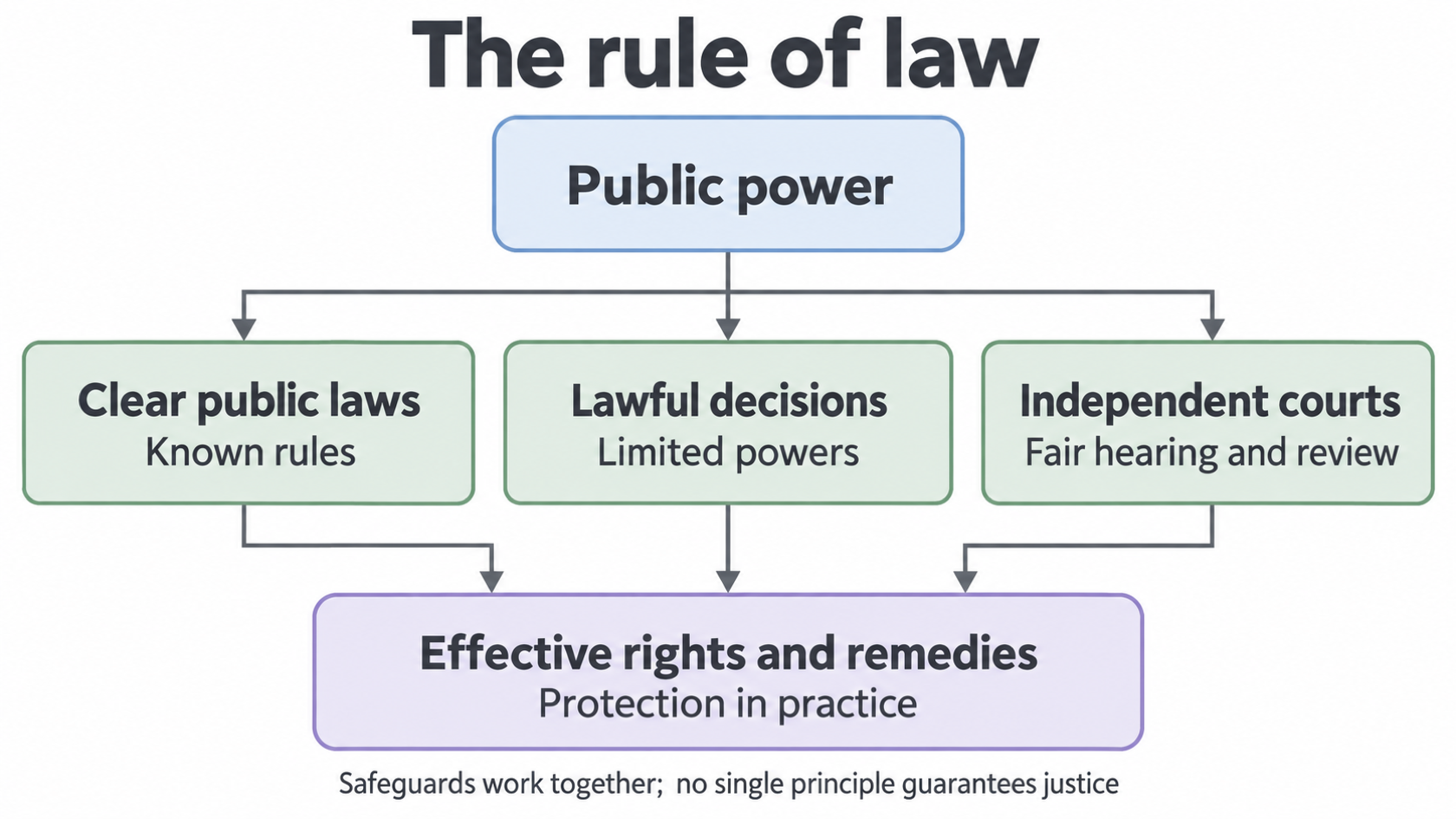
The diagram shows complementary safeguards. Clear rules help people identify a right; lawful decisions prevent officials ignoring it; independent courts provide a fair route to challenge interference. The arrows do not mean rights emerge automatically. Access, resources and enforceable remedies must make protection work in practice.
In R (UNISON) v Lord Chancellor (2017), the Supreme Court held employment tribunal fees unlawful because their practical effect prevented access to justice. The common-law right of access enabled people to enforce statutory employment rights. The case links public-law control of delegated legislation with civil dispute resolution: a right loses practical value if people cannot use the forum needed to enforce it. It did not abolish every court fee.
Continue this lesson.
You’re previewing NovaLearn without an account. Create a free account to read the rest.
Create free account