H418/03 - Article 10: freedom of expression
Learn how Article 10 protects expression, how restrictions must be justified, and how English law balances speech with reputation, privacy and fair trials.
Protected expression
Article 10 protects holding opinions and receiving and imparting information and ideas, including across national frontiers.
Expression is wider than a spoken political opinion. It can include writing, journalism, art, broadcasting, signs and expressive conduct. Receiving information protects the audience as well as the speaker; imparting means communicating it to others. Criticism of public authorities is especially important to democratic accountability. Commercial and artistic expression can also engage the right, though their weight and the permissible restrictions may differ from political debate.
Protection does not depend on everyone liking the message. In Handyside v United Kingdom (1976), the European Court of Human Rights explained that democratic pluralism requires protection of ideas that offend, shock or disturb. The case concerned a publisher's conviction and confiscation of a book aimed at schoolchildren under obscenity law. The Court nevertheless found the restriction justified on the facts for protecting morals, allowing a national margin of appreciation. Its significance is twofold: offensive expression can be protected, but engagement of Article 10 does not settle justification. The judgment is not a general defence to every offensive or unlawful act.
The text allows licensing of broadcasting, television and cinema enterprises. This is not permission for unrestricted censorship. Article 10(2) also recognises that expression carries duties and responsibilities. Reporting that endangers a fair trial or seriously harms another person's reputation raises different interests from merely embarrassing a government.
Original contrast: a student writes that a council policy is wasteful. The council cannot treat its discomfort as proof that the criticism falls outside Article 10. A threat of unlawful violence against an opponent is a different legal problem: expressive form does not immunise intimidation or harmful conduct.
The restriction test
A restriction on protected expression must meet all the requirements of Article 10(2).
It must be prescribed by law, pursue a listed legitimate aim, and be necessary in a democratic society. “Law” can include sufficiently clear common law as well as statute. A person must be able, with appropriate advice where necessary, to understand the rule and reasonably foresee its consequences; perfect certainty is not demanded. The Sunday Times v United Kingdom (No 1) (1979) explains this quality-of-law principle.
The listed aims are national security, territorial integrity, public safety, prevention of disorder or crime, protection of health or morals, protection of the reputation or rights of others, preventing disclosure of information received in confidence, and maintaining the authority and impartiality of the judiciary. Do not import Article 8's economic-well-being aim into Article 10 as an additional ground. A government wishing to avoid criticism has not supplied a listed aim merely by calling a report inconvenient.
Necessity requires a pressing social need and proportionate interference, supported by relevant and sufficient reasons. Ask how the measure addresses the danger, whether a narrower effective measure would work, and whether the harm avoided warrants the restriction. The severity of a penalty and the chilling effect on future legitimate speech matter as well as the initial ban.
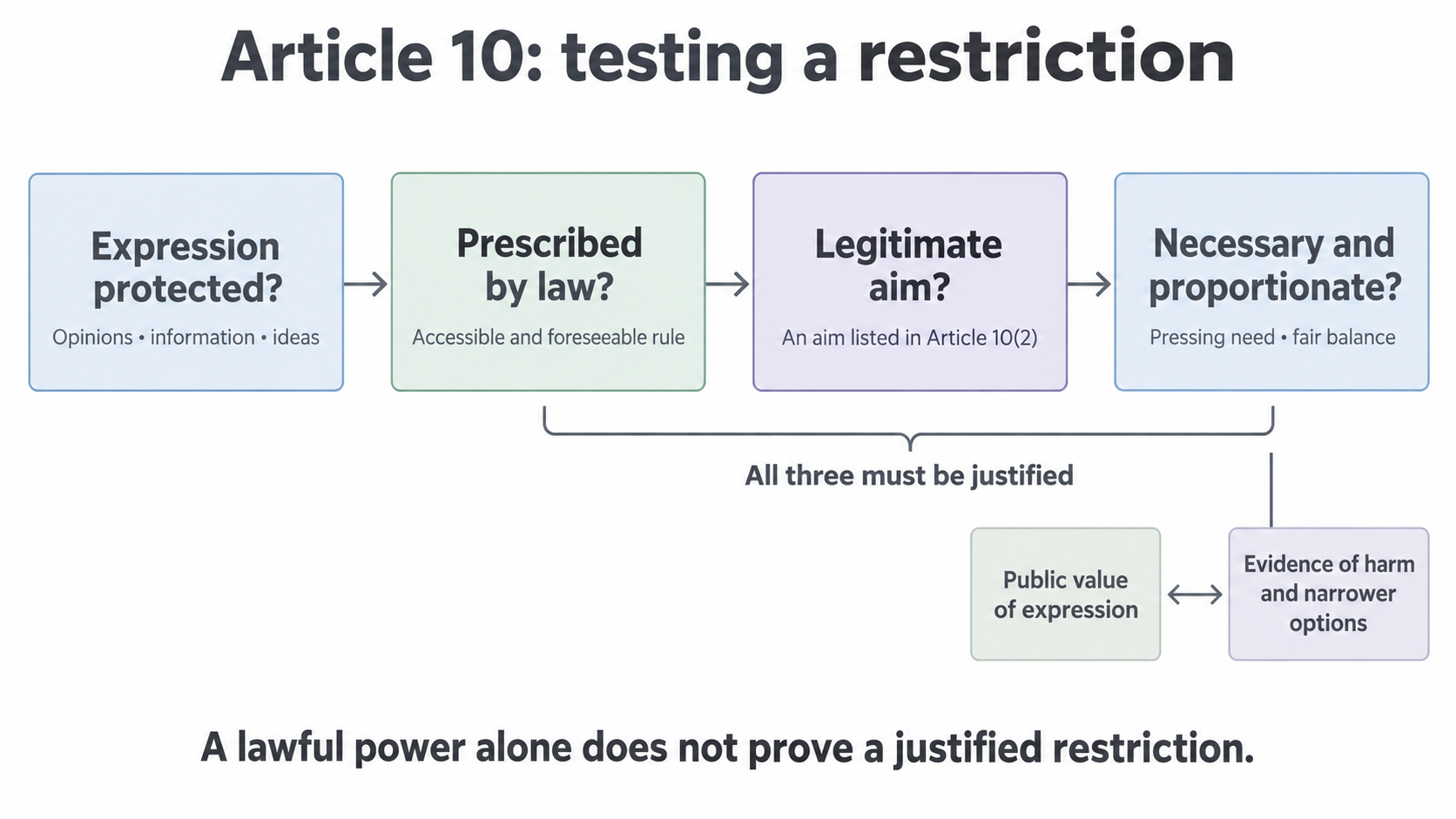
Each restriction gate requires justification. A legal power and a legitimate aim do not make every use proportionate.
In Sunday Times, an injunction prevented reporting about thalidomide while civil proceedings were pending. Strasbourg accepted a lawful basis and the legitimate aim of protecting judicial authority, but found the restriction unnecessary in the circumstances, giving weight to public discussion of the serious issue. The case therefore does not abolish contempt law: it requires justification for its use.
Original example: an authority proposes a year-long ban on all criticism of a hospital after an inaccurate post causes concern. Protecting health or others' rights may be relevant, but a correction and action against the specific false allegation could address the harm. Suppressing accurate reports of dangerous treatment would impose a much wider burden and weaken accountability.
Reputation and defamation
Defamation law restricts damaging publications while providing defences that protect justified expression.
Defamation concerns published statements harming a person's reputation in the eyes of others. A statement is not defamatory under Defamation Act 2013 section 1 unless publication has caused or is likely to cause serious harm to the claimant's reputation. A body trading for profit must show serious financial loss for this threshold. Hurt feelings alone do not establish the statutory requirement.
The Act provides distinct defences. Section 2 protects truth where the imputation conveyed is substantially true. Section 3 protects honest opinion if the statement is opinion, indicates its basis, and an honest person could have held it on qualifying facts or privileged material. An author must actually hold the opinion. For someone republishing another person's opinion, the separate rule asks whether they knew or ought to have known the author did not hold it. A factual accusation cannot be converted into opinion merely by adding “I think”. Section 4 protects publication on a matter of public interest where the defendant reasonably believed publishing the statement was in the public interest, assessed in all the circumstances. It is not enough that readers would buy the story.
Continue this lesson.
You’re previewing NovaLearn without an account. Create a free account to read the rest.
Create free account