H418/03 - The Human Rights Act and devolution
The Human Rights Act gives specified Convention rights domestic legal protection while preserving Parliament's legislative authority. Learn how courts, public bodies and devolved institutions are constrained, and assess whether this balance protects rights effectively.
Domestic rights and public power
The Human Rights Act 1998, or HRA, mainly came into force on 2 October 2000. Before it, a Convention complaint could require a lengthy Strasbourg application after domestic proceedings. The Act brought specified Convention protections into domestic legal decision-making; it did not make the UK join the Convention for the first time.
Section 1 identifies the Convention rights given effect by the Act, including Articles 2–12 and 14 and specified protocol rights. Not every treaty provision is itself one of the HRA's scheduled rights. Section 2 requires courts and tribunals to take relevant Strasbourg case law into account. That is not an instruction to treat every Strasbourg decision as binding domestic precedent. A UK Supreme Court decision binds lower domestic courts in the usual way; the UK's separate Article 46 obligation concerns final Strasbourg judgments in cases against it.
Section 6 makes it unlawful for a public authority to act incompatibly with a Convention right. Police forces, councils, government departments, courts and tribunals are covered. Some bodies have both public and private functions: a body can fall within section 6 for its public functions without every private act being covered. Government funding alone is not a complete test of the nature of an act. Either House of Parliament and persons acting in connection with parliamentary proceedings are excluded from this definition.
Section 6(2) provides important exceptions where primary legislation leaves the authority unable to act differently, or the authority gives effect to provisions which cannot be read compatibly. If a statute gives a council a choice, it ordinarily must exercise that choice compatibly. A mandatory incompatible rule raises a different route from an unlawful discretionary decision.
An original example: a council has discretion to provide an accessible hearing but refuses to do so. Its own decision can be challenged under section 6. If a private neighbour insults the claimant, section 6 does not automatically create a direct HRA claim against that neighbour. Courts themselves must act compatibly, and rights may influence interpretation and development of ordinary private law. This indirect effect is different from making every private person a public authority.
Compatible interpretation
Section 3 requires primary and subordinate legislation, whenever enacted, to be read and given effect compatibly with Convention rights so far as possible. This goes beyond choosing between two ordinary dictionary meanings: a compatible reading can require reading words in or narrowing their operation. However, a court cannot use section 3 to contradict a fundamental feature of the statutory scheme or undertake a legislative redesign beyond its institutional competence.
In Ghaidan v Godin-Mendoza (2004), a surviving same-sex partner sought succession to a protected tenancy. The House of Lords read the Rent Act provision referring to living together as wife or husband so that it included a same-sex relationship of the relevant stable character. This avoided discriminatory treatment connected with home and private life. The decision illustrates substantial interpretive power because the court went beyond the ordinary historical meaning, while preserving the tenancy scheme's basic purpose.
Compare Bellinger v Bellinger (2003). A transgender woman sought recognition that her marriage was valid under the legislation then in force. The House of Lords considered that the necessary change raised wide policy questions about legal recognition of gender which Parliament had to settle; section 3 could not supply the whole scheme. It instead made a declaration of incompatibility. This is a historical illustration of the boundary between interpretation and law making, not a statement that marriage and gender-recognition law today remain as they were in 2003.
To apply section 3, identify the incompatible effect, suggest the particular reading that removes it, and test that reading against the statute's structure. The existence of a rights problem alone does not prove that any proposed rewriting is possible. Nor does clear original wording automatically defeat section 3: Ghaidan shows why that argument is too narrow. These House of Lords decisions remain domestic precedent subject to the normal hierarchy and later developments.
Incompatibility and legislative response
Section 4 allows specified senior courts, including the High Court, Court of Appeal and Supreme Court, to make a declaration of incompatibility when compatible interpretation is unavailable. A magistrates' court does not have this section 4 power. The declaration identifies a rights defect, but does not affect the validity, continuing operation or enforcement of the provision and is not binding on the parties. It does not strike down primary legislation or itself supply the claimant with a replacement statutory rule.
Section 10 enables a minister to make a remedial order amending legislation to remove an incompatibility where its conditions are met and there are compelling reasons to use that procedure. It is a power, not an automatic duty to repair every declaration immediately. The Act's Schedule 2 supplies parliamentary procedures and scrutiny. Parliament can instead respond through ordinary legislation. If subordinate legislation is incompatible and primary legislation does not prevent removal of the defect, courts can have stronger remedies than a section 4 declaration, including quashing it in an appropriate challenge.
Section 19 requires the minister responsible for a Bill to state before its second reading either that the Bill is considered compatible or that the government wishes to proceed despite being unable to make that statement. This promotes public and parliamentary scrutiny. A statement is not a judicial ruling, and section 19 does not prevent Parliament from passing a Bill without a compatibility statement.
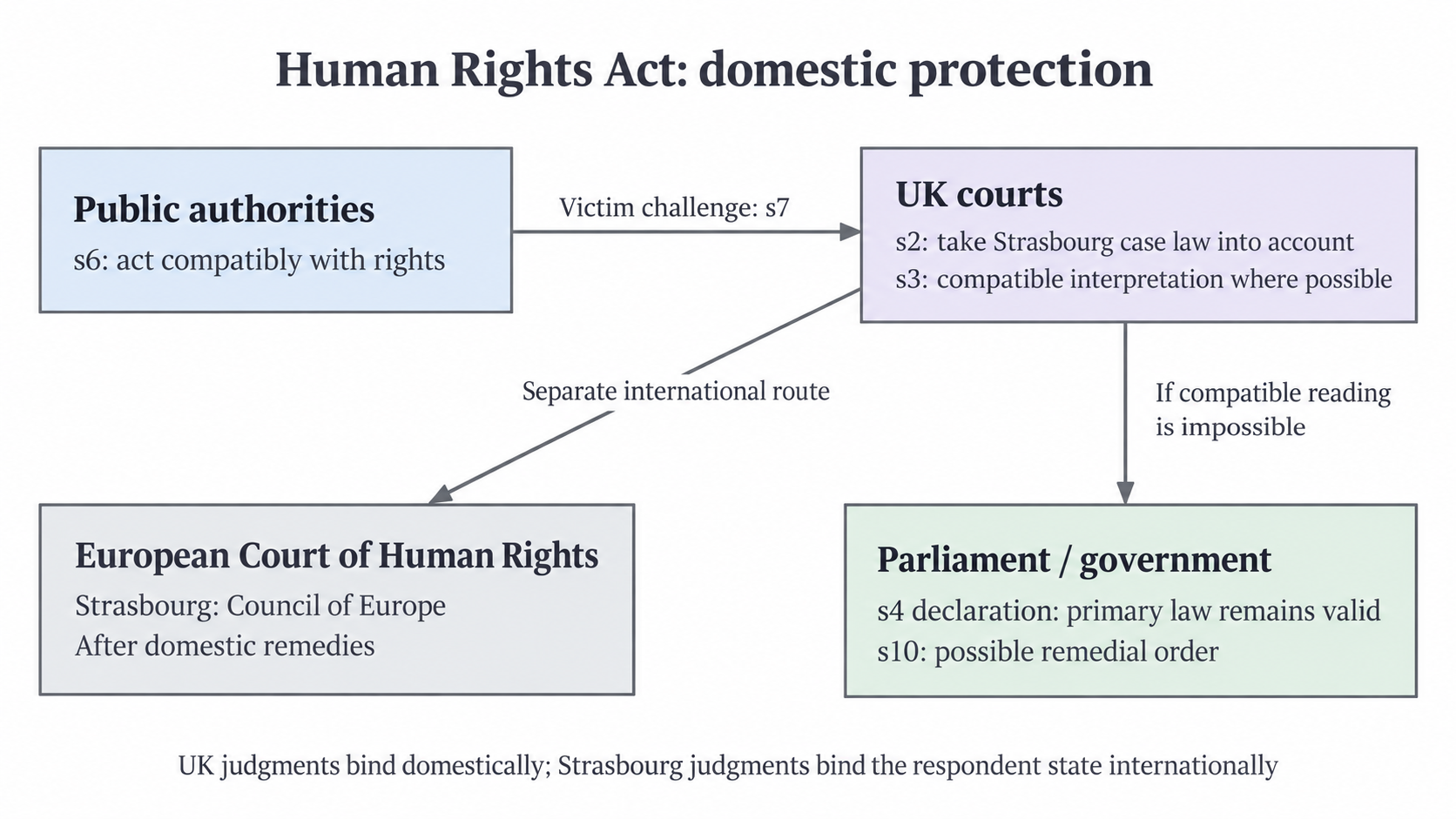
UK courts make section 4 declarations; Parliament or ministers decide the legislative response. The diagram summarises routes, with section 6 exceptions and admissibility conditions explained in the text.
An original counterexample: a senior court finds an Act incompatible and an official announces that the Act ceased to exist that morning. That is incorrect. The defect has been judicially identified, but the primary law continues until a lawful change is made. The mechanism creates constitutional dialogue and political pressure while preserving Westminster's authority to legislate.
Continue this lesson.
You’re previewing NovaLearn without an account. Create a free account to read the rest.
Create free account