H418/02 - Negligence, damage and causation
Even a clear failure of care does not make a defendant responsible for every later loss. Learn how factual and legal causation connect breach to recoverable damage, who must prove the claim, and how defences and damages shape a fair result.
Factual causation
Factual causation asks whether the breach actually made the relevant difference to the harm. The ordinary but-for test asks: would the claimant have suffered this damage but for the defendant's breach? If the same damage would have occurred even with reasonable care, the breach has not ordinarily caused that damage. Ask about the breach, rather than removing the defendant's entire existence from the story.
In Barnett v Chelsea and Kensington Hospital Management Committee (1969), a man with arsenic poisoning was sent home without appropriate examination or treatment. Although the hospital's response breached its duty, the evidence showed that proper treatment would not have prevented his death. The claim for that death therefore failed on causation. The Court of Appeal's later Calvert judgment explains Barnett's causal significance. Breach was not transformed into compensation merely because the outcome was tragic.
Original example: a worker negligently leaves a cable across a corridor and a visitor trips on it, breaking a wrist. If removing the cable would have prevented the fall, the breach satisfies ordinary factual causation. Change the facts: reliable evidence shows the visitor had already fallen because of an unrelated collapse before contacting the cable. The cable's presence alone does not prove it caused the wrist injury. Evidence about timing, mechanism and what reasonable care would have changed matters.
The ordinary test can be difficult with several possible causes or missing evidence. Special causal doctrines exist for particular situations; they are not a reason to assume that every uncertainty proves liability. For the straightforward personal-injury and physical-property problems here, identify the damage, the particular failure of care and the counterfactual position. Legal responsibility remains a separate step even when factual causation is established.
Legal causation and remoteness
Legal causation limits which consequences of a factual cause the defendant must answer for. Two important questions concern remoteness, whether the kind of damage was reasonably foreseeable, and a novus actus interveniens, a new intervening event sufficient to break the causal chain. Being a historical part of the story does not necessarily create legal responsibility for every consequence.
In The Wagon Mound (No 1) (1961), oil spilled into a harbour and fire later damaged a wharf. On the evidence in that case, fire damage was not reasonably foreseeable, so the defendant was not liable for that kind of damage merely because the oil spill was a factual cause. The Privy Council judgment replaced a rule based simply on direct consequences with foreseeability of damage. Use the evidence and holding of this case; a different case or different evidence about foreseeability may produce a different result.
The precise mechanism and exact extent need not both be foreseen. In Hughes v Lord Advocate (1963), unattended paraffin lamps at road works caused an unexpected explosion which burned a child. Burns were a foreseeable kind of injury despite the unexpected way they arose. The judgment shows why describing the harm at the appropriate level matters. A completely different kind of harm cannot be made foreseeable simply by using the very broad word “damage”.
The thin-skull rule also means taking a victim as found: where actionable physical injury of the relevant kind is foreseeable, an unusual vulnerability does not automatically limit recovery to the injury an average person would suffer. This concerns extent, rather than eliminating the need for a foreseeable kind of harm. The Corr judgment explains the physical-injury principle using Hughes and Smith v Leech Brain.
An intervening event requires careful reasoning. In McKew v Holland and Hannen and Cubitts (1969), a claimant attempted to descend a steep staircase unaided, knowing that his weakened leg could give way. His unreasonable conduct broke the chain for the later injury; the original injury remained compensable. The House of Lords judgment distinguishes a reasonable response to injury from unreasonable creation of a new danger. A later act, ordinary medical treatment or foreseeable reaction does not automatically break the chain merely because it happens later.
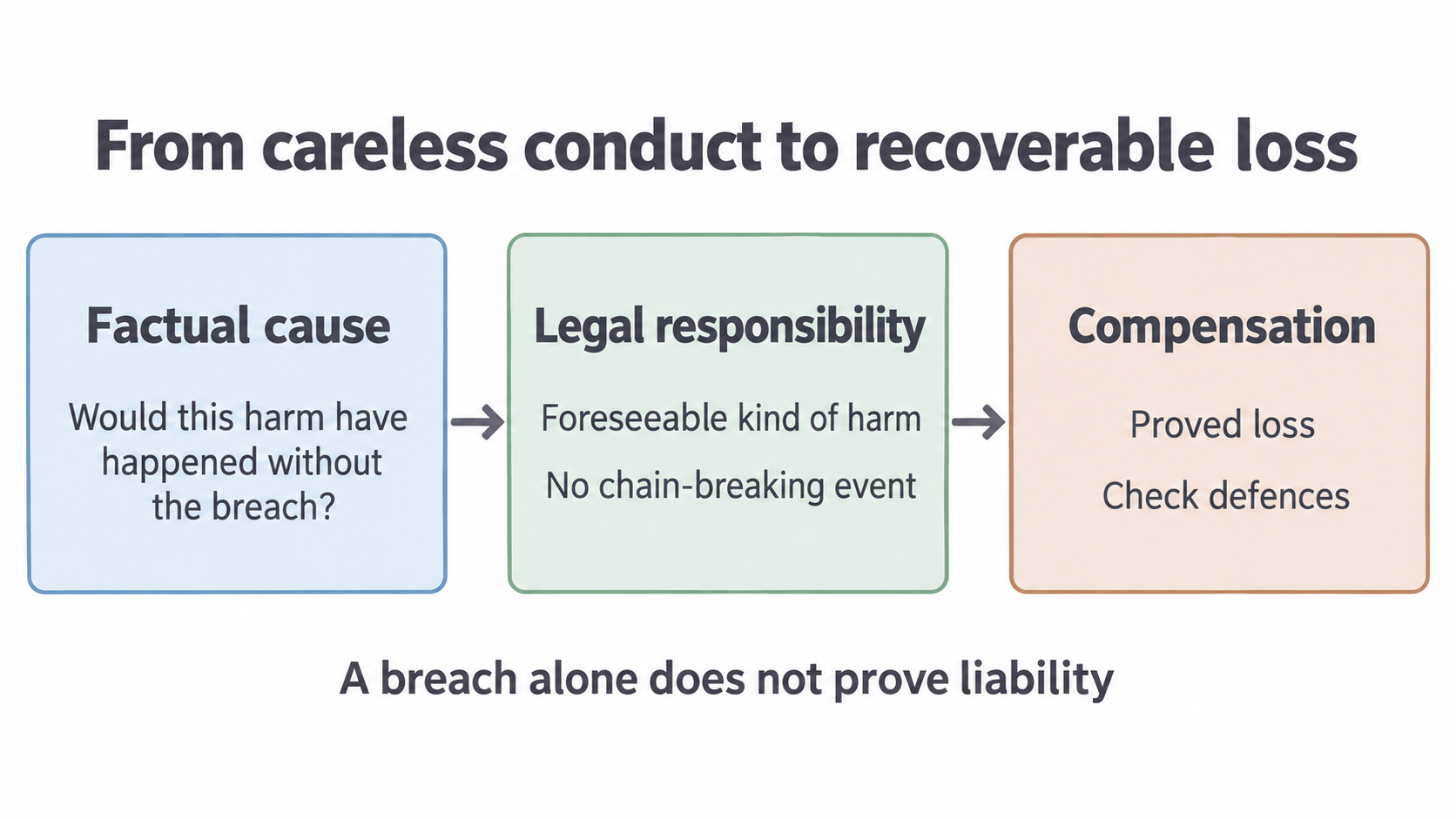
The first box tests whether reasonable care would have avoided the loss. The middle box asks whether the law connects that loss to the breach. The final box reminds us to prove the loss and consider defences before awarding compensation. Passing one box does not answer the others.
Burden and standard of proof
The claimant ordinarily carries the legal burden of proof of a tort and loss factually caused by the defendant's breach: establish the relevant duty, breach and causal damage. The standard of proof is the balance of probabilities, meaning the claimant's relevant factual proposition must be more likely than not. This is the civil standard, rather than the criminal requirement that guilt be proved beyond reasonable doubt.
The claimant does not have to disprove every possible limit on recovery in advance. In Armstead v Royal & Sun Alliance (2024), paragraphs 59–64, the Supreme Court explained that, once the tort and factual cause of loss are proved, the defendant must establish asserted limits such as remoteness, a chain-breaking event, failure to mitigate or contributory negligence. This distinguishes proving the wrongful cause of loss from proving a reason to limit compensation for it.
Continue this lesson.
You’re previewing NovaLearn without an account. Create a free account to read the rest.
Create free account