H418/02 - Precedent and court hierarchy
Learn which parts of judgments can bind later courts, how the civil and criminal hierarchies give decisions authority, and how persuasive and original precedents contribute to legal development.
Ratio and obiter
Stare decisis means following decided legal principles in later cases where they apply. A judicial precedent is an earlier court decision used as authority. The doctrine promotes consistent treatment of legally similar cases, rather than requiring the same result whenever two disputes share a superficial detail.
The ratio decidendi is the legal rule or principle on which the decision rests, understood in relation to the material facts and issues decided. The outcome, such as “the claimant won”, is not itself the ratio. To identify it, ask what legal question the court had to resolve, which facts mattered to that question, and what principle justified the outcome. A judgment can contain more than one ground forming its ratio. In an appeal decided by several judges, the reasoning supported by the majority must be identified; an individual judge's statement is not automatically the court's rule.
Obiter dicta are statements outside the legal grounds of decision, such as comments about a hypothetical situation not decided. They may be persuasive, particularly when carefully considered by a senior judge, but do not have binding force simply because they appear in a judgment.
In an original hypothetical appeal, the court holds that a seller who expressly promised next-day delivery breached that promise by delivering a week late. The judge adds that a seller who made no delivery promise would probably have a reasonable time to deliver. The first principle addresses the promise actually disputed; the hypothetical no-promise comment is obiter. The customer's surname, the van's colour and the weather may appear in the report without becoming material legal facts.
Donoghue v Stevenson [1932] illustrates a legal principle developing from facts. The claim concerned a consumer allegedly harmed by contamination in a sealed drink. The House of Lords recognised that a manufacturer could owe a duty of care to the ultimate consumer where a product was intended to reach that consumer without reasonable opportunity for intermediate examination. It allowed the claim to proceed; it did not finally prove the alleged snail or award damages at that stage. Lord Atkin's broader neighbour reasoning influenced negligence, but it is unsafe to turn the case into a rule that everyone is liable for every foreseeable loss.
When precedent binds
A binding precedent is a relevant ratio that the later court must follow under the rules of the court hierarchy. Authority and applicability are separate questions. A higher court's unrelated ratio does not decide the present issue, while a compelling argument from a lower court does not gain binding status merely through its quality.
Check the legal system and the court, whether the proposition is ratio rather than obiter, and whether its material facts and issue fit the present dispute. Also check whether a later statute or valid later decision has replaced the rule. Courts interpret statutes, but precedent cannot authorise them to ignore an applicable later Act. Earlier House of Lords decisions remain relevant as decisions of the Supreme Court's predecessor; the change of institution did not erase the case law.
In an original hypothetical case, the Supreme Court decides that a statutory right applies only to employees, not independent contractors. A County Court hearing the same legal issue cannot choose the opposite rule because its judge considers that fairer. It must apply the binding principle if the person is legally an independent contractor. But if the dispute concerns a person employed under a contract of employment, the exclusion of contractors does not itself defeat the claim. The facts and the scope of the ratio matter.
Distinguishing recognises a material difference that makes an earlier ratio inapplicable, leaving that rule intact. A difference in the claimant's name cannot justify it; a legally relevant difference in status may. The later lesson examines how courts can depart from or change rules, but a lower court's personal disagreement is not such a power.
The Supreme Court normally follows its own previous decisions and those of the House of Lords, while having a limited power to depart. The Court of Appeal is also normally bound by its own decisions, subject to defined exceptions. Vertical binding authority from above and these rules about a court's own precedents should not be confused. Nor does the larger number of judges in a lower court give it permission to reject a higher court's ratio.
The civil hierarchy
The civil hierarchy determines whose relevant legal principles must be followed, while appeal routes determine where a particular decision can be challenged. These relationships overlap, but a precedent diagram is not a complete map of appeals.
The Supreme Court is the highest domestic appellate court for the English civil system. Its relevant ratios bind the Court of Appeal, High Court and County Court. The Court of Appeal, Civil Division binds the High Court and County Court and normally its own later panels. The High Court binds the County Court. A single High Court judge is generally not strictly bound by another single High Court judge, although such decisions deserve strong respect and are ordinarily followed unless there is good reason. A High Court Divisional Court, normally sitting with more than one judge, has stronger authority: its relevant decisions bind single High Court judges and lower courts, and it normally follows its own decisions subject to limited exceptions.
County Court decisions do not create binding precedents for other County Court judges or higher courts. They may still supply useful reasoning. A court's job in a particular case is to apply relevant law and decide facts, not necessarily to announce a new rule.
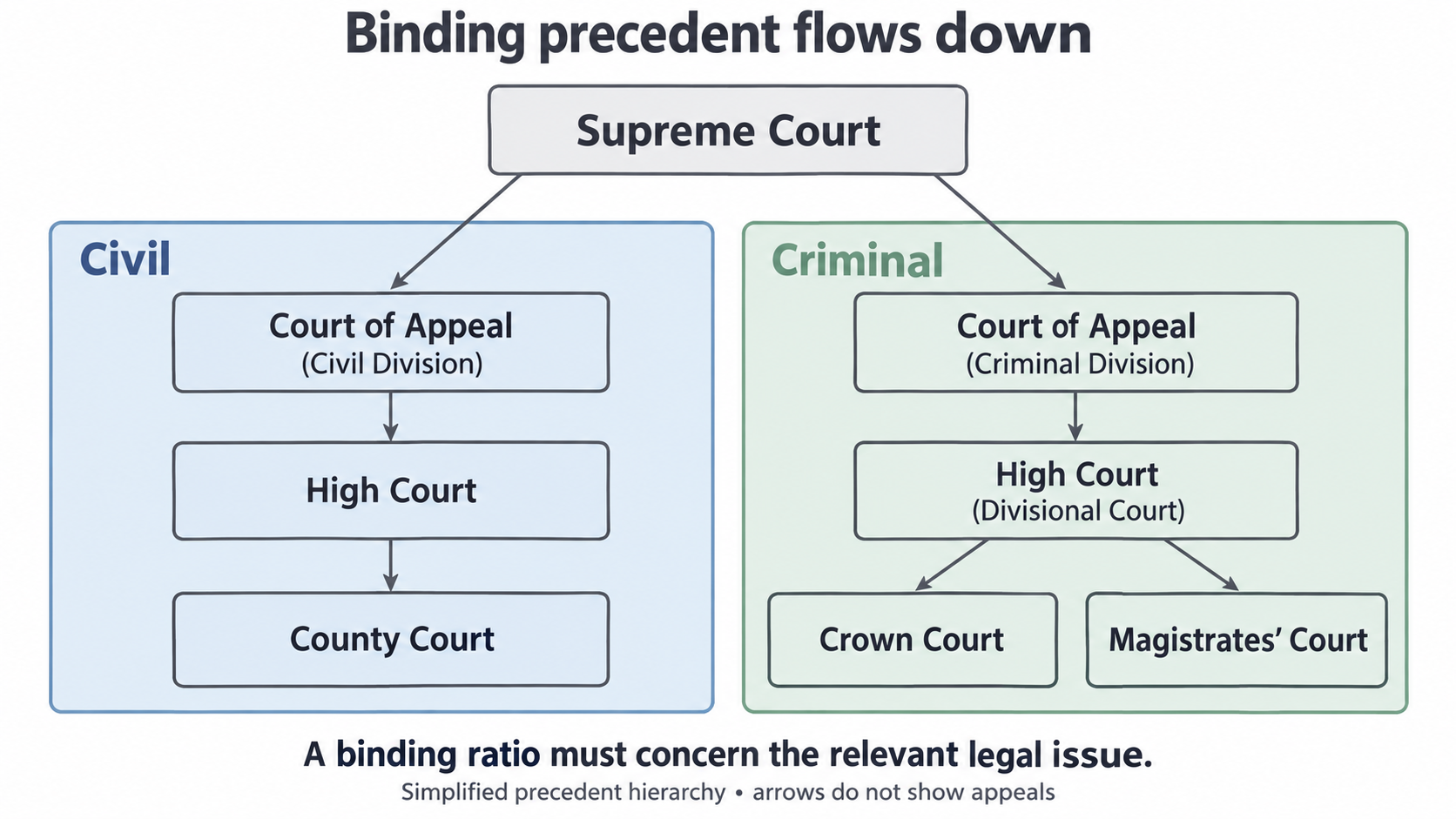
The arrows show binding authority on a relevant English-law issue. Crown Court and magistrates' decisions do not bind one another merely because an appeal can travel between them.
Continue this lesson.
You’re previewing NovaLearn without an account. Create a free account to read the rest.
Create free account