H418/02 - Employment and vicarious liability
Learn why an organisation may answer for someone else's tort, how courts distinguish employees and independent businesses, and when a relationship outside ordinary employment can justify liability.
Liability for another's tort
A delivery driver negligently injures a pedestrian, but has little money to pay compensation. The pedestrian may have a claim against the driver and, if the legal requirements are met, against the driver's employer.
Vicarious liability makes one person legally responsible for a tort committed by another. The person committing the tort is the tortfeasor. The claimant must establish the underlying tort: for negligence, duty, breach, causation and actionable damage still matter. An accident without a tort does not become actionable merely because a wealthy company employs the person involved.
There are then two separate questions:
- Was the relationship between defendant and tortfeasor employment, or sufficiently akin to employment?
- Was the particular tort sufficiently connected with that relationship?
This lesson develops the first question; the next develops the second. An employee's purely private act can fail the second question even though the employment relationship is clear.
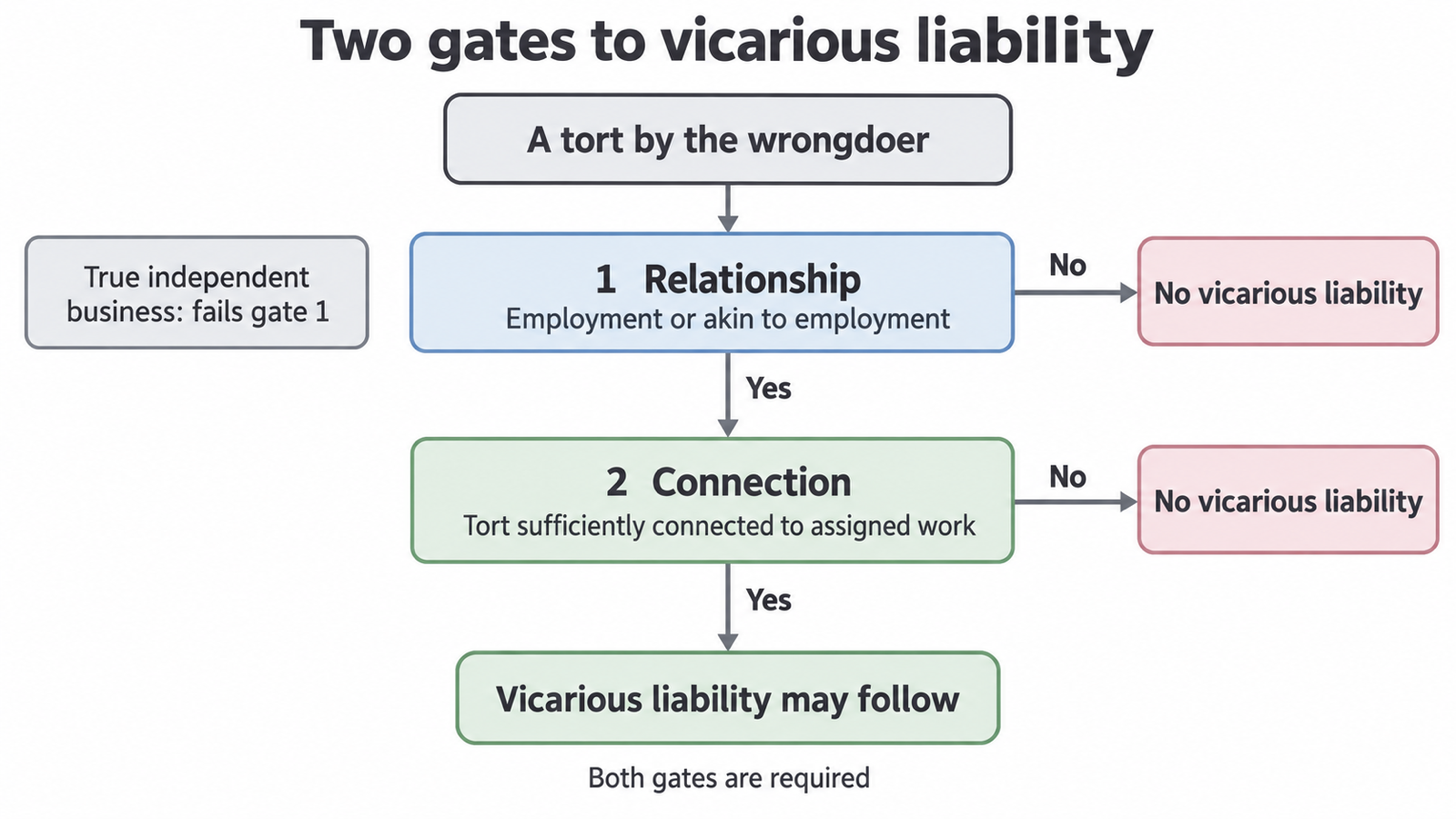
The relationship and connection requirements are separate: passing one does not establish the other.
The employer need not have been careless itself. Liability for its own unsafe instructions or careless selection would be direct liability, requiring proof of its own wrong. Vicarious liability is additional responsibility based on the relationship and connected tort; it does not erase the tortfeasor's responsibility. The claimant cannot collect compensation twice for the same loss.
The doctrine serves compensation and the allocation of enterprise risks. Organisations obtain the benefit of work, create risks by assigning it, and can often spread losses through insurance and prices. Liability can encourage safer selection and supervision. These are reasons for the doctrine, not substitutes for its requirements. As the Supreme Court emphasised in Cox v Ministry of Justice (2016), wealth alone does not justify liability.
Control, integration and economic reality
Employment status depends on the substance of the relationship rather than a convenient label on a form. A contract of service describes employment; a contract for services normally describes an independent contractor supplying a result through their own business.
Traditional approaches identify relevant evidence from different angles:
| Approach | What it asks | What it can miss |
|---|---|---|
| Control | Who has the right to direct the work, including what, when, where and, where appropriate, how it is done? | A skilled professional may be an employee although a manager cannot dictate the technical method. |
| Integration or organisation | Is the person part of the organisation's operation, rather than an external provider? | An external supplier's work may be essential without making the supplier an employee. |
| Economic reality | Is the person working in their own business, bearing financial risk and having opportunities for profit? | No single indicator, such as owning a small tool, settles the whole relationship. |
Consider an employed radiographer. A hospital can select shifts, allocate patients and discipline the radiographer without knowing enough to direct every technical decision. A simple test of hands-on control would wrongly exclude this skilled worker. Conversely, a specialist firm may repair the hospital scanner, set its own price and supply its own team: useful integration into the hospital's operation is not conclusive employment.
Relevant facts include personal service, payment arrangements, equipment, the right of substitution, financial risk, disciplinary powers and freedom to work for other clients. Personal service means an obligation to do the work oneself. A genuine unrestricted right to send anyone suitable points away from employment; a limited occasional substitute is less decisive. Assess the right actually agreed and operated, not an unused label alone.
The different approaches explain the movement from a single control test towards a combined assessment. They also show why the same badge or uniform can fit both an employee and a branded independent business.
The multiple test for employment
The multiple test combines the core obligations with the rest of the working arrangement. In Ready Mixed Concrete v Minister of Pensions and National Insurance (1968), MacKenna J identified three conditions for a contract of service:
- The person agrees to supply their own work and skill for wages or other remuneration.
- They agree to be subject to a sufficient degree of the other party's control.
- The remaining contractual terms are consistent with employment.
The third condition prevents control from becoming an automatic answer. The case concerned an owner-driver supplying and operating a lorry. Despite company colours, obligations of personal work and significant controls, his investment in the vehicle and financial responsibilities were inconsistent with a contract of service. He was an independent contractor. The case arose under national insurance legislation, but its analysis is a foundation for understanding ordinary employment status; later vicarious-liability decisions also recognise relationships outside a contract of service.
Weighing facts together
Original example: Noor works regular shifts in a bakery. She must attend personally, receives an hourly wage, uses its equipment, follows its allocation of duties and can be disciplined by its manager. These facts support all three conditions and employee status. Calling her a “freelancer” does not change the substance.
Continue this lesson.
You’re previewing NovaLearn without an account. Create a free account to read the rest.
Create free account